
Abstract
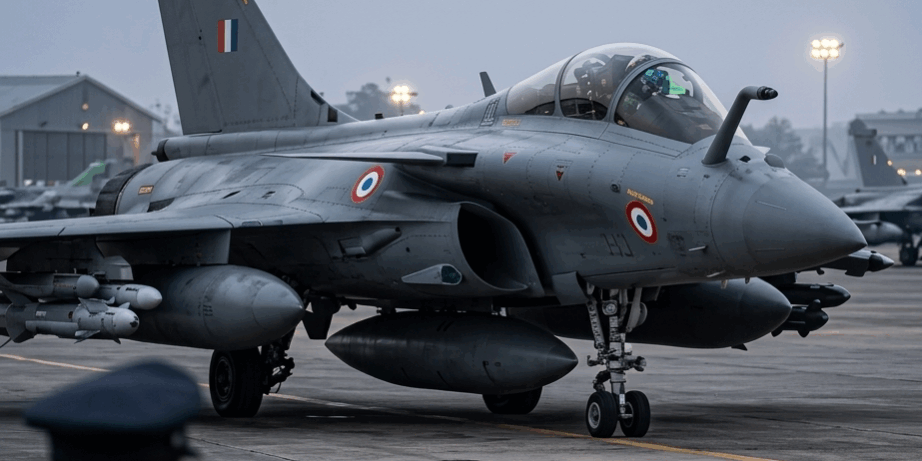
In January 2026, India’s Defence Procurement Board (DPB) cleared a landmark ₹3.25 lakh crore ($39 billion) deal for 114 Rafale jets, concluding a 25-year search for a fleet backbone. This “Rafale Pivot” addresses a critical operational void, as the Indian Air Force’s (IAF) strength had plummeted to 29 squadrons against a requirement of 42.
Beyond procurement, the agreement secures Strategic Autonomy by granting India access to the aircraft’s source code. This allows the integration of indigenous Astra missiles, reducing costs by approximately ₹17 crore per unit compared to European alternatives. Furthermore, the deal includes co-developing a 90kN-110kN engine with Safran, providing the essential technology for India’s 5th-generation AMCA fighter.
Technologically, the F4.1 and F5 standards offer “Electronic Stealth” via the SPECTRA suite, countering regional 5th-generation threats like the J-20. With 96 jets manufactured domestically, the deal acts as a bridge to the Atmanirbhar Bharat mission, ensuring immediate lethality while fostering long-term industrial self-reliance.
Introduction: The End of a 25-Year Search
The journey to modernise the Indian Air Force (IAF) has been one of the most protracted sagas in global arms procurement. What began in 2001 as a quest for a backbone for the fighter fleet has weathered twenty-five years of technical evaluations, political dogfights, and stopgap measures. The original 126-jet tender, which saw the Rafale initially succeed against global competitors like the F-16 and MiG-35, was famously scrapped in 2015. This left a critical void in India’s aerial defence, leading to an emergency purchase of 36 jets that served only as a “band-aid” for a much deeper operational wound.
In January 2026, the Defence Procurement Board (DPB) provided a landmark clearance for 114 Rafale jets. This decision is valued at approximately ₹3.25 lakh crore ($39 billion) and signifies the official “endgame” for the Multi-Role Fighter Aircraft (MRFA) program. By moving forward with this massive order, New Delhi has signalled a decisive strategic pivot toward Paris. This move is not merely a purchase but a long-term commitment to French aerospace technology as the primary pillar of Indian air power.
The timing of this clearance is particularly significant, occurring ahead of major diplomatic milestones and amidst a heightened security environment. It represents a shift from the “promise of the new” to the “certainty of the known”. After decades of testing various platforms, the Indian defence establishment has determined that the Rafale provides the most reliable path to closing the capability gap. This 25-year-long game has finally culminated in a roadmap that prioritises immediate lethality alongside long-term industrial cooperation.
The Rationale: Why India is Doubling Down
The primary driver behind the Rafale “double down” is the alarming depletion of the IAF’s combat strength. The sanctioned strength required to effectively manage a two-front war is 42 squadrons; however, that number plummeted to just 29 in recent years. The 114-jet order is designed to arrest this decline and provide the “Multi-Role Fighter Aircraft” (MRFA) backbone the IAF has lacked for decades.
Logistics and infrastructure played a pivotal role in this selection over American contenders like Boeing’s F-15EX or Lockheed Martin’s F-21. India has already invested billions of dollars in “India-Specific Enhancements” (ISE) tailored specifically for the Rafale. Furthermore, specialised hangars and maintenance hubs are already operational at strategic bases in Ambala and Hasimara. Introducing a new American platform would have effectively “reset the clock” on pilot training and logistics by an estimated decade.
By sticking with the Rafale, India capitalises on existing economies of scale. The IAF already understands the platform’s maintenance cycles, flight characteristics, and operational costs. This “certainty of the known” allows for a faster induction process compared to starting a fresh program with a different manufacturer. Ultimately, while American jets offered raw power, the Rafale won on the pragmatic fronts of established infrastructure and immediate operational readiness.
Strategic Autonomy: Breaking the “Source Code” Barrier
The 2026 agreement is hailed as a breakthrough primarily because it addresses the “Holy Grail” of defence procurement: the source code. Historically, Western powers have guarded the digital “brains” of their aircraft, preventing buyers from modifying software or integrating third-party systems. Without this access, India was restricted in its ability to pair the aircraft with its own indigenous hardware. Under the new deal, France has agreed to the “full integration” of Indian-made weapons.
This concession allows the Rafale to carry the Astra Mk1 and Mk2 beyond-visual-range missiles, which are products of India’s own defence industry. The economic implications are massive: an Indian Astra missile costs approximately ₹8 crore, whereas the European Meteor missile carries a price tag of roughly ₹25 crore. This enables the IAF to achieve “fire and forget” lethality at a fraction of the cost, ensuring that high-intensity combat does not lead to an unsustainable drain on the national exchequer.
This level of cooperation is the essence of “Strategic Autonomy”. It ensures that India is not beholden to a foreign power for every software update or weapon integration. By breaking the source code barrier, India transforms the Rafale from a “black box” into a flexible platform that can evolve alongside India’s domestic technological advancements. This sovereign control over technology is a cornerstone of New Delhi’s modern defence strategy.
Technological Superiority: Countering Regional Threats
In the context of regional tensions with China and Pakistan, the Rafale deal focuses on the most advanced iterations of the jet: the F4.1 and the forthcoming F5 (Super Rafale) models. While China’s J-20 “Mighty Dragon” boasts 5th-generation physical stealth, Indian strategists argue the Rafale F4/F5 excels in “Electronic Stealth”. This is achieved through the SPECTRA electronic warfare suite, which can jam, “spoof,” and deceive enemy radar systems, effectively making the Rafale undetectable to the J-20’s sensors.
The F5 standard, in particular, acts as a “flying command post”. It is designed for the modern era of “Data Fusion,” where the jet distributes intelligence throughout the force and remotely controls swarms of Unmanned Combat Aerial Vehicles (UCAVs). This networked approach to warfare allows a single Rafale to multiply the effectiveness of an entire squadron, providing a technological edge that goes beyond simple dogfighting capabilities.
The focus on these high-end standards ensures that the 114-jet order is not just about quantity, but about maintaining a qualitative superiority in the region. By leveraging SPECTRA and advanced data-linking, the IAF can counter the numerical advantages of its neighbours with superior situational awareness and electronic dominance. The Rafale thus serves as a critical deterrent against the evolving threat of 5th-generation adversaries.
The Engine “Holy Grail”: Fueling Future Independence
The most transformative element of the 2026 framework may lie within the aircraft: the Safran M88 engine. For decades, India’s indigenous jet engine ambitions, specifically the Kaveri project, were hindered by a lack of “hot section” technology—the most complex part of a jet engine. Under the current deal, the French firm Safran is not just supplying engines; they are co-developing a new 90kN-110kN engine with Indian partners.
Safran is currently expanding its footprint in India, including the establishment of a factory in Hyderabad. This partnership is designed to transfer the critical technical know-how required to manufacture and maintain high-performance jet engines domestically. This is not limited to the Rafale fleet; this new engine is intended to be the “lifeblood” for the Advanced Medium Combat Aircraft (AMCA), India’s homegrown 5th-generation fighter.
Mastering jet engine technology is seen as the final step in breaking the “import trap” that has historically defined Indian defence. By co-developing the M88’s successor, India gains the tools to power its future indigenous platforms without relying on foreign suppliers for critical propulsion systems. This engine-centric strategy ensures that the benefits of the Rafale deal will be felt across the entire Indian aerospace ecosystem for decades to come.
Conclusion: Building a Bridge to Self-Reliance
While the $39 billion price tag has drawn criticism for potentially contradicting the Atmanirbhar Bharat (Self-Reliant India) mission, the deal’s structure suggests otherwise. Out of the 114 jets, 96 are slated to be built within India. This high level of domestic production, combined with the co-development of engine technology and the sharing of source code, transforms the deal from a simple “buy” into a “seed” for future growth.
The Rafale is being used as a bridge to span the gap between current operational requirements and future indigenous capabilities. It provides the IAF with the world-class lethality needed to deter regional neighbours today, while simultaneously equipping the Indian aerospace industry with the manufacturing skills and technical data needed for tomorrow.
Ultimately, the “Rafale Pivot” is a long-term investment in national security and industrial maturity. By doubling down on this platform, New Delhi has secured a path that balances immediate defence needs with the ultimate goal of a self-reliant defence sector. The 114-jet order ensures that the IAF remains a formidable force while the foundations for India’s own next-generation fighters are firmly laid.
References
1. Linganna, G. (2026, February 7). The Rafale Pivot: Why New Delhi is Doubling Down on French Wings.
2. Pasricha, A. (2026, February 13). India clears the way for landmark deal to acquire French Rafale jets. Defense News.
3. The Indian Express. (2026, February 12). DAC clears proposal to buy 114 Rafale jets from France, 90 to be manufactured in India.
4. The Quint. (2026, February 17). India Moves Forward On Rafale Jet Deal With France.
5. Air Power Asia. (2025, December 28). Rafale F4/F5 Getting Closer to the Make in India Deal.
6. Rediff News. (2026, February 16). Boost For IAF: Free Hand On Weapons For 114 Rafales.
7. The Aviationist. (2026, February 16). India Greenlights Acquisition of 114 Rafales.
8. Indian Defense News. (2026, February 18). Safran To Assemble Rafale’s M88 Engines In India, Turbocharging Atmanirbhar Bharat.
9. Aerospace Global News. (2025, November 26). Safran & India to co-develop clean sheet fighter jet engine for AMCA.
10. Airforce Technology. (2026, February 18). India’s Self-Reliance campaign hinges on aircraft propulsion.
11. Defence.in. (2026, February 20). Indian Defence Minister Urges France to Reach 50% Indigenisation.
12. Indian Masterminds. (2026, February 20). After Sukhoi-30 and Tejas, Astra to Arm Rafale Next.
13. Zee News. (2026, February 2). Indian air force to integrate astra mk1 mk2 missiles on rafale jets.
By Leena