
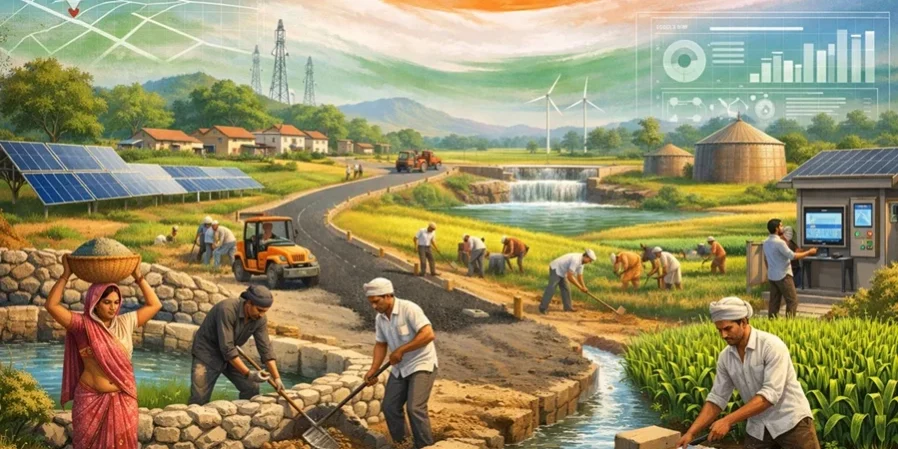
Viksit Bharat- G RAM G Act 2025: Reforming MGNREGA for Prosperous and Great Rural Bharat
Over the past 20 years, rural employment has been a key pillar of Bharat’s social security architecture. Since its implementation in 2005, the Mahatma Gandhi National Rural Employment Guarantee Act (MGNREGA) has played a pivotal role in providing wage employment, stabilizing rural incomes, and promoting infrastructure development. However, over time, the structure and purpose of rural Bharat have changed significantly. Rising incomes, improved connectivity, widespread digital access, and a variety of employment options have reshaped rural employment needs.
Against this background, the Government of Bharat has enacted the Viksit Bharat- Guarantee for Rozgar and Ajeevika Mission (Gramin) Bill, 2025, a milestone in transforming rural employment policy. The Viksit Bharat- G RAM G Act, 2025, introduces a major legislative reform to MGNREGA, aligning rural employment with the long-term vision of prosperous and great Bharat in 2047, while strengthening accountability, infrastructure outcomes, and income security.
Background of Rural Employment and Development Policy in Bharat
After independence, rural development policies in Bharat have focused on reducing poverty, improving agricultural productivity, and creating employment for underemployed and unemployed people in rural areas. Wage employment programs have gradually evolved as a key means of supporting rural livelihoods and strengthening infrastructure, and their methods have adapted to changing socio-economic conditions.
Bharat’s wage employment initiatives have gone through several phases, beginning with early programs such as the Rural Manpower Program (1960s) and the Crash Scheme for Rural Employment (1971). More systematic efforts followed in the 1980s and 1990s, including the National Rural Employment Programme and the Rural Landless Employment Guarantee Programme, which were later merged into the Jawahar Rozgar Yojana (1993), which in turn became the Sampoorna Grameen Rozgar Yojana (Sampoorna Grameen Rozgar Yojana) in 1999, aiming to improve coverage and convergence. Complementary schemes such as the Employment Assurance Scheme and the Food for Work Programme addressed issues of seasonal unemployment and food security. A major change came with the Maharashtra Employment Guarantee Act of 1977, which introduced the concept of a legal right to work. These experiences culminated in the enactment of the Mahatma Gandhi National Rural Employment Guarantee Act (MGNREGA) in 2005, which provided a nationwide legal framework for employment generation in rural areas.
Amendments in MGNREGA
The Mahatma Gandhi National Rural Employment Guarantee Act (MGNREGA) was a key program aimed at enhancing livelihood security for rural families. It provided at least 100 days of guaranteed wage employment annually to those willing to perform unskilled work. Over the past few years, several administrative and technical reforms have strengthened its implementation, significantly improving participation, transparency, and digital governance. Between fiscal year 2013-14 and 2025-26, women’s employment participation steadily increased from 48% to 58.15%, Aadhaar seeding accelerated, Aadhaar-based payment systems were widely adopted, and electronic wage payments became nearly universal. Monitoring of work also improved, leading to a significant increase in geo-tagged assets and an increased share of individual assets created at the household level.
Experience under MGNREGA also highlighted the crucial role of ground-level staff, who ensured consistent work and scale of implementation despite working with limited administrative resources. However, alongside these benefits, deeper structural problems persisted. Monitoring in several states revealed shortcomings such as a lack of work on the ground, a gap between expenditure and physical progress, the use of machines for more labour-intensive tasks, and frequent misuse of digital attendance systems. Over time, leakages accumulated, and in the post-pandemic period, fewer households were able to complete the full 100 days of work. These trends indicated that while the delivery system had improved, the overall MGNREGA framework had reached its limits.
The VB- G RAM G Act, 2025, responds to this experience with a major legislative reset. It strengthens the implementation framework by increasing the administrative expenditure limit from 6% to 9%, providing greater support for staffing, wages, training, and technical capacity. This change reflects a practical and people-centred approach to program management, moving towards a more professional and well-supported system. It is hoped that strengthened administrative capacity will improve planning and execution, enhance service delivery, and strengthen accountability, ensuring that the goals of the new framework are consistently met at the village level.
The need for a new legal framework
The need for reform also lies in major socio-economic changes. MGNREGA was implemented in 2005, but rural Bharat has undergone a significant transformation. Rising consumption, improved financial inclusion, and enhanced welfare coverage have led to a decline in poverty levels from 27.1% in 2011-12 to 5.3% in 2022-23. With rural livelihoods becoming more diverse and digitally integrated, MGNREGA’s open-ended and demand-driven design no longer fully fits today’s rural realities.
In this context, the VB- G RAM G Act, 2025, strengthens it by modernizing it, strengthening accountability, and linking job creation with long-term infrastructure and climate resilience goals.
Key Provisions of VB- G RAM G Act, 2025
This Act guarantees 125 days of wage employment to every rural household in each financial year. This is provided to rural households whose elder members voluntarily engage in unskilled work. This provides income security in addition to the entitlement for the previous 100 days. A total of 60 days of work will be free to provide agricultural laborers during the peak sowing and harvesting seasons. Workers will continue to receive 125 days of guaranteed employment during the remaining 305 days, benefiting both farmers and laborers. Payment for employment will be made weekly, or in any case, within two weeks from the date of work. Employment generation is linked to infrastructural development through four priority areas:
- Water security through water-related works
- Core rural infrastructure
- Livelihood-related infrastructure
- Specialized works to mitigate extreme weather events
All assets created are aggregated into the Vikas Bharat National Rural Infrastructure Stack, ensuring a cohesive, integrated national development strategy. The scheme is decentralized through Viksit Gram Panchayat Plans, which are prepared at the local level and integrated spatially with national systems like PM Gati Shakti.
MGNREGA vs. VB- G RAM G Act
The new act is a major upgrade from MGNREGA, addressing structural deficiencies while enhancing employment, transparency, planning, and accountability.
Financial Framework
The shift from a central sector scheme to a centrally sponsored scheme reflects the inherently local nature of rural employment and asset creation. Under the new law, states share both costs and responsibilities through a standard allocation framework, which provides strong incentives for effective implementation and prevention of misuse. The scheme is based on regional realities through Gram Panchayat schemes. Furthermore, the Centre continues to set standards, while states operate with accountability, creating a cooperative partnership that improves efficiency and strengthens results.
The total estimated annual funding requirement for wages, materials, and administrative components is ₹1,51,282 crore, including the state share. Of this, the central share is estimated at ₹95,692.31 crore. This change does not impose any undue financial burden on the states. The funding structure is determined based on state capacity, with a standard cost-sharing ratio of 60:40 between the central and state governments, enhanced support of 90:10 for North Eastern and Himalayan states, and 100 percent central funding for Union Territories without legislative assemblies. Under the previous framework, states were already bearing a portion of the material and administrative costs, and moving to a fixed standard allocation further contributes to strong budgeting. Providing states with additional support and robust monitoring systems during disasters also helps mitigate long-term damage from misuse and strengthen accountability and financial sustainability.
Implementation and Monitoring Authority
The act creates a clear institutional framework for coordinated, accountable, and transparent implementation of the Mission at the national, state, district, block, and village levels.
- Central and State Rural Employment Guarantee Councils provide policy guidance, review implementation, and strengthen accountability.
- National and State Steering Committees provide strategic direction, convergence, and performance review.
- Panchayati Raj institutions lead planning and execution, with Gram Panchayats bearing at least half of the cost of implementation.
- District Program Coordinators and Program Officers manage planning, compliance, payments, and social audits.
- Gram Sabhas play a strong role in ensuring transparency by conducting social audits and providing access to all records.
Transparency, Accountability, and Social Protection
The act gives the central government clear enforcement powers to ensure compliance and safeguard public funds. It empowers the central government to investigate complaints related to implementation, suspend the release of funds if serious irregularities are found, and take corrective or remedial measures to address deficiencies. These provisions strengthen accountability throughout the system, maintain financial discipline, and enable timely intervention to prevent misuse.
The Act also establishes a comprehensive transparency framework covering every stage of implementation. It supports the use of artificial intelligence and biometric authentication for early detection of irregularities, which is accomplished through continuous guidance and coordination by central and state steering committees. A focused approach, through four clearly defined rural development tasks, allows for close monitoring of results. Panchayats have been given an increased role in supervision, which is accomplished through GPS and real-time mobile-based monitoring of work. Real-time MIS dashboards and weekly public disclosures make everything visible to the public, while social audits, required at least once every six months, strengthen community participation and trust.
Benefits of the VB- G RAM G Act 2025
The Act strengthens the rural economy by linking job creation with the creation of productive assets, thereby increasing household incomes and improving resilience. Prioritizing water-related activities that support agriculture and groundwater recharge. Investments in core rural infrastructure, such as roads and connectivity, will improve market access, while livelihood infrastructure, including storage, markets, and production assets, enables income diversification. Focused work on water harvesting, floodwater drainage, and soil conservation strengthens climate resilience. A 125-day employment guarantee increases household incomes and boosts village-level consumption, and digital presence, wage payments, and data-driven planning help reduce distress migration.
Farmers will benefit from state-mandated moratoriums on government work during peak sowing and harvesting seasons, control over wage increases, and assured labor availability through improved irrigation, storage, and connectivity. Workers will also benefit from higher earnings potential, predictable work through developed Gram Panchayat plans, secure digital wage payments, direct benefits from their assets, and mandatory unemployment allowances. Where work is not provided, daily unemployment allowances will be paid after 15 days, with the state being responsible for the payment. Rates and conditions will be determined by regulations that ensure flexibility while protecting workers’ rights and promoting timely employment.
The VB- G RAM G Act, 2025, represents a significant shift in India’s rural employment policy. Although MGNREGA achieved significant gains in participation, digitization, and transparency over time, persistent structural weaknesses have diminished its impact. The new Act builds on previous reforms and addresses their shortcomings through a modern, accountable, and infrastructure-focused framework.
By expanding guaranteed employment, aligning work with national development priorities, and incorporating strong digital governance, the Act re-establishes rural employment as a strategic tool for sustainable growth and strong livelihoods, fully aligned with the vision of a prosperous and great India by 2047.
– Dr. Rakesh Arya, Research Associste, SSS