What Is the Orange Economy?
The Orange Economy is an umbrella term for all economic activity that originates from human creativity, cultural heritage and intellectual talent, such as films, music, visual arts, fashion, architecture, software, gaming, performing arts, handicrafts, and culinary culture. Any sector where the primary input is imagination and the primary output is cultural or intellectual value. Formally introduced by economists Felipe Buitrago Restrepo and Iván Duque Márquez in their 2013 Inter-American Development Bank report, the framework rests on a simple but radical argument: a nation’s cultural imagination is as economically productive as its natural resources. One shall not be limited to traditional value generators like oil fields, critical minerals, but rather the intellectual and intangible value generated by artists, storytellers, designers, creators and innovators in this field of imagination is perhaps a true indicator of human progress.
Global Economic Footprint
The global Orange Economy generates approximately $2.25 trillion in annual revenues (around 3% of world GDP) and employs over 29 million people, more than the combined workforce of the global automotive and aerospace industries. In South Korea, the UK, and the US, creative industries contribute 5-7% of GDP. The UK’s creative sector alone generates more export value than its automotive industry. Most of the world has barely begun to tap this potential.
Why Now Is Different
Digital platforms have dissolved the geographical barrier. A filmmaker in Lagos or a textile designer in Jaipur can now reach hundreds of millions globally without a major studio behind them. YouTube, Spotify, Etsy, Netflix, and Steam have restructured how creative work reaches consumers.
Younger consumers are spending more on experiences, meaning, and identity than on physical goods. A product carrying a cultural narrative commands a premium that no generic equivalent can match. Intellectual property has quietly become the most valuable real estate on earth-a single franchise’s IP portfolio can today exceed the GDP of a mid-sized nation. Governments are beginning to treat cultural policy as economic policy. South Korea’s Hallyu wave is the proof: a state-backed cultural export strategy now worth billions in soft power and hard revenue.
Monetising India’s cultural capital
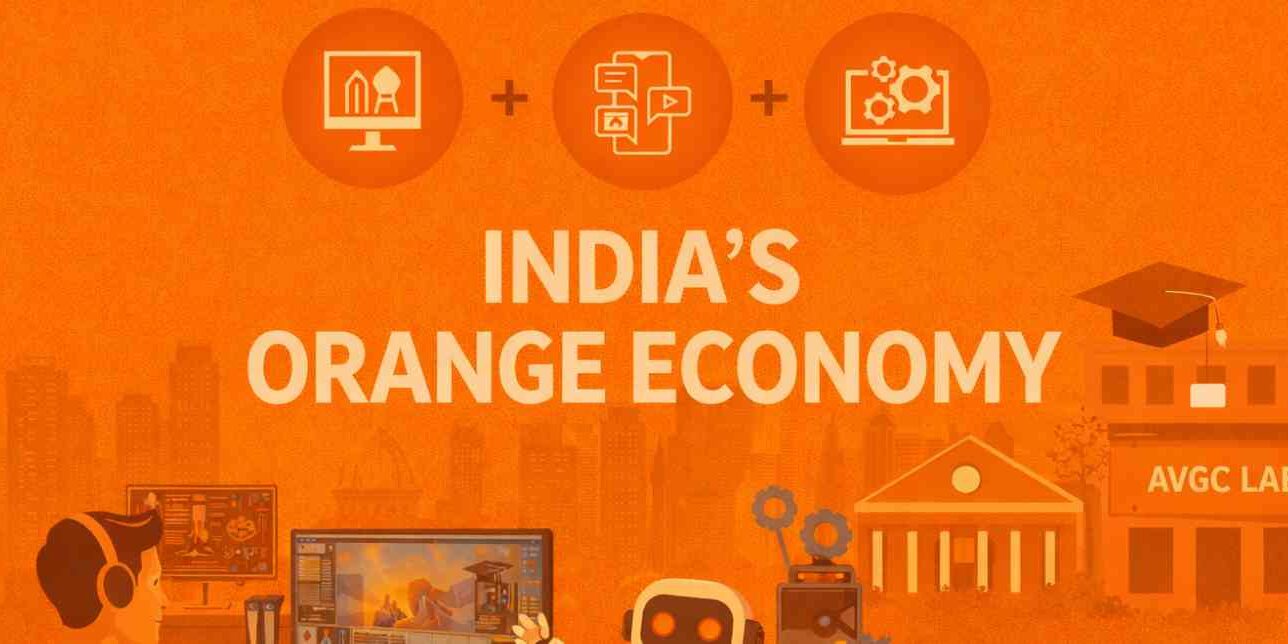
Today, India is manoeuvring a bold economic pivot by treating imagination as infrastructure. Cultural Capital, which was long viewed as mere heritage, today, the Orange Economy, encompassing media, AVGC, design, and live events, has matured into one of the core growth engines. Currently, supporting 10 million jobs, the sector is capitalising on its 40–60% cost advantage over foreign studios. Gradually, India has transformed the visual effects from a low-margin back-office processor into a premium global intellectual property (IP) owner.
Driven by rapid mobile adoption and an expansive digital gig economy-adapt style, our creative service exports have climbed by 20%, which brings home over $11 billion. Although this global impetus has given India a worldwide footprint, it makes us heavily dependent on the platform. Creators today are exposed to vulnerable and volatile foreign tech algorithms. Perhaps building domestic corporate resilience is now a critical prerequisite to hitting the sector’s projected $100 billion valuation by 2030. Recognizing these structural gaps, the Union Budget 2026–27 has proactively targeted grassroots capacity building. The state is establishing AVGC Content Creator Labs across 15,000 schools and 500 colleges through the Indian Institute of Creative Technologies (IICT). Combined with the Live Entertainment Development Council (LEDC) streamlining fragmented regulatory approvals, the government is successfully institutionalising creative hustle into a future-proof, technology-resilient powerhouse.
The Orange Economy does not privilege nations rich in capital. It privileges nations rich in culture. For India, this is the most consequential aspect of the entire framework.
India’s creative inheritance runs extraordinarily deep. Archaeologists studying the Indus Valley Civilisation have documented evidence of standardised bead-making, woven textiles and intricate craft production dating back over four thousand years, suggesting that organised creative enterprise is not a modern import but a native tradition rooted in the very foundations of Indian civilisation.
Khadi is perhaps the most vivid living example. What Gandhi reintroduced as a political symbol of self-reliance has since evolved into a genuine design and fashion industry. The Khadi and Village Industries Commission today supports over 5 lakh artisans. Designers like Abraham & Thakore and Anavila Misra have taken the fabric to international fashion weeks, demonstrating that a hand-spun cloth rooted in village economy can command serious market value when framed with cultural intention. This is the Orange Economy in its most tangible form: heritage converted into livelihood and then into aspiration.
Indian gastronomy represents another underappreciated frontier. Regional cuisines, from the fermented rice dishes of the northeast to the tamarind-laced coastal cooking of Tamil Nadu, carry centuries of agricultural knowledge and cultural identity. Restaurants like Indian Accent have shown that Indian culinary culture, presented with modern technique and storytelling, can compete at the highest levels of global fine dining. The export of Indian food culture through the diaspora, the rise of Indian food on YouTube, and the premium commanded by authentic regional cooking in international cities all point to a gastronomy economy that remains largely unmapped in national accounts.
Technology has been the multiplier. Studios like Prime Focus Technologies and DNEG, with significant Indian operations, now provide VFX for major Hollywood productions. The Indian VFX industry, valued at over ₹10,000 crore and growing, services content globally while building a domestic talent ecosystem. Baahubali demonstrated that Indian studios can produce world-class visual spectacle and generate IP that compounds in value across merchandise, streaming, and cultural tourism. This is not a service export it is the emergence of an Indian creative technology industry with original capabilities and global reach.
Moving forward: Our Creative Endeavour
India’s march towards reclaiming its heritage on global platform through the Orange Economy represents a fundamental shift in how a nation measures its wealth. It proves that a country’s cultural imagination is just as economically productive as its natural resources. For India, a nation uniquely rich in culture rather than just capital, this new paradigm of intellectual space offers an unprecedented path of growth. By connecting an ancient creative inheritance spanning from Indus Valley craftsmanship to regional culinary traditions such as Bollywood, deep design talent, classical and folk traditions of extraordinary richness, and a diaspora carrying Indian cultural identity into every major market in the world. Perhaps our task is to blend these rooted identities with modern tech algorithms.
The infrastructure to convert this inheritance into economic value at scale is still being built, but the foundations are already in place. Today, India is successfully transitioning from a low-margin back-office service provider into a premium global intellectual property owner. However, sustaining this upward trajectory requires addressing critical structural vulnerabilities. Much of this vast creative output remains unrecognised in formal national accounts, restricting access to institutional credit, while independent creators face severe revenue volatility from foreign platform algorithms. Every major economic transformation has rewarded those who recognised the pattern before it became consensus: the agricultural economy, the industrial economy, the knowledge economy, the digital economy. The creative economy is next. Moving forward with this resolve demands treating this creative ecosystem as vital economic infrastructure. Beyond the Union Budget’s proactive deployment of grassroots AVGC labs across 15,000 schools, the next phase must prioritise institutionalising intangible asset financing, allowing creators to leverage registered copyrights as valid banking collateral. By streamlining regulatory frameworks for live events and building open, sovereign digital distribution alternatives, India can effectively insulate its workforce. Formalising this talent pool ensures that the nation’s creative technology industry secures both global soft power and lasting macroeconomic resilience.
Indian footprint on global blockbusters such as iconic dragons for Game of Thrones, to executing over 200 high-end visual shots for Avatar and contributing to Thor: The Dark World, along with 2800 VFX shots in domestic production like RRR, has established India as an authority in AVGC. Today lies the question before us, not whether the Orange Economy will boom for it already has. The question is whether we will be able to maximise our potential before it becomes impossible to ignore.
By- Kashica Raya, Research Intern &
Kartik Shyam Mogha, Research Associate
Swadeshi Shodh Sansthan