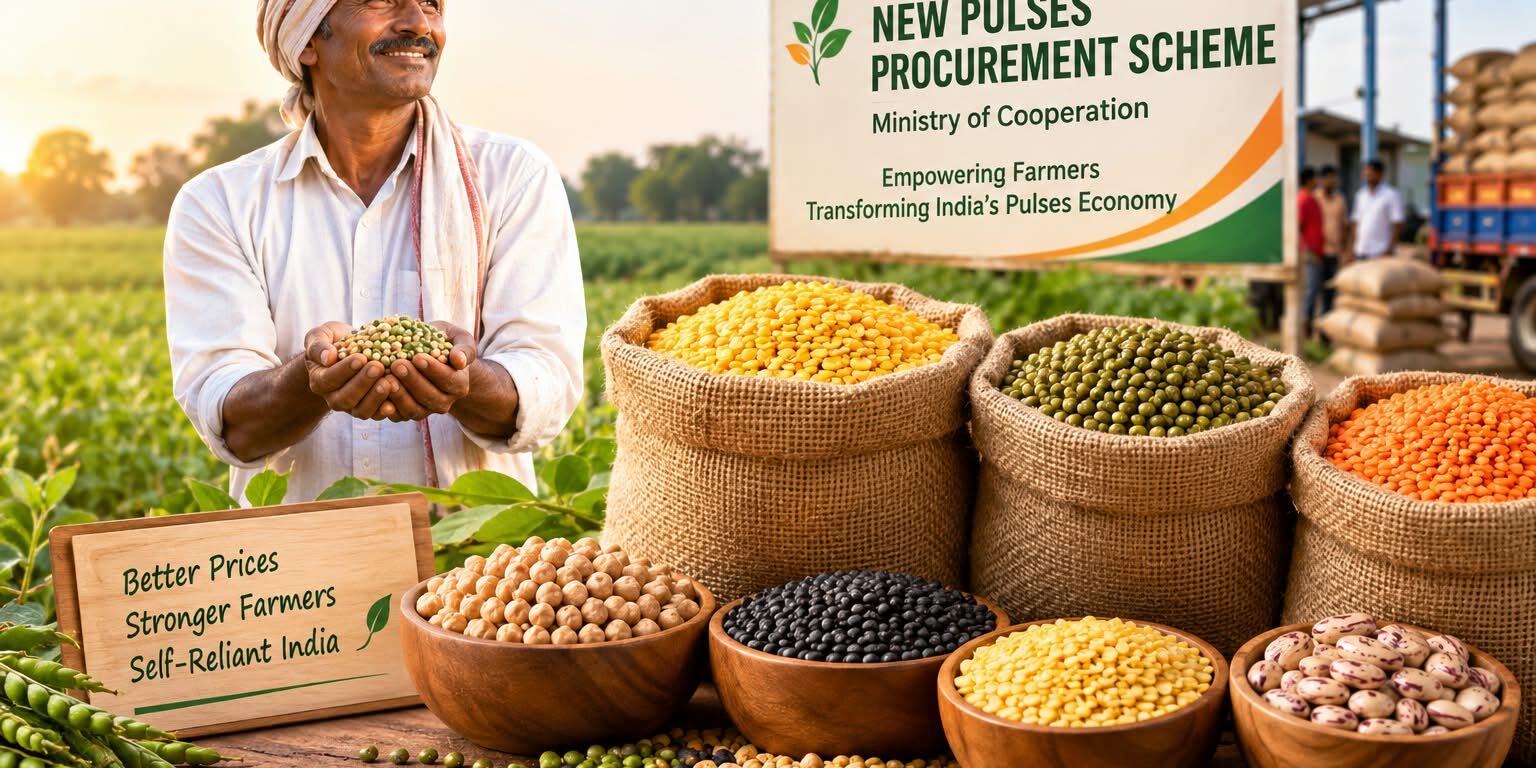
New Pulses Procurement Scheme: Empowering Farmers and Transforming India’s Pulses Economy
– By Parthan R G
The slogan “Jai Jawan, Jai Kisan” by Lal Bahadur Shastri reflects the foundational role of agriculture in India’s economy, especially in the areas of food security, rural livelihoods, and national development. So, it means farming and farmers are the backbone of India’s economic growth. Pulses are occupying an important role in the agriculture sector of India, which is not only ensuring food and nutritional security but also helpful for soil protection, environment-friendly farming and ensuring the livelihood of farmers. At present, India is the largest producer of pulses in the World. According to the report of the Unified Portal for Agricultural Statistics 2025, India’s total pulse production during the period of 2024-2025 (Third Advance Estimate) was 252.38 lakh tonnes (UPAg, 2025), and according to the NITI Aayog’s report of 2025,38 % of the global cultivated area of pulses is in India, which is 28% of the global output. In India, pulses are grown in all three seasons (kharif, rabi and summer). The pulse production in India is concentrated in a few states, which include Madhya Pradesh, Maharashtra, Rajasthan, Uttar Pradesh, Gujarat, Karnataka, Jharkhand, Andhra Pradesh, Chhattisgarh, and West Bengal. In the financial year 2022-23, pulses accounted for about 21.9% of the total foodgrains.
Trend in Yield (t/ha) of Major Pulse Crops Grown in India (1970-71 to 2022-23)
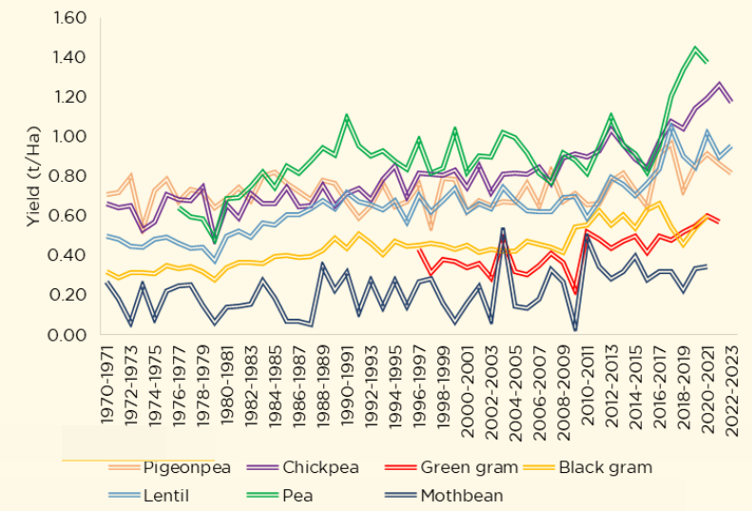
Source: NITI Aayog Report 2025
According to the report of NITI Aayog 2025 report, the major destinations of pulses during 2024-25 include Bangladesh, China, UAE, USA and Sri Lanka. On the other hand, India is importing nearly 15-20 per cent of its pulse requirement by spending billions of dollars annually. The main paradox is that the country where dal is a staple in millions of households is the world’s largest consumer, producer, and importer of pulses.
In the year 1966, the Government of India implemented the ‘All India Coordinated Pulse Improvement Project’. After that, in 1969-74, the pulse development scheme was introduced. During the period 1985-90, the government introduced the National Pulses Development Project (1988-89) and the special food grain production programme on pulses. In the 1990s, the government started a technology mission on oilseeds, pulses and maize. During the period between 2004-10, it started the integrated scheme of oilseeds, pulses, oil palm & maize. And in 2010-14, the government introduced the ‘Accelerated Production Programme’(A3P). To achieve self-sufficiency in pulses, the government announced the Mission for Aatmanirbharta in Pulses (2025-31) in the Union Budget 2025-26. The main aim of the scheme was to achieve self-sufficiency in production, reduce import dependence, and sustainably improve farmers’ incomes. The mission also aims to expand the area under pulse cultivation. The scheme focuses on developing and making available high-yielding, pest-resistant, and climate-resilient pulse varieties, supported by a strong and efficient seed system.
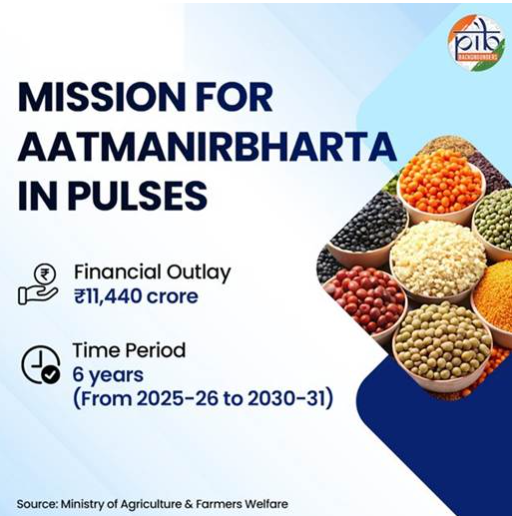
Source: PIB India
The main challenges faced by pulse farmers include market price fluctuation and the uncertainty related to the returns from pulse farming, limited pulse procurement at Minimum Support Price (MSP), unlike rice and wheat, exploitation by middlemen and commission agents, issues related to low productivity, weak market linkages and value addition of pulses, etc. The challenges of pulse farmers are not only in production alone, but also extend to marketing, infrastructure, institutional support, etc. By considering all these issues, the Ministry of Cooperation has now introduced the New Procurement Scheme as an initiative for the empowerment of pulse farmers through the cooperative model.
The new scheme came into force mainly due to the limitations of the ongoing issues faced by pulse farmers related to production and marketing. In pulse farming, farmers are facing several issues. Mainly, farmers face price volatility due to market price fluctuations, which creates uncertainty for pulse farmers. Sometimes farmers are selling the product at lower prices due to the need for immediate loan repayment, and when the harvest comes, the supply of pulses increases; prices often decrease to below the MSP (Minimum Support Price). Another issue pulse farmers face, unlike rice and wheat, is that India’s pulse production is heavily concentrated in specific regions, especially in 7 states. Nearly 80 per cent of India’s pulse production is dependent on rainfed areas. The farmers are facing procurement issues in remote areas due to the lack of procurement centres in nearby areas. Farmers are not ready to sell the pulses even at MSP rates because of the delays in registration and quantity restrictions. Due to the lack of adequate procurement centres, farmers are mainly depending on the local traders or commission agents for selling their product. The exploitation of these intermediaries by various means leads farmers to sell their product at lower prices. Pulse production mainly happens in rain-fed areas with limited scope of irrigation. It leads to reduced profitability in pulse cultivation, and the activity of cultivation is riskier for the farmers. Inadequate storage capacity is another issue for pulse farmers who are compelled to sell immediately after the harvest time, when market prices are at lower levels.
The new Pulse Procurement Scheme, which was introduced by the Ministry of Cooperation, has set a two-year deadline for both NAFED (National Agricultural Cooperative Marketing Federation of India Ltd.) and NCCF (National Cooperative Consumers’ Federation of India Ltd.) to procure all grains of pulses directly from the farmers. There are four steps in the implementation part of the scheme.
- First, farmers should register on the NAFED portal before the Harvest time.
- Second, in this stage, farmers can sell their products directly to NAFED or NCCF collection centres.
- In the third stage, the commission agents and middlemen (Intermediaries) are completely removed from the chain of process.
- The fourth stage is the Direct Bank Transfer (DBT) of 100 per cent of the MSP value to the farmer’s account within 48 hours.
Another feature of the scheme is the introduction of the “Kalyan Scholarship” for farmers’ children. The NAFED will earmark 1% of profits for this purpose. The repealed 2020 three farm laws aimed to bypass middlemen by allowing private players, which created protests over the fear of losing Minimum Support Price (MSP). But the new directives of the cooperative ministry bypass middlemen through ‘Government Cooperatives’ while explicitly guaranteeing MSP. It will solve the intermediary issues while keeping the financial safety net of farmers.
The main benefits for farmers are;
- In the earlier system, the intermediaries would exploit the farmers through commissions. In the newly implemented system,100 per cent of the value goes to the farmer’s bank account, which will ensure direct and full payment of the total value.
- It ensures a guarantee on MSP, as the specific formula ensures prices even if market rates fluctuate.
- Another benefit is that it eliminates local corruption through Direct Bank Transfer (DBT).
- The 1 per cent of NAFED profits will be used for the scholarship of children from farming families. It can be used for higher education and career development of the students.
The decision by the Ministry of Cooperation to implement the scheme through cooperative institutions reflects the empowerment of farmers through collective action. In India, cooperatives are working on the principles of voluntary and open membership, democratic member control, members’ economic participation, autonomy and independence, education, training and information, cooperation among cooperatives and concern for community. The policy of cooperative procurement will enhance the bargaining capacity of farmers; it also facilitates the organised marketing of the pulses. The cooperatives not only work for procurement but also for the storage, development, transportation, grading, and value addition of infrastructure. From a broader point of view, the scheme ensures the government’s view of ‘Sahkar se Samriddhi’ (Prosperity through Cooperation), identifying the cooperative sector as an important tool for achieving inclusive growth, rural development and farmers’ welfare.
In conclusion, the new pulses procurement scheme is not merely a welfare scheme, but it’s a dynamic intervention by the government to transform the pulse economy of India. The new initiative not only benefits the farmers but also consumers and cooperatives, and will be helpful for infrastructure development, which will contribute to the overall development of the economy. The main issue of implementation is the lack of technical knowledge among farmers to get benefits from the scheme. It needs a massive awareness programme and training programmes for farmers for the effective implementation of the scheme.
If the scheme is implemented effectively by the government with the support of various stakeholders, the scheme can become a turning point in India’s agricultural transformation journey. It can enhance the standard of living of pulse farmers, reduce import dependency, promote self-reliance and be helpful in creating an inclusive and environment-friendly agriculture sector, which ultimately leads to a prosperous and great Bharat.
References
- Agricultural and Processed Food Products Export Development Authority. (n.d.). Pulses.
Government of India. https://apeda.gov.in/Pulses - National Institution for Transforming India (NITI Aayog). (2025, September). Strategies and pathways for accelerating growth in pulses towards the goal of Atmanirbharta. https://niti.gov.in/sites/default/files/2025-09/Strategies-and-Pathways-for-Accelerating-Growth-in-Pulses-towards-the-Goal-of-Atmanirbharta.pdf
- Press Information Bureau. (2025, October 1). Mission for Aatmanirbharta in pulses approved by the Union Cabinet (Press Release No. 2177847). Government of India. https://www.pib.gov.in/PressReleasePage.aspx?PRID=2177847®=48&lang=2
4. Express News Service. (2026, June 24). NAFED to share 1% profit for education of farmers’ children: Amit Shah. The Indian Express.
https://indianexpress.com/article/india/nafed-to-share-1-per-cent-profit-for-education-of-farmers-children-amit-shah-10754351/