
When the Same Sky Brings Flood to One Hand and Drought to the Other: Understanding Bihar’s Climate Crisis
By Nikhil Shrivastava
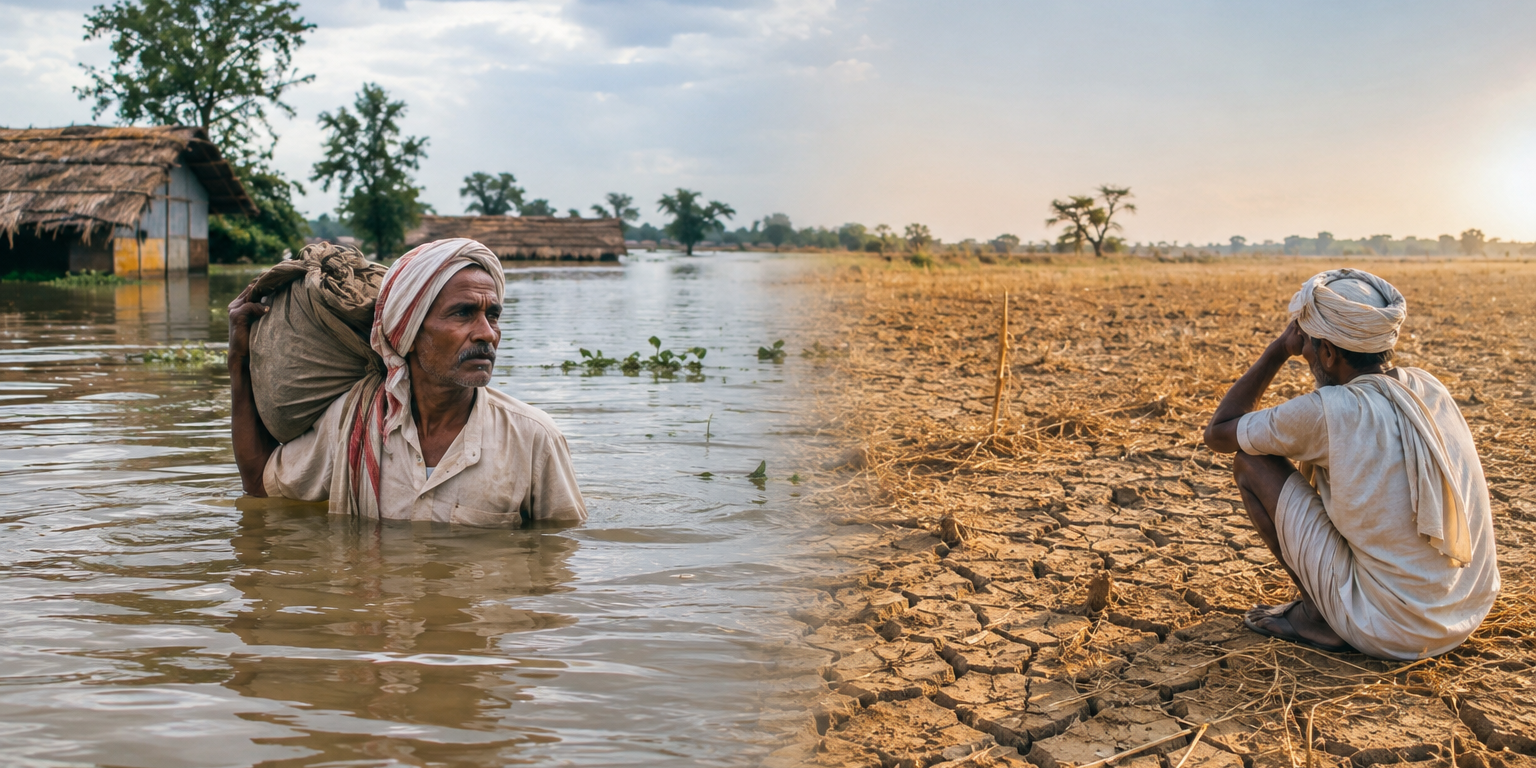
Suppose that two farmers lives, a few hundred kilometres apart; they are in the same state, in the same season, in the same monsoon sky. He is standing in a wall of flood water, as the Kosi or the Gandak stream rolls over his fields, his house floods and his paddy crop washed away in the flood. The other one looks at the same sky, praying for one drop of rain, while his land splits like an old leather and his borewell drains out at forty feet as opposed to the twenty. This is not a what-ifs. This is Bihar, right now. North Bihar is in waterlogged conditions while South Bihar is in a thirst-hungry situation, and both are a victim of the same disease: non-functioning climate system for decades.
It is more than just ‘bad weather’ or ‘just another monsoon’. It’s the very fact of climate change, not a headline, but a warning for the climate future we will all play a part in:
What is really happening in Bihar?
Flood and drought situations have always been part and parcel of Bihar, occurring at various periods of time and at different times of the year. The crisis is alarming because both disasters are occurring together, this season, this state. Districts in North Bihar that are adjacent to Nepal, depend on the waters of the Kosi, Gandak, Bagmati, Kamala Balan and Burhi Gandak, are flooded with water from these rivers forcing lakhs of people to flee, drowning standing crops and destroying homes, schools and health centres. In the meanwhile, less than normal rain has been received in the Magadh belt of South Bihar where fields are parched with sometimes 30 to 50 per cent less rains than the normal, with the groundwater level falling significantly.
Scientists term what is happening climate “whiplash,” as the same area experiences a double spike of too much water followed by too little water in a single season, and sometimes even in a single month. It’s no longer a rare occurrence. It has become the trend.
Affected areas of North Bihar (the flood zone)
The Disaster Management Department of Bihar has said the crisis has worsened drastically as of mid-September 2026. About 47 lakh people are now affected and the Ganga has come up to its highest flood level ever at Gandhi Ghat in Patna. The current water affected areas are 15 districts, 88 blocks and 561 gram panchayats in Patna, Bhojpur, Saran, Vaishali, Bhagalpur, Begusarai, Buxar, Samastipur, Munger, Katihar, Lakhisarai, Khagaria, Madhepura and Araria. Katihar, Purnea, Saharsa, Supaul, Madhepura and Araria are identified as the most affected in the Kosi and Gandak basin. At the various monitoring stations from Digha and Gandhi Ghat to Bhagalpur, Munger and Khagaria, multiple rivers are simultaneously flowing above danger levels: Ganga, Kosi, Gandak, Burhi Gandak, Punpun, Bagmati and Ghaghra.
At present, the state has opened 951 community kitchens and is operating almost 1,932 boats for evacuation and transport to control the magnitude of displacement while providing lakhs of polythene sheets and dry-ration packets.
The economic impact of Bihar floods isn’t new but it happens almost on an annual basis and has costed several thousands of crores in the past. During one flood season, in 2010, crop damages in 6.5 lakh hectares were estimated at Rs 894 crore, with the worst affected districts being East Champaran, West Champaran, Darbhanga and Purnia and the state separately released Rs 2,300 crore for the direct relief to the families. In another case, the state requested Rs 3,638 crore from the central government for flood damages in the embankments, roads, crops and power infrastructure after just one flood season. A variety of individual flood years have experienced crop losses between about Rs 34 crore (2008) and as high as Rs 678 crore (1987) and Rs 511 crore (2002), which, when adjusted for today’s costs, would be much higher. To give a sense of scale, the central government has also given Bihar Rs 11,500 crore to aid the state in dealing with the frequent flooding from the catchment areas of Nepal.
The drought area of South Bihar
Meanwhile, deficits in rainfall were being observed in the Magadh belt of South Bihar. During past dry spells, these districts (26 to 55 percent) and others have experienced less than their normal rainfall, with Gaya and Aurangabad being the districts worst hit, with rainfall of around 202 mm against the normal of 289 mm for a single month of Gaya. During one of the worst drought years, only 180 mm of rain was received across the state as compared to an average of 1200 mm per year, while paddy field production in 17 districts including Jamui, Munger, Sheikhpura, Aurangabad, Bhojpur, Buxar, Jehanabad, Kaimur, Gaya, Nalanda and Saran was less than 10 per cent of normal. The depth of the groundwater in these belts has dropped from an average summer level of approximately 20 feet to almost 40 feet in some places.
It has also repeatedly been criticised for not being sufficient, as in one drought year, the state had announced farmers’ compensation of Rs 3,500 per family for farmers in 11 drought-hit districts, which farmers said is little more than a pittance to compensate for their lost crop, apart from covering their input costs.
Why is this happening? Identifying the root causes.
1. A warm atmosphere retains more water that is subsequently released
The burning of fossil fuels is causing global temperatures to rise, which in turn means that the atmosphere has a greater ability to retain moisture. Warm air over the Bay of Bengal and Indian Ocean brings in more moisture and when it does pour out, it does not drench the ground lightly, but with a concentrated heavy rain. That is why North Bihar can get the same kind of rain in just a few days that would be considered a weekly amount in other parts of the country, and which acts as an overwhelming flood for the rivers, which have never seen such an amount of water in such a short time.
2. The Himalayas are changing the rules.
The rivers in North Bihar are mainly fed by the catchment in the Himalayan region of Nepal. Mountain snowfall and glacial melt patterns are changing, further upstream deforestation and irregular rainfall are causing the river flow to be volatile and sometimes extreme, while the flat plains of Bihar are poorly equipped to drain such water swiftly.
3. Weather patterns – weakened and shifted monsoon patterns.
The regular seasonal pattern of the monsoon has changed. There are certain areas that get heavy rains while other areas even outside the neighbourhood are left untouched. That is why, in South Bihar, rainfall may be 40 per cent less and in North Bihar, there is flooding.
4. Human decisions which made bad situation worse.
The only half of the story is in the shifting patterns of nature. The crisis has been exacerbated by human acts:
- Deforestation: When forests are removed from catchment areas, there will be more runoff downhill and more silt in the water.
- Siltation of riverbeds: Through the gradual increase of the riverbed (particularly from rivers of the Himalayas), means that the riverbed is rising and water in the river can no longer be carried without the river overflowing.
- Encroaching on water bodies: Bihar has almost two lakh natural ponds, lakes and wetlands, but a large proportion of these are encroached by the real estate and land interest. The water bodies once took up excess rain water and replenished the groundwater – their disappearance has reduced their capacity to buffer against flood and drought.
- Unplanned urbanisation: Even normal rainfall is now unable to drain away as unplanned urbanisation has paved over natural drainage channels.
5. Groundwater Mismanagement
Over extraction of the ground water for irrigation has led to a very low water table in South Bihar and the reduction of rainfall. Soil which ought to recharge during the monsoons just does not receive the rain, and the water taken is not complemented.
This is not just about Bihar:
It’s easy to think of this as a regional issue, but it’s a taste of what’s to come. The simultaneous flood and drought events are also becoming a common occurrence in India and globally in Assam, in parts of Maharashtra, in East Africa, and in the American Southwest. Bihar’s crisis is a local chapter of a global story: a climate system that has gone beyond the limits within which it has evolved, and has now become unpredictable and swinging between extremes. The consequences are far reaching, extending beyond the state’s boundaries, including loss of crops valued in hundreds of crores, disease outbreaks in flood-hit areas, drinking water shortages in drought-stricken areas and the unspoken loss of human lives – farmers losing a full season of income, families being displaced, children pulled out of school.
What Can We Do?
While the problem may seem overwhelming, there is someone at every level — government, community and individual — who can take action that will make a difference in the real world.
At the policy and government level:
- Make river barrages more robust and stable before monsoon rains, not after disasters happen
- There is a need to strictly enforce the anti-encroachment laws and restore and protect water bodies in Bihar.
- Investing in flood-forecasting and early-warning systems to give communities more time to prepare
- Construction of irrigational infrastructure that can withstand drought in South Bihar, such as check dams and water harvesting facilities.
- Implementing catchment area afforestation projects in concert with Nepal as large share of flood water is coming from the upstream
At a community level:
- Restoring traditional water harvesting infrastructure such as ponds, tanks and ahar-pyne water storage systems, which were traditionally implemented during monsoons in Bihar to store water for the dry season
- Plantation drives in catchment areas and river banks by the communities themselves to reduce soil erosion and runoff
- Establishing local disaster-preparedness groups that are able to coordinate evacuation and relief more quickly than outside organisations can do.
For each individual:
- Reducing personal carbon footprint — whether it’s small steps such as switching to public transport, conserving electricity or avoiding single-use plastic, it helps when multiplied by the millions of people.
- Rainwater harvesting at home – even small rooftop rainwater harvesting systems
- Preventing the construction or encroachment on natural drains, ponds and wetlands
- Promoting and endorsing policies and leaders that place emphasis on climate adaptation and disaster preparedness.
- Exposing awareness; communicating about this issue with family, friends and community members to avoid ignoring it until the next disaster forces the issue to the forefront
A Final Word
Flood and drought are not a coincidence in Bihar. Climate change that has arrived at our doorstep in the most visible manner, in the fields which farmers no longer can rely on, the rivers which no longer obey, and the rain which falls when and where can’t be predicted. There’s no more excuse to give it a pass and think it’s somewhere else or someone else’s issue. The two faces of warning in North Bihar and South Bihar are the floodwaters and the cracked earth respectively. The first step is to understand what is causing this to happen. So what will the next monsoon look like will be determined by the actions of citizens, communities, and a nation.