
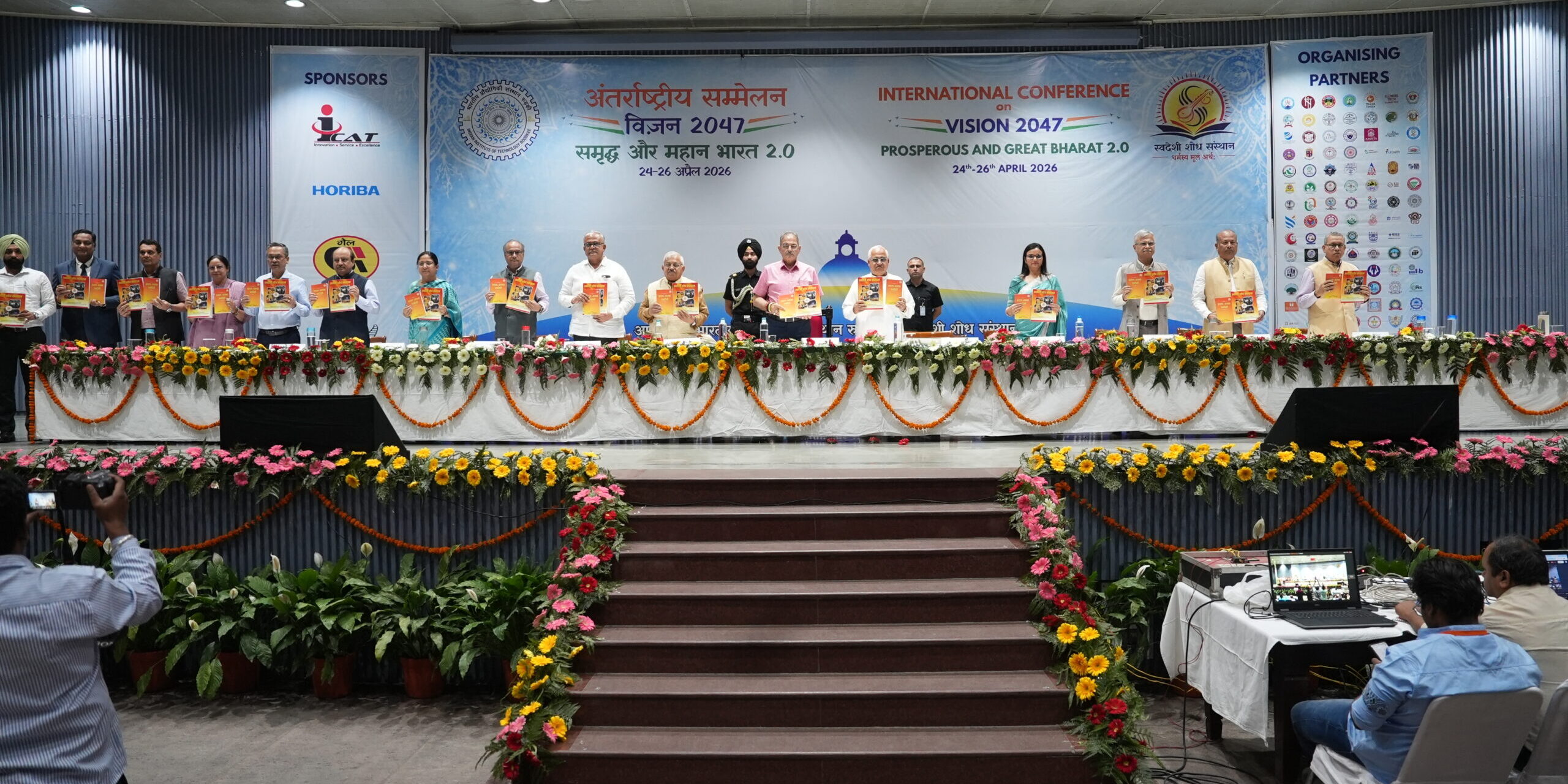
The International Conference on “Vision 2047 – Prosperous and Great Bharat 2.0”, held from 24th to 26th April 2026, stands as a historic milestone in India’s journey toward its centenary. Organised by the Indian Institute of Technology (IIT) Roorkee in collaboration with Swadeshi Shodh Sansthan (SSS), the symposium served as a high-level melting pot for eminent scientists, policymakers, academic leaders, and industry titans. The event was a clarion call for “Jan Bhagidari” (people’s participation), emphasising that the dream of a developed India is not just a government mandate but a collective national mission.
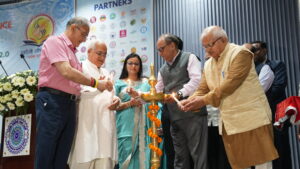
The Inaugural Ceremony: A Confluence of Visionary Minds
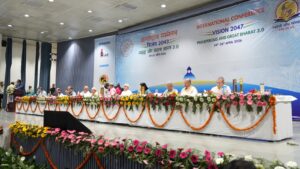
The opening ceremony began with the formal reception of the eminent leaders presiding on stage, headlined by the Honourable Governor of Himachal Pradesh, Shri Kavinder Gupta Ji, who served as the Chief Guest. We also extend a warm greeting to the prestigious figures joining him on the dais, including Prof. K. K. Pant, Director of IIT Roorkee; Prof. U. P. Singh, Deputy Director of IIT Roorkee; Prof. N. P. Padhy, Director of MNIT Jaipur; Prof. Somnath Sachdeva, Executive Chairperson of Swadeshi Shodh Sansthan; Prof. Ajit Chaturvedi, Vice Chancellor of Banaras Hindu University; and Prof. Surekha Dangwal, Vice Chancellor of Doon University, whose participation significantly elevates the stature of this event.
Prof. K. K. Pant opened the dialogues by emphasising the vital synergy required between academia, government, and industry. He underscored that research-driven product design and an entrepreneurial spirit are the engines of this transformation. Prof. Somnath Sachdeva further detailed the organisation’s commitment, noting that SSS has signed Memorandums of Understanding (MoUs) with over 100 institutions to drive national development verticals.
The Launch of Three Landmark Policy Frameworks
A central feature of the conference, and perhaps its most enduring legacy—was the official unveiling of three transformative policy frameworks. These are designed to move India beyond a mere “wish list” and toward concrete, actionable progress:
- The National Employment Policy Act, 2026:
- World Policy 2026 (Exporter-Academia Collaboration):
- One Nation One Research Policy Act, 2026:
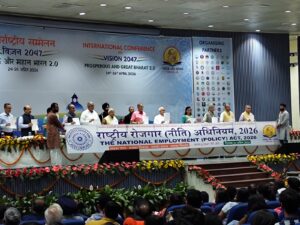

These initiatives, unveiled before a global gathering of 150 institutions, aim to transition India from a nation of job-seekers to a global hub of innovation. By integrating ethical entrepreneurship with high-value research, these policies provide the concrete 3-5 year roadmaps necessary to achieve a $1 trillion bio-economy and a fully “Viksit Bharat” by 2047.
Economic Reimagination: From GDP to QDP
One of the most provocative themes was the challenge to Western paradigms of development. Shri Satish Ji advocated for a decisive shift from Gross Domestic Product (GDP) to “Quality Domestic Product” (QDP). He argued that while traditional models often prioritise money-driven pursuits, India’s “Samriddh Bharat” must be rooted in ethical wealth creation, environmental sustainability, and collective happiness.
This shift includes a focus on energy independence. Currently, India’s energy imports account for nearly $190 billion, contributing to 60% of the nation’s trade deficit. Achieving true “Atmanirbharta” (Self-Reliance) requires not just producing more green energy, but radical research into curbing energy wastage and enhancing efficiency.
The Bio-Economy and the “Amrit Generation”
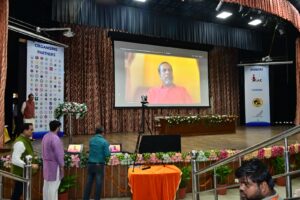
Dr. Jitendra Singh, Union Minister of State for Science & Technology, delivered a virtual keynote highlighting that the 21st century will be dominated by India’s biology-centred economic model.
- The Valuation: The domestic bio-economy, which grew from $10 billion in 2014 to over $130 billion today, is projected to reach $1 trillion by 2047.
- The Strategy: The BioE3 Policy (Economy, Employment, and Environment) is the catalyst, driving breakthroughs in high-performance biomanufacturing and carbon-neutral technologies.
- The Mission: Dr. Singh tasked the “Amrit Generation” (the youth leading the way during the 25-year lead-up to the centenary) to transition from theoretical research to practical, market-ready solutions.
Shri J.P. Nadda echoed these sentiments via video message, stating that India is at a “defining moment” where the fusion of tradition and technology will create an inclusive “Viksit Bharat” that reaches the last person in the last village.
- A Holistic Vision for ‘Viksit Bharat’: Shri Nadda highlighted that the collective aspiration for 2047 is to build a “Viksit Bharat” (Developed India) that is prosperous, inclusive, innovative, and globally respected. He stressed, “The vision of a developed India is not limited to economic progress alone. It encompasses social equity, technological advancement, environmental sustainability, and the empowerment of every citizen”.
- Innovation and the Knowledge Economy: Identifying innovation as the key driver of India’s transformation, the address called for India to emerge as a global hub of research, technology, and entrepreneurship. By nurturing talent and promoting a culture of inquiry, India can unlock the immense potential of its youth.
- Sustainable and Equitable Growth: The development model for 2047 must be people-centric, ensuring that opportunity reaches the “last mile”. Furthermore, Shri Nadda reaffirmed a commitment to sustainable development, stating that economic ambition must be integrated with environmental responsibility to pave the way for a “greener and more resilient future”.
- The Power of ‘Jan Bhagidari’: Underscoring that the journey to 2047 is not the government’s responsibility alone, Shri Nadda pointed to “Jan Bhagidari” (people’s participation) as the cornerstone of national progress. He noted that when the country moves forward with a shared purpose and determination, no goal is beyond reach.
Rural Empowerment: The Zoho “Tenkasi Model”
Sridhar Vembu, CEO of Zoho Corporation, provided a revolutionary blueprint for rural revival. He critiqued the current economic “value-addition” crisis, where rural India sells raw goods at low prices but consumes high-cost technology from urban or foreign centres.
- The Tenkasi Success: Zoho’s R&D centre in Tenkasi grew from 6 employees to 1,000, recruiting talent from local Tamil-medium government schools.
- The Impact: The centre maintains global productivity standards with salaries exceeding 1 lakh per month, proving that world-class R&D can thrive outside of congested metros.
- The Goal: Achieving “Chinese prices and Japanese quality with Indian talent,” while ensuring that the wealth stays within local rural ecosystems.
Sustainability and the Himalayan Vision Partnership
The Honourable Governor of Himachal Pradesh expressed urgent concern regarding the environmental stability of the Himalayan region. Highlighting recent tragedies and melting glaciers, he proposed the “Himachal-Uttarakhand Vision Partnership 2047”. This collaboration aims to:
- Establish a Green Hydrogen Corridor.
- Address the $190 billion energy import bill through regional innovation.
- Create a Joint Disaster Research Institute to study and prevent glacial lake outbursts and landslides.
Highlighting India’s monumental strides in innovation, the Governor declared that the nation has evolved from being a mere consumer of technology to a global frontrunner. India now ranks among the top five countries globally in 45 out of 64 critical technologies, having leapt from 81st to 39th position in the Global Innovation Index over the past decade. He attributed this success to strategic national frameworks, including the ₹1 Lakh Crore R&D Innovation Fund, the ₹500 Crore Anusandhan National Research Foundation, the Quantum Mission, and the Semiconductor Mission.
He challenged every graduating student to file at least one patent that addresses a grassroots problem, urging them to become “problem solvers” for the nation.

The Foundation of Character: Akhand Prachand Purusharth
Beyond policies and technology, the conference emphasised the human element. Acharya Balkrishna and Shri Kashmiri Lal Ji spoke deeply about the necessity of moral character.
- Hard Work: They advocated for “Akhand Prachand Purusharth”, relentless and immense hard work rooted in integrity.
- Business Ethics: Using the example of global corporate scandals, they reminded the audience that a “Prosperous Bharat” cannot be built on deception. Success must be sustainable and ethically grounded.
- Dignity of Labour: There was a strong call to respect all forms of labor, ensuring that as India grows, the gap between the “high-tech” and the “blue-collar” worker is bridged by dignity and fair wages.
Actionable Roadmaps: 3-5 Year Windows
Prof. Ajit Chaturvedi provided a final strategic insight: a vision for 2047 is only a “wish list” if it isn’t broken down. He advocated for 3-5 year actionable roadmaps to allow for continuous course correction. This agile approach is necessary to navigate the rapid pace of global technological changes, such as Artificial Intelligence and Quantum Computing.
While future winners in AI, energy, and technology remain unpredictable, Prof. Chaturvedi identified India’s “demographic dividend” as the nation’s most certain and powerful natural resource. With a population of 1.4 billion, he stressed that the massive youth demographic is currently in its most productive range and must be the focal point of these 3 to 5-year roadmaps.
A Call for Action Over Discussion. In his concluding remarks, Prof. Chaturvedi congratulated the event organisers, IIT Roorkee and the Swadeshi Krodh Sansthan. He left the audience with a strong call to action, stressing that to truly realise the dream of a prosperous and developed India, the ideas discussed at such conferences must be met with an equal focus on concrete implementation.
Conclusion: A Unified Call to Action
The conference concluded with a unified resolution. By merging the academic excellence of IIT Roorkee with the swadeshi (self-reliant) vision of Swadeshi Shodh Sansthan, India has laid the groundwork for a second “Renaissance.”
The journey to 2047 is not just about becoming a superpower; it is about becoming a “Great Bharat”,a nation that is self-reliant in energy, a leader in the bio-economy, a hub for rural innovation, and a global beacon of ethical leadership. The three policies launched, National Employment Policy, World Policy 2026, and One Nation One Research, are the pillars upon which this future will be built.
As the “Amrit Generation” steps forward, they do so with a clear mission: to transform India from a consumer of global technology into a creator of global solutions, ensuring prosperity for every citizen from the peaks of the Himalayas to the coasts of the south.