Report on the Commemorative Lecture on Pandit Deendayal Upadhyaya’s Birth Anniversary: “Bharat’s Contribution to the World: Past, Present and Future”
On 24 September 2026, Swadeshi Shodh Sansthan, New Delhi, organised a commemorative lecture to mark the 110th birth anniversary of Pandit Deendayal Upadhyaya. Themed “Bharat’s Contribution to the World: Past, Present and Future”, the event convened university leaders, scholars, researchers, and social thinkers to examine Bharat’s civilisational vision and its implications for contemporary policy, education, and national development.
The programme was held at the premises of Swadeshi Shodh Sansthan, located at 46–47, Gyan Kunj, Pandit Deen Dayal Upadhyaya Marg, ITO, New Delhi. The session commenced at 9:30 a.m. and was organised under the aegis of Swadeshi Shodh Sansthan.
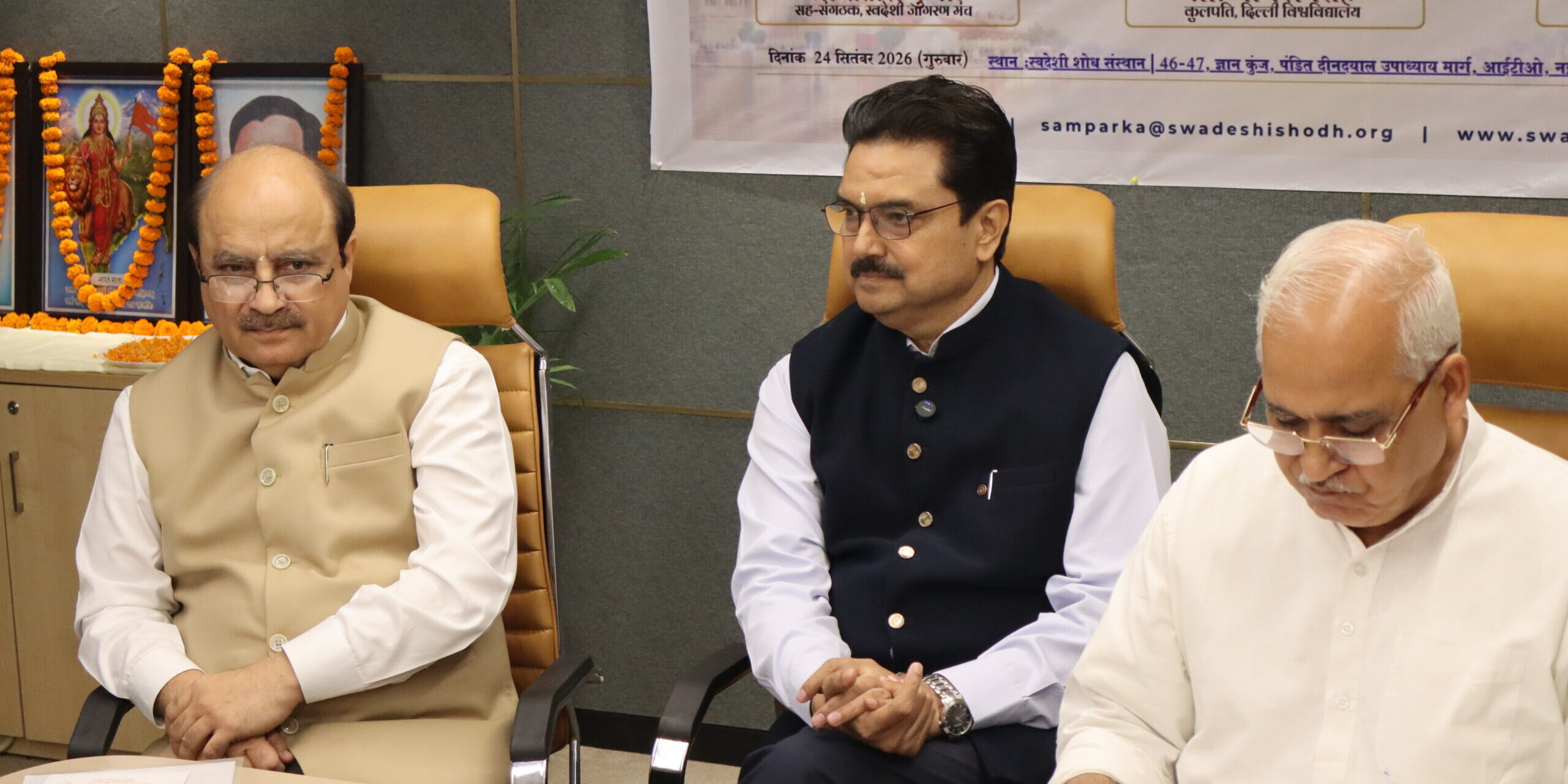
- Keynote Speaker: Yogesh Singh, Vice-Chancellor, University of Delhi
- Presiding Dignitary: Somnath Sachdeva, Vice-Chancellor, Kurukshetra University
- Margdarshak: Shri Satish Kumar, Co-organiser, Swadeshi Jagaran Manch
- Convener: Pradeep Chauhan, Secretary-General, Swadeshi Shodh Sansthan
- Moderator and Secretary: Dr. Sarabjeet Kaur, Secretary, Swadeshi Shodh Sansthan.
Other notable participants included Prof. Ajay Kumar Bhagi (University of Delhi), Prof. Vijendra (IIT Delhi), Prof. B. R. Kamboj and faculty and researchers from Delhi University, Kurukshetra University, and other institutions.
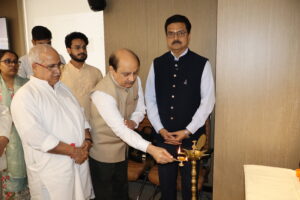
The event began with lamp-lighting by the chief guests and dignitaries, followed by the rendition of the national song “Vande Mataram”. After brief introductions of the dignitaries and participants, Prof. Pradeep Chauhan delivered the formal welcome address. He invoked the leadership maxim, “Leadership is not about oneself; it is about helping others” and connected it to Pandit Deendayal’s concepts of Antyodaya, upliftment of the last person and Integral Humanism.
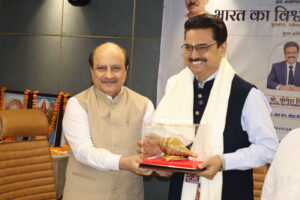
A felicitation ceremony was subsequently held. Prof. Yogesh Singh was felicitated by Prof. Somnath Sachdeva; Shri Satish Kumar was honoured by Prof. B. R. Kamboj; and Prof. Somnath Sachdeva was felicitated by Prof. Pradeep Chauhan.
Prof. Somnath Sachdeva introduced the theme of the lecture and outlined the recent initiatives of Swadeshi Shodh Sansthan. He referred to two international seminars previously organised by the institute (in the Pusa campus area and at IIT Roorkee) and described the eight thematic verticals through which the institute contributes to policy discourse on a non-governmental basis.
He emphasised that the central question, what Bharat has given the world, what it contributes now, and what it can offer in the future? must anchor both research and pedagogy. He highlighted Bharat’s holistic vision of development, the framework of the four puruṣārthas, the ideal of “Sarve Bhavantu Sukhinah”, and enduring institutions such as Ayurveda, Yoga, Buddhist thought, Ahimsa, Nalanda, and Takshashila as key civilisational contributions.
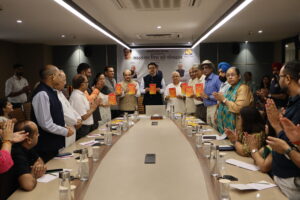
During this segment, a book titled Saral Samagra Swadeshi, authored by Shri Satish Kumar and Dr. Himani Sharma, was launched by Prof. Yogesh Singh, with a brief introduction by Shri Narendra Ji. The institute also inaugurated the official website of its journal Arthaayaam. Dr. Anjani announced that the journal has been assigned an ISSN, marking its entry into the global serials ecosystem.
In his keynote address, Prof. Yogesh Singh focused on Bharat’s civilisational framework for happiness and ethical prosperity. Drawing upon the Kautilya tradition, he outlined the following sequence:
“Sukhasya mūlaṃ dharmaḥ; dharmasya mūlaṃ arthaḥ; arthasya mūlaṃ rājyam; rājasya mūlaṃ indriya-jayaḥ; indriya-jayasya mūlaṃ vinayaḥ; vinayasya mūlaṃ vṛddhopasevā.”
He explained this as a causal chain in which happiness is rooted in dharma; dharma in artha (material well-being); artha in good governance (rājyam); governance in self-restraint (indriya-jaya); self-restraint in humility (vinaya); and humility in service to elders and society. He argued that this framework offers a practical pathway for individuals and institutions: service cultivates humility; humility sustains dharma; dharma channels wealth ethically; and ethical wealth yields lasting happiness.
Prof. Singh cautioned against the growing individualism in education and assessment systems. He observed that an overemphasis on marks and selection-oriented examinations (such as JEE) tends to reward individual performance while neglecting teamwork, compassion, and character formation. He shared insights from Delhi University’s new two-stage faculty recruitment process, comprising a teaching presentation followed by an interview, designed to evaluate not only subject competence but also the temperament and compassion expected of teachers. He stressed that degrees are merely “receipts of expenditure on education”, whereas true education is manifest in conduct.
He further invoked the ideal of “Vasudhaiva Kuṭumbakam” (“the world is one family”), noting that while this universalism is one of Bharat’s greatest gifts, it must be balanced with national interest and security. Referencing Pandit Deendayal’s Integral Humanism, he underlined the need for harmony among manas (mind), buddhi (intellect), śarīra (body), and ātmā (self), and warned against the pop-cultural slogan “follow your heart, ignore all else” when it severs ethical reasoning from desire.
Following the keynote, Prof. B. R. Kamboj spoke on Bharat’s development priorities, invoking the vision “Har haath ko kaam, har khet ko paani” (work for every hand, water for every field). He highlighted Bharat’s rising role in milk production and fertiliser output and underscored the strategic importance of MSMEs in employment generation and export growth. Dr. Vijendra then addressed the future role of agriculture in Bharat’s development and global contribution, emphasising technology adoption, value-chain integration, and sustainability.
Margdarshan was delivered by Shri Satish Kumar, who provided overarching guidance on aligning research, education, and policy with the ethos of Swadeshi and national self-reliance.
A wide-ranging question-and-answer session followed, with active participation from faculty members, researchers, and researchers of Shodh sansthan. The discussion was summarised by Dr. Sarabjeet Kaur. A formal vote of thanks was presented by Prof. Deepak Sharma.
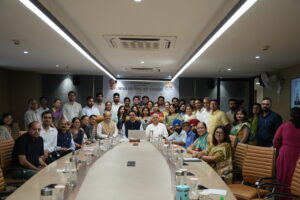
The commemorative lecture reinforced Swadeshi Shodh Sansthan’s mission to root policy and education in Bharat’s civilisational categories while engaging contemporary challenges. By linking Antyodaya, Integral Humanism, and the dharma–artha–vinaya–sukha framework to modern issues, assessment reform, teacher recruitment, MSMEs, and agricultural innovation, the event offered a conceptual and practical roadmap for translating Bharat’s holistic vision into institutional practice and global contribution.