“Demographic Contraction in Bharat: Addressing the Challenges”
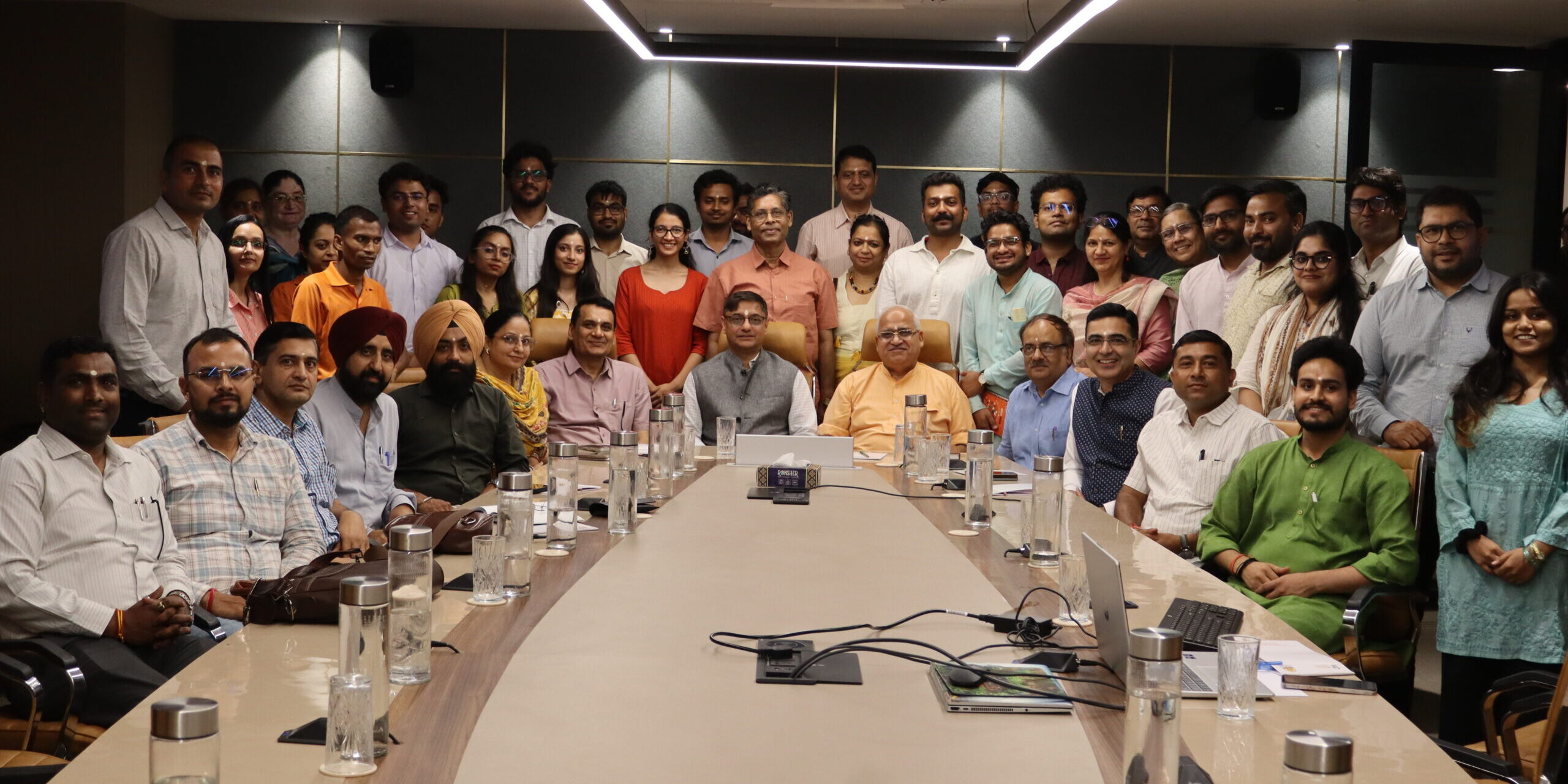
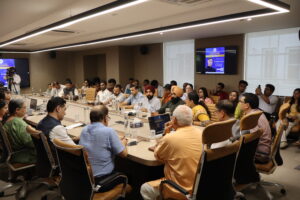
On 15 July 2026, Swadeshi Shodh Sansthan, located in Pandit Deendayal Upadhyay Marg,
ITO, New Delhi, hosted a seminar on “Demographic Contraction in Bharat: Addressing the
Challenges.” The session began at 4:00 p.m. and brought together scholars, organizers and
invited guests for a focused discussion on the long-term implications of demographic change
in Bharat. The event opened with the ceremonial lighting of the lamp in the presence of senior
dignitaries, including Shri Satish Kumar, Prof. Pradeep Chauhan, Dr. Deepak Sharma, Prof.
Nandini Sinha Kapoor and other distinguished guests. The session was moderated by Dr.
Sarabjeet Kaur, Secretary of Swadeshi Shodh Sansthan, who introduced the invited
dignitaries and framed the importance of the theme in relation to Bharat’s changing social and
economic profile. In keeping with academic convention, the formal welcome address was
then delivered by Prof. Pradeep Chauhan, who greeted the gathering and presented a brief
biographical introduction to the keynote speaker, Mr. Sanjeev Sanyal.
Mr. Sanjeev Sanyal is an Indian economist, author, and public intellectual who currently
serves as a Member of the Economic Advisory Council to the Prime Minister with the rank of
Secretary to the Government of India. He earlier served as Principal Economic Adviser to the
Finance Minister for five years until February 2022, and before entering government he spent
more than two decades in international financial markets, including as Chief Economist for
South and South-East Asia and later Global Strategist and Managing Director at Deutsche
Bank. An alumnus of Shri Ram College of Commerce, University of Delhi, he later studied at
Oxford University as a Rhodes Scholar and has also represented Bharat in major global
policy forums such as the OECD, G7, and G20-related processes.
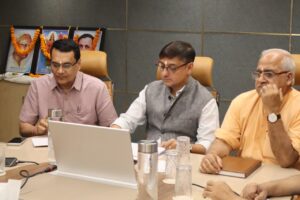
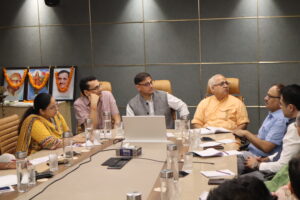
In his keynote lecture, Mr. Sanjeev Sanyal argued that public discourse in Bharat is still
governed by an outdated anxiety about population explosion, whereas the more pressing
long‑term concern is demographic contraction driven by sustained fertility decline. He
situated Bharat’s transition within a wider global pattern already visible in Europe and East
Asia, particularly in countries such as South Korea and China, and contended that Bharat is
only a few decades behind these societies and must prepare now rather than wait for severe
consequences to manifest.
A key focus of the lecture was the decline in the annual number of births. Mr. Sanyal noted
that Bharat’s peak annual births occurred around 2001, after which the number has fallen
significantly, indicating that demographic change is an ongoing process that has been
unfolding for roughly 25 years rather than a hypothetical future. He used this trend to argue
that ageing, labour‑force compression, and long‑term stress on institutions should be brought
to the centre of policy debate instead of being overshadowed by older narratives of
“population control.”
He then introduced the concept of TFR as the average number of children per woman and
pointed out that Bharat’s fertility has already fallen below replacement level in several data
series, with urban Bharat even further below this threshold. He underscored that once smaller
birth cohorts are in place, the future workforce is structurally constrained, no subsequent
policy can retroactively enlarge the number of people reaching working age 20 or 25 years
later. This logic makes demographic contraction a pipeline issue rather than a variable that
can be quickly “corrected.”
Another strand of the lecture examined the unevenness of demographic change across states.
Mr. Sanyal emphasized that national averages are misleading because some parts of Bharat,
such as Kerala, Tamil Nadu, Andhra Pradesh, Punjab and West Bengal have already exhibited
low fertility and rapid ageing, while states like Bihar and Uttar Pradesh remain younger,
though they are moving along the same trajectory. This differentiated picture implies that
Bharat is entering a phase of multiple demographic realities, some regions must actively plan
for ageing and contraction while others are still in transition but will eventually face similar
challenges.
He further distinguished between population growth arising from reproduction and growth
sustained by increasing longevity. Even if Bharat’s total population continues to rise for some
time, fertility decline has already reshaped the structure of future age cohorts, leading to a
shrinking youth base and rising average age. Temporary population increase therefore does
not negate the deeper process of demographic contraction. Mr. Sanyal argued that this
transition will affect schools, universities, pension systems, taxation, labour markets, and
housing demand, and must be factored into long‑range planning.
On the policy side, Mr. Sanyal offered a critique of legacy population‑control thinking. He
maintained that many incentives, administrative routines and textbook narratives still reflect
the assumptions of the 1970s, when rapid population growth was treated as the principal
threat. These older frameworks remain embedded in bureaucratic practice, including at the
local level, and may now work against Bharat’s long‑term demographic interests. He
therefore called for a systematic review of policy architecture to ensure outdated
disincentives to family formation are not mechanically perpetuated in an altered demographic
context.
He also drew on international experience to illustrate how difficult it is to reverse low fertility
once it becomes culturally normalized. China figured prominently as a cautionary example,
even after restrictive policies such as the one‑child norm were relaxed, fertility did not return
to replacement levels. In his analysis, demographic contraction is inseparable from social
expectations, family structures, delayed marriage, changing lifestyles and adaptation to
smaller households; it is not merely a matter of revising policy rules or providing financial
incentives.
The lecture concluded by stressing the need to rethink social infrastructure in light of
demographic shifts. Shrinking cohorts of school‑age children may require reconfiguration of
the scale and distribution of educational institutions, especially in rural areas, while an ageing
population demands serious reflection on medical provisioning, long‑term care and pension
design. His tone was cautionary rather than alarmist, Bharat still has time to respond, but
meaningful preparation depends on recognizing the problem before demographic trends
become irreversible in practical terms.
An interactive question‑answer session followed, in which participants raised questions about
fertility decline, delayed marriage, class‑based differences, and cultural dimensions of
demographic behaviour. Shri Satish Kumar’s subsequent remarks functioned as a reflective
and motivational intervention. He suggested that although demographic decline may appear
to be a “natural” process, this is not a reason for passivity, human societies have always
sought knowledge and remedies rather than accepting harmful developments as given.
Anxiety, he argued, should be transformed into sustained reflection, research and eventually
policy and social awareness.
He further contended that demographic decline must become a national subject of study
across institutions and disciplines. Once genuine thinking and research begin, social
understanding matures and policy options become clearer. He noted rising awareness of the
issue in parts of the country, including Andhra Pradesh, Tamil Nadu, and Uttar Pradesh and
stressed the importance of dismantling negative legacies from older population‑control
programmes while promoting new intellectual and institutional engagement.
He appealed to universities and research centres to treat demography as an urgent field of
national relevance and indicated that efforts were underway to build more structured
academic work and dedicated platforms on demographic challenges. As per him, serious
study of demographic contraction and the development of realistic policy responses
constitutes both an academic responsibility and a form of national service.
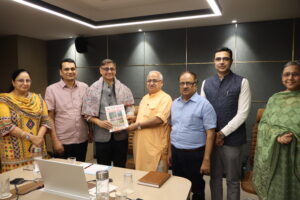
The session ended with guidance remarks, felicitation of the speaker and formal thanks.
Overall, the programme at Swadeshi Shodh Sansthan framed demographic contraction within
a broader civilizational, social and policy horizon rather than as a purely technical issue. It
argued that Bharat must move beyond inherited assumptions of endless population expansion,
confront fertility decline and ageing with intellectual seriousness and promote
interdisciplinary dialogue among economists, social thinkers, policy practitioners and
researchers to address a challenge likely to become central to Bharat’s future.
Reported By
Anushka Verma
Researcher, Swadeshi Shodh Sansthan