
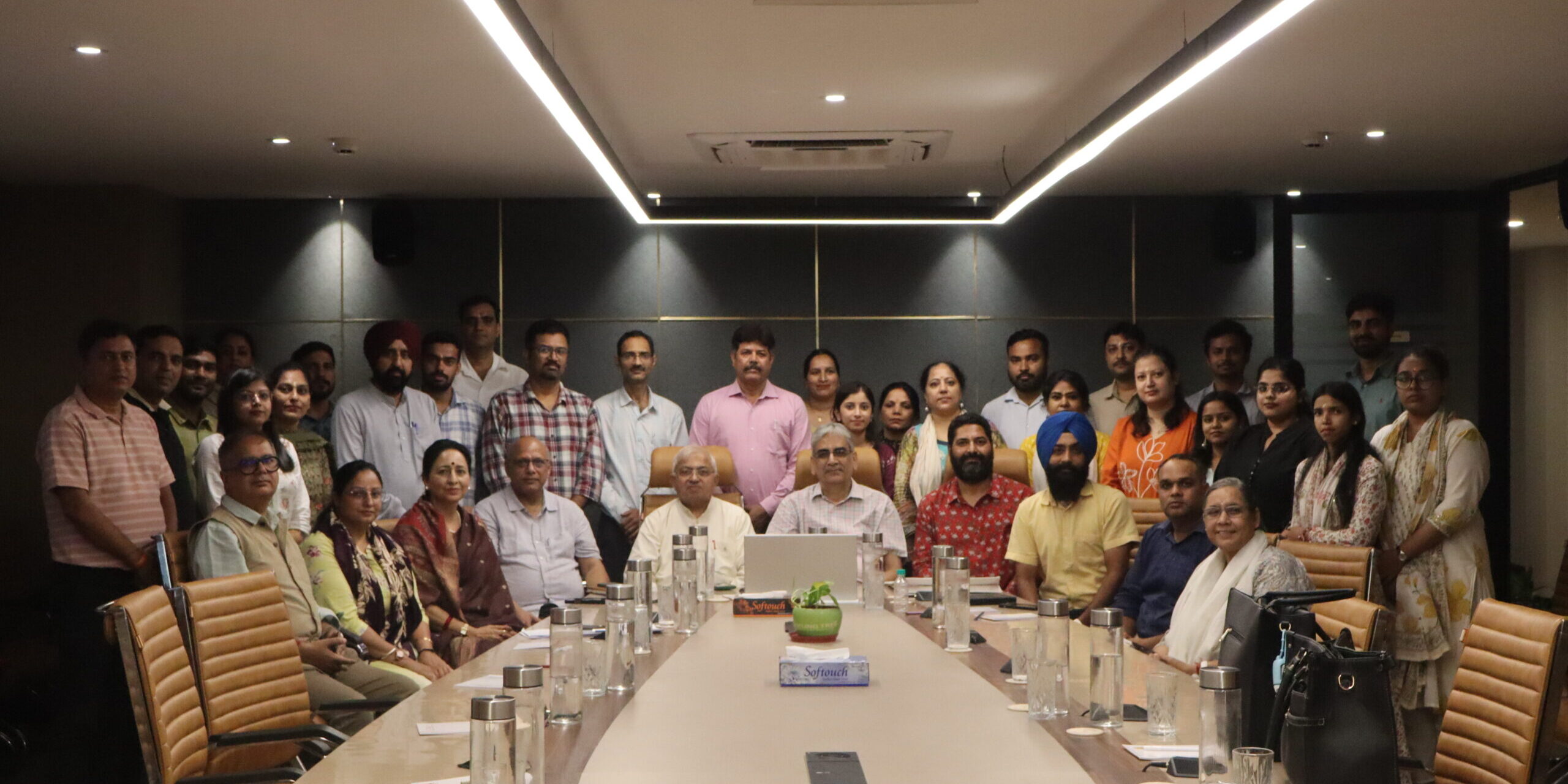
Organised by: Swadeshi Shodh Sansthan – Punjab Chair
Date: 29 August 2026
Venue: Gyan Kunj, 46–47, Pandit Deen Dayal Upadhyay Marg, ITO, Delhi–110002
Speaker: Prof. Ajay Kumar Bhagi, Professor, Department of Chemistry, Dyal Singh College, University of Delhi
Moderator: Prof. Rajinder Singh, Shivaji College, University of Delhi
Introduction
Swadeshi Shodh Sansthan, through its Punjab Chair, organised a special lecture on “Impact of Agricultural Reforms in Punjab” on 29 August 2026 at Gyan Kunj, New Delhi. The lecture brought together academics, researchers, social thinkers and practitioners to examine the historical trajectory of agriculture in Punjab, the transformative consequences of the Green Revolution, and the contemporary ecological, economic and social challenges confronting the state.
The programme commenced with the ceremonial lighting of the lamp by the dignitaries. The welcome address was delivered by Prof. Rajinder Singh, who also moderated the programme. He welcomed the distinguished guests and participants and provided an introduction to the theme of the lecture.
In his introductory remarks, Prof. Singh also briefly introduced Swadeshi Shodh Sansthan, highlighting its broader intellectual orientation towards research, dialogue and the examination of contemporary national and social questions from the perspective of swadeshi, self-reliance and indigenous development. The Punjab Chair of the Sansthan provides a focused platform for engaging with the historical, economic, agricultural and social dimensions of Punjab and its contribution to India’s development.
Prof. Rajinder Singh introduced the keynote speaker, Prof. Ajay Kumar Bhagi, Professor in the Department of Chemistry at Dyal Singh College, University of Delhi. He subsequently acknowledged and introduced the distinguished dignitaries present at the programme, including Mn. Kashmiri Lal, Mn. Satish Kumar, CA Anil Sharma, Prof. Nandini, Prof. Chaman, Dr. Sarabjeet Kaur and other members and well-wishers associated with the programme. The lecture was further graced by the presence of Smt. Anupama Singh, Pro-Vice-Chancellor of Sardar Patel University, Mandi, Himachal Pradesh and Prof. Virendra Vijay of IIT Delhi’s Department of Rural Development and Technology. His work and initiatives were noted in areas including biogas, the Unnat Bharat Abhiyan, Swadeshi Urja, and the Khad Atmanirbharta Abhiyan.
The thematic introduction was provided by CA Anil Sharma, who placed the question of agricultural reform within the larger context of Punjab’s economic and social transformation. His introductory remarks raised three broad and interconnected concerns which provided an appropriate framework for the subsequent lecture, in which Prof. Bhagi examined the historical achievements as well as the unintended consequences and emerging challenges of agricultural reforms in Punjab.
The main lecture was delivered by Prof. Ajay Kumar Bhagi, who approached the subject through a broad historical, economic, ecological and social framework. His presentation began by establishing the geographical and agricultural significance of Punjab. The accompanying presentation noted that Punjab has a geographical area of approximately 50,362 square kilometres, of which nearly 42,000 square kilometres is under agricultural cultivation. Agriculture therefore occupies a central position in the state’s economic and social structure.
Prof. Bhagi first situated contemporary Punjab within the history of the undivided Punjab, Partition and the subsequent reorganisation of the state. The presentation explained how Partition in 1947 disrupted integrated irrigation, transport and administrative systems, while the 1966 reorganisation further reshaped Punjab’s territorial configuration.
The lecture then turned to the condition of Indian agriculture before Independence and the post-Independence imperative of achieving food security and self-sufficiency. The presentation highlighted the poverty of farmers, exploitative marketing practices, inadequate infrastructure and the role of institutional reforms in addressing these problems. Following Independence, increasing agricultural production became a national priority, eventually creating the conditions for technological and institutional interventions associated with agricultural reforms and the Green Revolution.
A major part of the lecture examined the Green Revolution and Punjab’s transformation into the “Granary of India.” The introduction of high-yielding varieties, chemical fertilisers, pesticides, tractors, tubewells and improved irrigation substantially increased agricultural productivity. The presentation particularly emphasised the importance of the Bhakra-Nangal project and the extensive adoption of HYV seeds in Punjab.
The speaker, however, stressed that the achievements of the Green Revolution must be evaluated alongside its long-term costs. Punjab’s increasing dependence on the wheat–rice production system generated serious ecological pressures. The presentation identified groundwater depletion, soil degradation, chemical pollution and the consequences of stubble burning as major concerns. The presentation further noted that the intensive cultivation of paddy has placed considerable pressure on groundwater resources, with several districts experiencing significant declines in water tables.
Another significant dimension was the economic and social differentiation within Punjab’s agricultural sector. According to the presentation, capital-intensive farming has tended to favour farmers possessing larger landholdings and greater access to machinery, technology and inputs. Small and marginal farmers, in contrast, have faced difficulties in meeting rising production costs, contributing to rural indebtedness and inequality.
Prof. Bhagi also discussed the wider social consequences associated with agrarian distress, including rural unemployment, indebtedness and the state’s contemporary drug crisis. The presentation explored these issues as part of a broader discussion about the transformation of Punjab’s rural economy and the challenges faced by its younger population.
The issue of paddy stubble burning received particular attention. The presentation explained that the short interval between paddy harvesting and wheat sowing, combined with the costs and limited availability of residue-management machinery, encourages farmers to burn crop residue as the quickest and least expensive method of field clearance. The lecture also discussed alternatives such as converting paddy straw into biogas and biofertilisers, using balers and seeders, employing straw as fuel in thermal power generation, and producing composite materials from agricultural residue.
In concluding this section, Prof. Bhagi drew attention to the need for crop diversification and a sustainable agricultural model. The discussion of the Punjab Agriculture Policy 2023 highlighted recommendations concerning crop diversification, MSP, debt settlement and pension support for small farmers and agricultural workers. The presentation ultimately argued that diversification cannot succeed merely as a policy directive; farmers must be provided with credible and economically viable alternatives to the existing wheat–paddy system.
The keynote lecture was followed by an engaging question-and-answer session, during which participants had the opportunity to seek clarification and engage with the issues raised during the presentation. The interaction further enriched the discussion by connecting the historical analysis with contemporary concerns surrounding farmers’ livelihoods, agricultural sustainability and rural transformation.
The programme subsequently moved towards its concluding segment. Mn. Kashmiri Lal delivered the margdarshan and concluding address. The programme concluded with the felicitation of Prof. Ajay Kumar Bhagi, presented by Mn. Kashmiri Lal and CA Anil Sharma, in recognition of his contribution to the intellectual discussion. The formal vote of thanks was delivered by Dr. Sarabjeet Kaur, who expressed gratitude to the speaker, dignitaries, organisers and participants for making the programme meaningful and intellectually enriching.
Report Submitted by
Anushka Verma
Researcher, SSS