Students’ Emotions and Their Leaders’ Political Ambitions: Lessons from Bangladesh
Author – Dr. Jasvir Dalal, University of Delhi
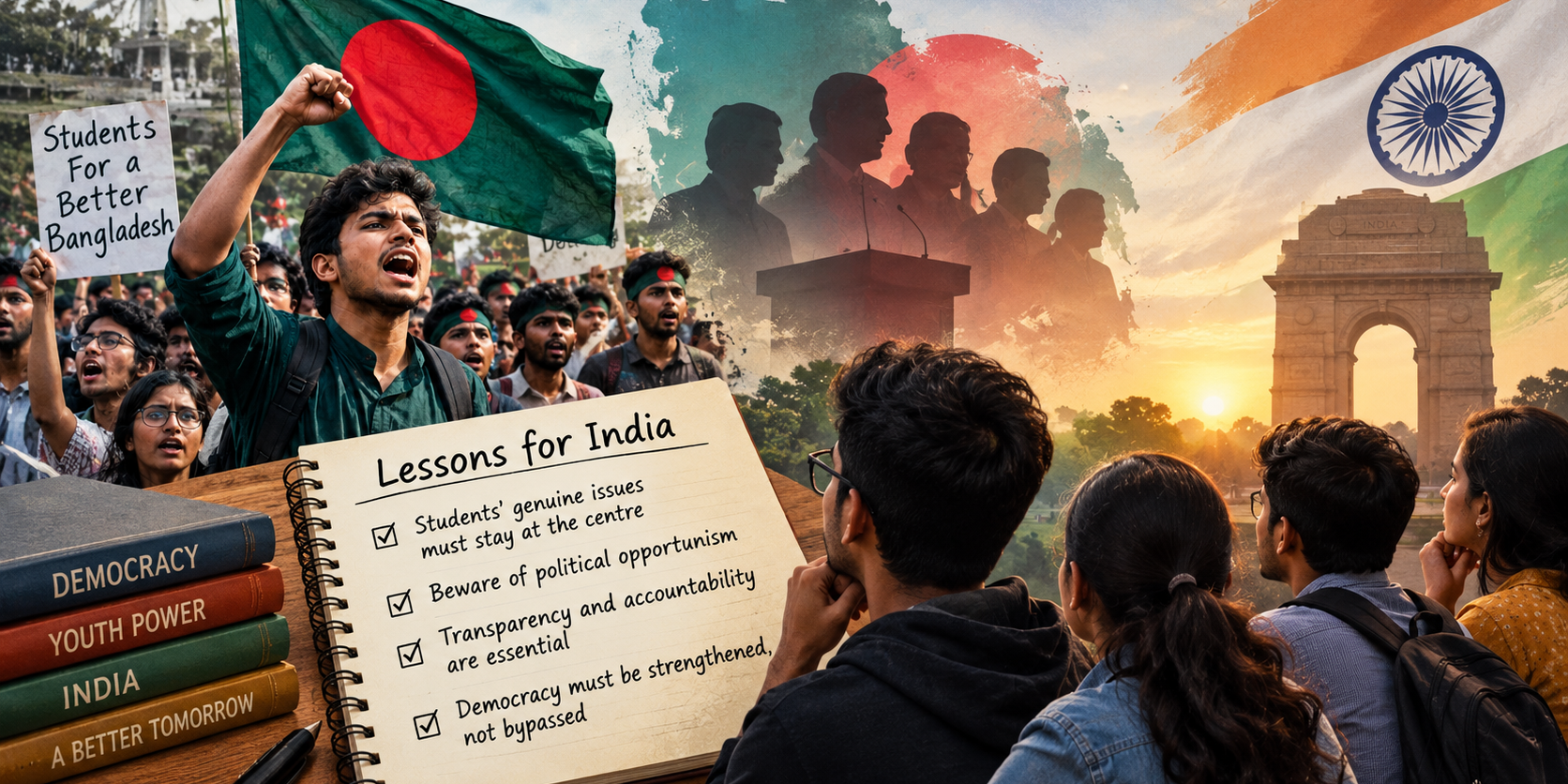
When and how does a movement that begins with students’ genuine problems become a means for political forces to fight for power? This question concerns young people’s trust and future, beyond support for or opposition to a government. A student who spends years preparing for an examination naturally feels angry when faced with paper leaks, irregular recruitment or unequal opportunities. These concerns involve employment, family expectations and respect for hard work. When this anger becomes a collective voice, it can create the strength needed to improve the system. But as a movement grows, groups with different political goals may join it. It then becomes important to ask whether students’ original demands still guide decisions or whether their trust is being used for another purpose. This is where questions about the movement’s direction and its leaders’ accountability begin.
The recent statement by Neha Bora, national president of the left-wing All India Students’ Association (AISA), deserves attention in this context. She spoke of drawing inspiration from Bangladesh’s youth movement of 2024 and said it had “shown us the way.” Amid the same political controversy, Prashant Bhushan also expressed a desire for a change of government through such movements. Any attempt to change a government by bypassing electoral and constitutional processes goes against the basic principles of democracy. Leaders must make a movement’s goals, direction and methods clear while encouraging young people to participate.
Political parties joining movements is natural in a democracy. Concern grows when solving the original problems gives way to a race for credit, greater political influence and popularity on social media. It is therefore necessary to ask whether the proposed demands will offer real solutions, whether participants agreed to them, and whether details of talks, agreements and resources are public. Without transparency, students continue to take risks while a few people decide the movement’s direction.
To understand these questions, we need to examine how Bangladesh’s student movement began, how its direction changed and what it eventually achieved. In June 2024, a High Court ruling opened the way to restoring government job quotas for the families of freedom fighters. Student protests against the decision intensified. On 21 July, the Supreme Court changed the system and directed that 93 per cent of posts be filled on merit. The quota for freedom fighters’ families was reduced from 30 per cent to five per cent, with the remaining two per cent reserved for other designated groups. The government accepted the ruling on 23 July. The students’ initial demand had thus been largely met before the Hasina government fell.
By then, however, the use of force against sponsored protesters, deaths and arrests had changed the movement’s direction. Alongside quota reform, protesters began demanding justice for victims, the release of those arrested and action against the officials responsible. A United Nations investigation documented serious human rights violations by the former government and security forces. It estimated that up to 1,400 people may have been killed in the violence, including children. It is therefore necessary to understand the movement’s expansion and its changing demands. These events also show how a failure to address grievances in time, combined with a harsh response to protesters, can turn a limited dispute into a wider political crisis. As opposition grew, Sheikh Hasina left Bangladesh for India on 5 August 2024. Three days later, an interim government was formed under Muhammad Yunus. Nahid Islam and Asif Mahmud, prominent figures in the student movement, became advisers. Some leading faces of the movement had now become part of the government. They were responsible for turning the demands of the students whose support and struggle had brought them this opportunity into concrete policies and reforms. Later developments, however, raised concerns about the role of extremist groups and foreign influence in shaping this change. The fear was that the political opportunity created by students’ struggle had become a means of serving other forces’ interests rather than solving students’ problems. The organization and strategic leadership behind the movement also need examination in this context. At a public event in New York in September 2024, Muhammad Yunus described Mahfuz Alam as the movement’s chief strategist. His statement highlighted the role of coordination and planned leadership. The question is whether ordinary students had any role at all in developing the strategy and making decisions.
Discussion of the movement’s strategy and the political arrangements after the change of government also raises the issue of foreign influence. Bangladesh’s location on the Bay of Bengal, its sea links and its place in the regional balance of power make political changes there important to outside powers. Against this background, allegations emerged about an American role, Saint Martin’s Island and possible military facilities. In May 2024, Sheikh Hasina claimed that a foreign individual had offered her a smooth return to power in exchange for permission to establish an airbase. Foreign funding for political programmes is another important part of this debate. Between 2017 and 2024, a programme in Bangladesh funded by USAID and Britain’s DFID included leadership training for political workers and young people, along with activities to increase their political participation. This raises a question: did outside powers use such programmes to influence political conditions in their own interests? How were students misled and their emotions used? These questions need examination. The government should closely monitor the funding, aims and activities of such programmes. Findings from investigations should be made public promptly, with supporting evidence, to protect young people’s ability to make independent decisions and safeguard national interests.
Amid all this, the central question remains: what did ordinary students in Bangladesh ultimately gain from this long struggle? Quota reform was a concrete achievement, but it had already been secured before the Hasina government fell. Some student leaders with political ambitions gained recognition and entered government. Yet in the February 2026 election, the National Citizen Party, which emerged from the movement, won six of the 30 seats it contested as part of an alliance. Power went to the established Bangladesh Nationalist Party. This result raises the question of whether a movement that began with students’ genuine problems later became a means for some leaders to fulfil their political ambitions through crowd mobilization. Was ordinary students’ struggle used for political purposes while their original problems were pushed aside in the contest for power? The killing of prominent youth leader Sharif Osman Hadi during the election campaign also raised serious questions. This experience shows that turning a popular movement into a principled political alternative is not easy.
A movement’s real success should be judged by how far it solves ordinary students’ problems and provides them with justice, safety and better opportunities, rather than by a change of government alone. Ordinary students’ circumstances also need assessment. A student leader reaching power through this undemocratic movement does not prove that all students’ problems have been solved. Political change becomes meaningful when its benefits reach the young people whose struggle and sacrifice made it possible. In Bangladesh, however, this expectation of ordinary students remained largely unmet.
Bangladesh’s experience raises an important question for India too: how closely do movements held in students’ names remain connected to solving their actual problems? In India, Education Minister Dharmendra Pradhan’s resignation was a major demand of the Cockroach Janta Party (CJP) protests against paper leaks and examination irregularities. After his resignation in July 2026 and the announcement of an agreement on other demands, the leadership ended that phase of the protests. But a minister leaving office and faults in the examination system being corrected are two different achievements. A resignation may be one step towards accountability. The responsibility to protect students’ future continues afterwards.
Did the resignation end paper leaks in competitive examinations? Did affected students receive relief? Was a reliable system put in place to prevent their hard work, time and opportunities from being wasted again? The government had announced examination reforms, stricter penalties and measures for speedy hearings. Both the government and the movement’s leaders should therefore be asked how far these measures have been implemented and what students have gained from them. The leadership’s accountability is equally important. Were ordinary students consulted and their consent obtained before the demands were finalized? Could the proposed demands offer lasting solutions to their problems? What role did participants have in decisions about funding, the protest programme and ending the demonstrations? Who took responsibility for following up on the accepted demands? If claiming credit for a resignation, building a political identity and gaining social media popularity become the main priorities, while monitoring examination reforms takes a back seat, it is natural to ask whose interests students’ anger served. Was the energy gathered to solve their problems redirected towards a few individuals’ political ambitions? The answer must be sought in the leadership’s work and the results students receive, rather than in its publicity.
The movement then enters a second phase. The CJP leadership, earlier active against examination irregularities, now demands the Chief Election Commissioner’s resignation over alleged irregularities in the Special Intensive Revision of electoral rolls. It announces nationwide protests if the demand is not met. Once again, the same question arises: is an official’s resignation enough to solve the problem being raised? The leadership should explain how its demands will address these concerns. Meanwhile, foreign businessman Elon Musk’s comments about the Indian government and Mukesh Ambani appear to further inflame protesters’ anger. It is therefore important to understand the interests of outside forces as well. Those supporting his comments should explain which facts they agree with and how they see Indian citizens benefiting.
In this political atmosphere, Neha Bora describes Bangladesh’s youth movement as an inspiration and says it has “shown us the way.” Prashant Bhushan also expresses a desire for a change of government. Taken together, these statements raise questions about the movement’s political goal. Is the aim to address specific grievances and improve institutions, or to connect this public support to a wider political campaign to change the government? Leaders praising Bangladesh’s example should explain which part of it they consider worth following in India. Given the deaths, disorder and communal violence during the movement, and the employment problems ordinary students continued to face afterwards, on what basis is it being presented as an inspiration?
Peaceful protest, criticism of the government and calls for a change of government through elections are part of India’s democracy. But any attempt to bypass constitutional processes and change a government through violence, fear or coercion would go against democracy’s basic principles. Young students should therefore use their own judgement and independent thinking to assess a movement’s goals, methods and political intentions. They should also understand the ultimate purpose for which their support is being sought and how it will help solve their actual problems. Improving the system is a continuous process. It requires evidence-based complaints, practical solutions and sustained work to ensure that reforms are implemented. If a movement claims credit for one resignation and then moves to its next political target, it becomes even more important to demand an account of what happened to the earlier problems.
The country will grow stronger when young students work responsibly through democratic means to solve real problems and judge their success by concrete improvements. India has a rich legacy of courage, sacrifice and patriotism in young people such as Bhagat Singh, Khudiram Bose, Kartar Singh Sarabha, Hemu Kalani and Ashfaqulla Khan. For the youth of such a country, the violent and disruptive elements active in Bangladesh’s movement can never be sources of inspiration. Their inspiration should come from their own heritage of dedication to the country, independent thinking and responsible struggle for the public good.