
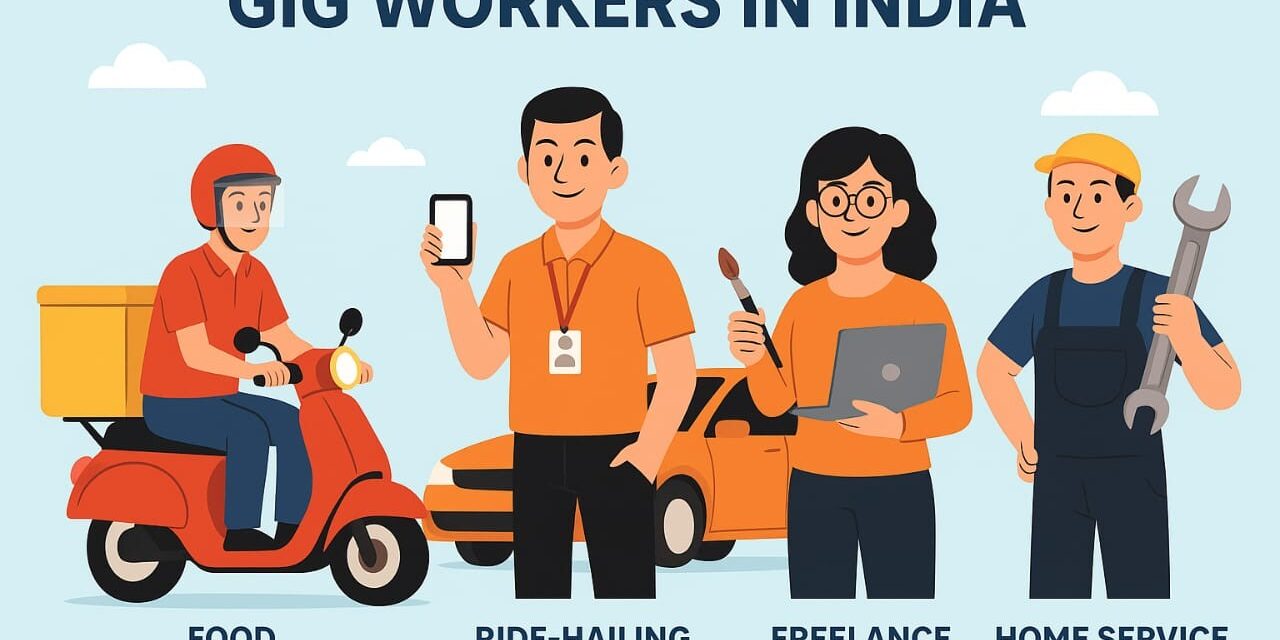
Employment of gig and platform workers has grown faster than economic growth, with elasticities exceeding those of the overall labour market in every round between 2011–12 and 2019–20 (NITI Aayog, 2022). Sometimes hailed as a success of digital modernisation, this is, nevertheless, an underlying and distressing structural transformation from a Swadeshi perspective: economic growth is creating livelihoods based on tasks and platforms, and eradicating real and self-reliant employment (Swarojgar) and genuinely secure industrial employment. Breathing life into the non-gig world and shaking up its analytical calculations is an economic model that prioritises creating and sustaining the dignity of labour, giving people a voice and ownership, and ensuring long-term security.
Globalised digital capital and platform intermediaries have turned non-gig jobs into atomised micro-tasks and opaque algorithms. In India, from white-collar IT workers who moonlight to delivery riders who must endure relentless streets, millions are swallowed by a system that offers them the flexibility of the corporation in exchange for autonomy and a lack of social security. This is recognised by emerging regulatory measures such as the Code on Social Security. Still, the dichotomy between high-tech developments and real-world economic justice remains the biggest labour conundrum in modern-day India.
How big has India’s gig economy actually grown?
NITI Aayog’s estimates confirmed that India’s gig workforce rose from 25.2 lakh in 2011-12 to 77 lakh (7.7 million) in 2020-21, representing 6.7% of India’s non-agricultural workforce, and would increase to 2.35 crore (23.5 million) by 2029-30. Although gig workers’ contribution is relatively small, accounting for 1.3% of the total workforce and 2.4% of the non-farm workforce, it is still a fast-growing segment of the economy (NITI Aayog, 2022).
Newer figures indicate that this increase is already surpassing the initial forecast. The Economic Survey 2025-26 noted that gig workers increased to 120 lakh (12 million) by FY2025, from 77 lakh in FY2021, which was due to a 55% surge over just four years, largely from the penetration of smartphones among more than 800 million users and approximately 15 billion UPI transactions per month (Economic Survey, 2025-26). The sector is expected to contribute almost ₹2.35 lakh crore to India’s GDP by 2029-30 (NITI Aayog, 2022). According to Redseer’s industry research, India’s gig internet workforce has already surpassed 6 million active users per month and is projected to reach 17-21 million by 2030 (Redseer, 2026).
Tracking the rise of gig work
‘Gig’ is actually almost a century old; its earliest usage, predating the modern platform economy, was by performing musicians, before being reappropriated to refer to modern freelance and contract work (Doshi & Tikyani, 2020). Its economic use, however, is of the 21st century. Joshi, Jain & Gupta (2024) attribute the growth of the gig economy to the merging of digital platforms and the “sharing economy” approach. Companies began to turn to independent workers rather than regular workers, as they offered flexibility and cost savings that traditional workers could not.
The transition in India was also quick. According to Roy & Avinash K. Shrivastava(2020), the gig workforce in India was around 15 million by 2015, representing the second-largest gig freelancer workforce in the world, with the U.S. having the largest at 53 million. India’s gig workforce was largely composed of those seeking flexible hours, autonomy over the work they took on, and the ability to be their own employer. In particular, the same study revealed that 41% of India’s early gig workers were in the information technology and related sector, working with customers across the country and abroad.
Sharma & Sharma (2025) situate this growth within a broader structural context. In addition to providing jobs, digital platforms restructured the economy by directly linking workers and clients, helping to scale down the traditional intermediary role of employment and normalising work focused on tasks and projects rather than jobs.
The moonlighting
The connection between gig work and the moonlighting issue in India is more than just a surface one. During the COVID-19 pandemic, moonlighting, or working a second job, either in secret or with the knowledge of one’s employer, has grown significantly among white-collar professionals, especially because working from home has made it easier to pursue a second source of income without the employer knowing (India TV News, 2022). This became more prominent in September 2022 when Wipro “found that about 300 employees were working at the same time for a direct competitor, which is a complete violation of integrity in its deepest form”, and the company terminated the workers (TechCrunch, 2022; India TV News, 2022). A pertinent fact is that in this scenario, the food delivery service Swiggy took the opposite approach and introduced a formal policy on “moonlighting,” which allowed staff to work on external projects for extra income as well (India.com, 2022).
This tension is no less than that of the gig economy; it is its extension. According to Roy & Avinash (2020), 41% of early gig workers in India were in the information technology sector, serving both domestic and international clients. What makes it easy for a delivery driver to accept more flexible shifts is the same support that makes it easy for a software engineer to quietly accept a second project, a second client or even a second employer. In this context, moonlighting is not a different form of work but rather a different class of worker with greater bargaining power, sharing the same motivation: to supplement a primary source of income rather than rely on a single one.
Challenges
However, there are some disadvantages of gig work beyond the flexibility advertised by these platforms: gig workers are not always employed, their pay is not always reliable, and they are unlikely to have the same basic protections as paid workers.
The first is work-life balance. NITI Aayog (2022) states that stress is also a major problem among workers in this sector due to algorithmic management practices and performance evaluation, which is done through customer ratings. The Economic Survey 2025-26 also mentions algorithmic workload as a cause for concern due to potential algorithmic bias and burnout (Economic Survey, 2025-26). The distinction between work and leisure time becomes fuzzy when income depends on being on-site at all times.
The second is job security. These workers are not direct employees but are considered to be independent contractors. Most workplace protections do not apply to them (NITI Aayog, 2022). The distinction is not only a legal one, but also directly linked to financial instability. Many workers lack a stable income due to irregular pay or job insecurity. As per the Economic Survey 2025-26, about 40% of gig workers earn less than ₹15,000 per month and face income volatility, which limits their access to institutional credit.
The third is a lack of health and social protection. Dwivedi & Deepak (2024) report that the prevailing labour laws and social security systems, which are more geared towards full-time salaried workers, systematically exclude gig workers from health insurance, pensions, paid leave, and unemployment benefits. According to their review, there was an increase in psychosocial risks, such as burnout and work stress, due to job insecurity and a lack of social security registration among food delivery workers in Delhi.
The framework
India’s regulatory response to this gap is the Code on Social Security, 2020, which was enacted on 21st November, 2025 and, for the first time, brings gig and platform workers within the ambit of social security (East Asia Forum, 2026). To meet this requirement, the Code requires aggregators to make between 1% and 2% of their annual turnover available to a separate Social Security Fund, up to a maximum of 5% of all payments made to gig workers, including for life and disability insurance, for accidents, health benefits, and maternity benefits, as well as for old-age protection (East Asia Forum, 2026).
In practice, the law has not been implemented. Draft rules would mandate that “at least 90 days with a single aggregator” (or 120 days on multiple platforms) are required for a worker to qualify for benefits, a threshold that a large proportion of gig workers, due to the volatility of the gig workforce and the platform’s part-time engagement, might not be able to achieve within one year (East Asia Forum, 2026). Only the Code on Social Security mentions gig workers, while the other three labour codes – wages, occupational safety, and industrial relations – still do not include gig workers (East Asia Forum, 2026). The issue of awareness exacerbates the situation: the majority of workers are unaware of the Code, and enrolment on national platforms such as e-Shram is far below the estimated workforce size.
Way forward
The numbers do not lie: India’s gig economy is not an experiment but a structural feature of how the country now creates jobs. It has shown much faster growth than the overall economy. It employs everyone from delivery riders to those who work additional jobs as IT workers, and its massive growth has made it difficult to keep it outside formal labour protections.
The Code on Social Security 2020 is indeed a step in the right direction, but an initial step is not a solution. Eligibility requirements must align with the nature of gig work, which typically involves short, often fragmented work periods across various platforms, rather than the type of work envisioned by the law. The same level of urgency is needed for awareness and registration as for the legislation itself, especially to ensure workers’ benefits and protections to which they are entitled; that is not possible without awareness. The remaining labour codes should recognise gig workers, as they are an important part of the economy’s labour force.
References
- NITI Aayog (2022). India’s Booming Gig and Platform Economy: Perspectives and Recommendations on the Future of Work. Government of India. https://www.niti.gov.in/sites/default/files/2022-06/25th_June_Final_Report_27062022.pdf
- Economic Survey (2025).-26 (2026). Department of Economic Affairs, Ministry of Finance, Government of India. Tabled in Parliament by Nirmala Sitharaman, January 29, 2026. https://www.indiabudget.gov.in/economicsurvey/
- Redseer Strategy Consultants (2026). Gig Internet Workforce in India: Bridge to ~20 Million Livelihoods. https://redseer.com/reports/redseer-gig-internet-workforce-report-2026/
- Doshi, B. M., & Tikyani, H. (2020). A theoretical integration of the gig economy: Advancing opportunity, challenges and growth. International Journal of Management, 11(12), 3013–3019. https://doi.org/10.34218/IJM.11.12.2020.282
- Joshi, A., Jain, R., & Gupta, S. (2024). Challenges and impact of the gig economy. Sustainable Economies, 2(2). https://doi.org/10.62617/se.v2i2.96
- Roy, G., & Shrivastava, A. K. (2020). Future of gig economy: Opportunities and challenges. IMI Konnect, 9(1), 14–27. https://www.researchgate.net/publication/340253836_Future_of_Gig_Economy_Opportunities_and_Challenges
- Sharma, P., & Sharma, R. (2025). The gig economy and the evolving nature of work in India: Employment, policy, and platform realities in the age of convenience. Journal of Digital Economy, 4, 156–167. https://doi.org/10.1016/j.jdec.2025.07.005
- Chaturvedi, A. (2022, September 21). Wipro fires 300 employees for ‘moonlighting’. India TV News. https://www.indiatvnews.com/business/news/wipro-fires-300-employees-for-moonlighting-2022-09-21-810301
- Singh, M. (2022, September 21). IT services group Wipro fires 300 employees moonlighting for competitors. TechCrunch. https://techcrunch.com/2022/09/21/it-services-group-wipro-fires-300-employees-for-moonlighting
- India.com News Desk (2022, September 21). No Twin-Timing! Wipro fires 300 employees caught moonlighting for competitors. Deets here. India.com. https://www.india.com/business/wipro-latest-news-today-21st-sept-2022-no-twin-timing-wipro-fires-300-employees-caught-moonlighting-for-competitors-deets-here-5644622/
- Dwivedi, N., & Deepak, A. (2024). Social security for gig workers in India: Challenges, gaps, and policy recommendations. National Research Journal of Business Economics, 11(2), 29–38. https://www.nrjbe.in/images/paper_pdffiles/SOC-6821a6f690f74.pdf
- East Asia Forum (2026, April 13). India’s gig economy is growing faster than its protections. https://eastasiaforum.org/2026/04/09/indias-gig-economy-is-growing-faster-than-its-protections/
By Kartik Shyam Mogha & Kalika Kumari