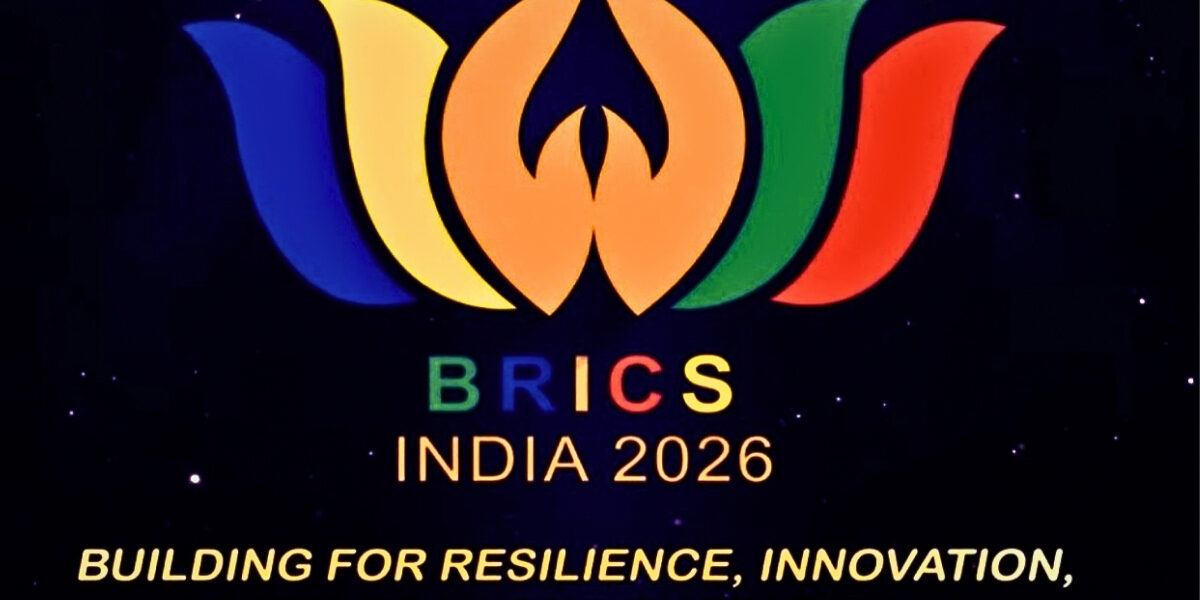
The 18th BRICS Summit in New Delhi on September 12-13, 2026, marks an important moment in the evolution of the emerging global order. Under Bharat’s presidency, the summit adopted the BRICS New Delhi Declaration, centred on “Building for Resilience, Innovation, Cooperation and Sustainability”. The declaration comes at a time when the international system is facing geopolitical conflicts, tariff tensions, economic fragmentation, technological disruption, energy insecurity and a growing demand from the Global South for greater representation in global institutions.
For Bharat, however, BRICS is not merely an economic grouping or an instrument for balancing Western power. It provides an opportunity to articulate a distinctly Bhartiya approach to international affairs- an approach that combines national interest with civilisational responsibility, strategic autonomy with international cooperation, and economic development with human welfare.
The New Delhi Declaration should therefore be understood not simply as another diplomatic document, but as an expression of Bharat’s aspiration to contribute to the making of a more multipolar, inclusive and equitable world order.
From BRIC to a Global Platform
BRICS began as an economic idea associated with Brazil, Russia, India and China. The term “BRIC” itself was coined by economist Jim O’Neill in 2001. Two decades later, the grouping has evolved into a much broader platform connecting major economies and developing countries across Asia, Africa and Latin America.
Its transformation reflects an important structural reality: the centre of gravity of global economic and political power is gradually becoming more diversified.
The current international system is largely shaped by Western institutions and priorities. Today, emerging economies increasingly demand a voice proportionate to their demographic, economic and geopolitical significance. BRICS represents this demand without necessarily advocating the destruction of the existing international system. This distinction is particularly important for Bharat.
Bharat does not seek a world without the West; it seeks a world in which no single power or group of powers can determine the rules of international politics unilaterally. This is the essence of Bharat’s multi-alignment and strategic autonomy.
BRICS and the Bhartiya Idea of Multipolarity
The ideological significance of the New Delhi Declaration becomes clearer when viewed through the Bhartiya civilisational concept of Vasudhaiva Kutumbakam- the world as one family.
This philosophy does not mean that nations should surrender their sovereignty or national interests. Rather, it suggests that national prosperity and global welfare need not be contradictory.
Bharat’s approach can therefore be described as “national interest with global responsibility”.
This is fundamentally different from both power politics based exclusively on domination and ideological internationalism that ignores national identities. Bharat’s vision seeks a balance: strong nations, independent civilisations and cooperative international institutions.
The declaration’s emphasis on multilateralism, development, cooperation and reform of global governance fits naturally within this broader Bhartiya global outlook. BRICS leaders have called for international institutions to become more representative, inclusive, effective and responsive to contemporary realities.
The message is clear: global governance cannot remain frozen in the geopolitical realities of the twentieth century when the economic and demographic realities of the twenty-first century have changed dramatically.
Strategic Autonomy: The Heart of Bharat’s BRICS Policy
Perhaps the most important strategic lesson from Bharat’s BRICS leadership is that strategic autonomy remains central to Bhartiya foreign policy.
Bharat maintains relations simultaneously with the United States, Russia, Europe, Japan, the Gulf, Africa, ASEAN, and the wider Global South. Its participation in BRICS does not mean alignment against the West, just as its partnerships with Western countries do not mean abandoning Russia or the developing world. This is the logic of multi-alignment. This is not diplomatic opportunism; it is an expression of sovereignty.
A confident Bharat should have the freedom to cooperate with different countries on different issues according to its national interests. Defence cooperation may require one set of partnerships; energy security another; technology yet another.
BRICS strengthens this strategic space.
Economic Sovereignty and Atmanirbhar Bharat
The economic dimension of BRICS is equally significant. The contemporary global economy is increasingly vulnerable to geopolitical conflicts, economic sanctions, supply-chain disruptions, protectionism, tariff wars, and financial volatility. The New Delhi Declaration’s emphasis on resilient economic cooperation and easier cross-border transactions is therefore strategically important.
For Bharat, this connects directly with the broader philosophy of Atmanirbhar Bharat. Self-reliance should not be confused with isolation. Atmanirbharta means developing domestic capabilities while remaining deeply connected with the global economy.
Bharat’s objective should be to become: locally capable, nationally resilient and globally competitive.
BRICS can contribute to this objective by expanding trade in national currencies, strengthening alternative payment mechanisms, encouraging investment, improving supply-chain resilience and facilitating cooperation in critical sectors. Such measures can reduce excessive dependence on any single financial or economic centre.
Technology: From Consumer to Creator
The word “Innovation” in the New Delhi Summit’s theme is particularly relevant to Bharat’s transformation.
The twenty-first century will not be determined only by military power or natural resources. Artificial intelligence, semiconductors, quantum computing, biotechnology, space technology and digital public infrastructure will increasingly determine national power.
Bharat’s experience with Digital Public Infrastructure, including digital identity, payments and technology-enabled welfare delivery, provides an important model for developing countries.
Bharat should use BRICS to promote technological partnerships that are affordable, accessible and development-oriented.
The objective should not be merely to consume technologies developed elsewhere. Bharat must increasingly become a creator, innovator and standard-setter.
This is where the civilisational idea of Atmanirbharta acquires a technological dimension: a nation that controls critical knowledge and technological capabilities possesses greater freedom in determining its future.
Swadeshi and Globalisation Are Not Contradictions
The BRICS agenda also offers an opportunity to reinterpret the idea of Swadeshi for the twenty-first century. Swadeshi should not mean economic isolation. Its deeper meaning is the strengthening of domestic productive capacity, indigenous knowledge, entrepreneurship, and local communities.
Bharat can simultaneously promote local manufacturing and global trade; traditional knowledge and modern science; small enterprises and advanced technology. This synthesis is crucial. BRICS can become an important platform for such a transformation.
Global South Leadership: From Voice to Agency
One of Bharat’s greatest diplomatic achievements in recent years has been the strengthening of its engagement with the Global South.
Bharat’s argument is increasingly moving beyond demanding a “voice” for developing countries. The objective is to give them greater agency in shaping international institutions, finance, technology, trade and development. The New Delhi Declaration reinforces this direction.
Bharat’s leadership should therefore focus on practical cooperation- healthcare, food security, energy, digital technology, climate resilience, education, capacity building and infrastructure. The Bhartiya model should be based on partnership rather than patronage.
Sustainability and the Bhartiya Civilisational Ethos
The final pillar- sustainability- is particularly compatible with Bharat’s civilisational traditions.
Bhartiya thought historically viewed nature not merely as an economic resource but as part of a larger ecological and ethical order.
Contemporary environmental challenges- climate change, water insecurity, biodiversity loss and energy transition- require precisely this combination of technology and responsibility.
Bharat’s emphasis on sustainable lifestyles, renewable energy, climate justice and development for all can provide BRICS with a distinctive developmental framework.
The principle should be simple: development must be ambitious, but development must also be responsible.
Emerging markets and developing countries (EMDCs) cannot be asked to sacrifice poverty reduction in the name of climate goals, while historically industrialised countries continue to enjoy the accumulated benefits of resource-intensive development.
BRICS can therefore become a stronger voice for both development justice and environmental responsibility.
The Challenge: BRICS Must Deliver
Yet Bharat’s leadership must also recognise BRICS’ limitations.
The expansion of BRICS has increased its geopolitical significance but also increased its internal diversity. Members have different political systems, economic interests, strategic priorities and relations with major powers. Managing these differences will be one of Bharat’s most difficult challenges.
BRICS cannot become effective merely by issuing declarations.
It needs measurable outcomes: stronger intra-BRICS trade, better financial mechanisms, technological partnerships, infrastructure connectivity, energy cooperation and institutional reforms. Bharat should therefore promote “BRICS of delivery” rather than merely “BRICS of declarations”.
The grouping must demonstrate that cooperation among developing and emerging economies can generate tangible benefits for ordinary citizens.
A New Delhi Moment for the Global Order
The BRICS New Delhi Declaration represents more than another summit communiqué. It reflects the continuing transition from a predominantly unipolar international system toward a more plural and multipolar world.
For Bharat, this transformation should not be understood simply through the language of power rivalry. It should be approached through a distinctly Bhartiya synthesis of national sovereignty, strategic autonomy, economic self-reliance, technological innovation, cultural confidence and global cooperation.
The deeper message of New Delhi is that Bharat is increasingly prepared not merely to participate in the international order but to help shape its future.
The combination of Atmanirbhar Bharat and Vasudhaiva Kutumbakam offers a powerful conceptual framework: self-reliance without isolation, nationalism without hostility, development without exploitation, and global cooperation without surrendering sovereignty.
If BRICS can convert these principles into practical institutions and deliverable outcomes, it can become one of the principal pillars of a genuinely multipolar twenty-first century.
For Bharat, therefore, the New Delhi Declaration should be seen as an opportunity and a responsibility. The objective should not be to replace one hegemon with another, but to help create a world where many civilisations, many centres of power and many voices can coexist with dignity, sovereignty and mutual respect. That would be the true meaning of building for resilience, innovation, cooperation and sustainability.