
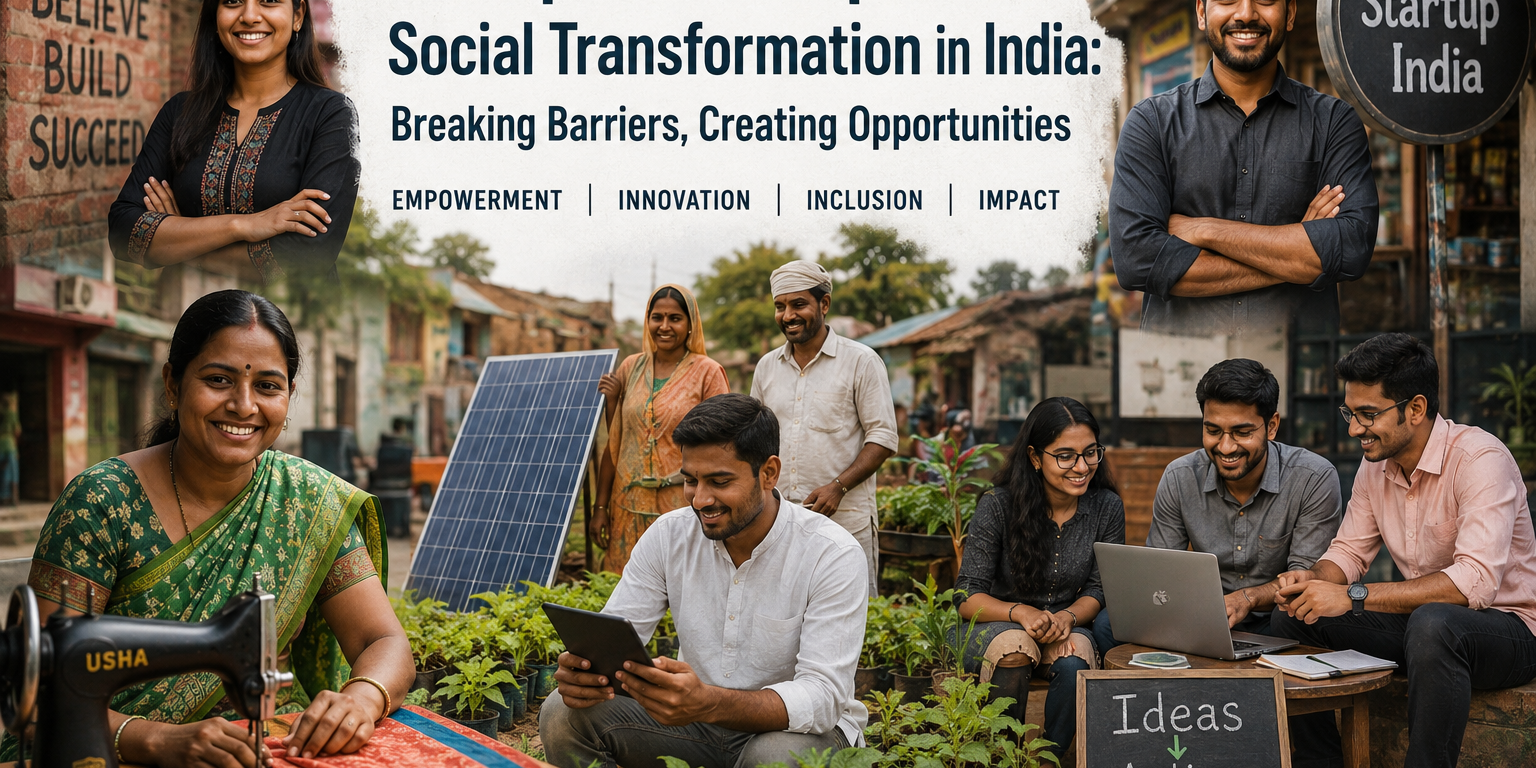
Abstract: The article aims to explore the co-dependent relationship between social barriers and entrepreneurship in India. Social inequalities based on caste, gender, class, religion, geography and educational status often limit access to capital, networks, skills, markets and even the dream of becoming an entrepreneur. Inclusive entrepreneurship can help to overcome these barriers by promoting economic independence, social mobility, role models for youth and new aspirations for the previously excluded categories. Based on Indian values of ātmanirbharta and svāvalamban, this article proposes a solution oriented approach based on respect for diversity of work, inclusion of entrepreneurship as a mechanism for wealth, job creation and the empowerment of entrepreneurship by the community. It further stands for the people, the way to expand the freedom of enterprise, to make sure that what we are doing is not only about economic gain but is also to make a small change in India’s society.
Introduction
Entrepreneurship is now seen as very much at the heart of current discussions about India’s economic future, especially for young people. It is associated with innovation, employment generation, technological development, local development and the national aspiration of ātmanirbharta. Government schemes, startup ecosystems, digital markets, self-help groups, producer organisations and social enterprises have made entrepreneurship more visible as a pathway to economic participation. But the opportunity to be an entrepreneur is not equally distributed among society. The decision to start a business, the ability to raise capital, the confidence to take risks and the ability to access markets are all dependent on where one is located in society.
In India, this is especially true of the link between entrepreneurship and social change. Entrepreneurship does not exist in a vacuum. Caste, gender, class, religion, geography, family networks, education and occupational traditions can also affect who is able to enter entrepreneurship and what kind of businesses they can establish. At the same time, entrepreneurship can change these very social conditions. If people from historically excluded or economically marginalised backgrounds start successful enterprises, they will have more economic independence and social recognition, new networks and greater decision making power. Their success can also lift the aspirations of others who see entrepreneurial opportunity that was previously thought of as untenable.
The relationship is reciprocal in the sense that social barriers can make entrepreneurship impossible, inclusive entrepreneurship may make the social barriers to entrepreneurship weaker. The present piece develops this idea in the Indian context and argues that entrepreneurship should not be seen just as an economic activity, but as an instrument of social change. Such change, however, is not automatic. Markets can reproduce existing inequalities as easily as they can challenge them. A truly transformative approach needs targeted interventions that expand access, recognize various forms of work, develop local capacities and guarantee that marginalised communities are part of the value created through enterprise.
The central question is not whether entrepreneurship can provide income or work. It is whether India can develop entrepreneurial forms that enhance economic opportunity, vocational freedom, social dignity and collective confidence in the various communities.
1. Social Barriers and the Unequal Starting Point of Entrepreneurship
Entrepreneurship is the one area of the world where talent, innovation and determination can rise above circumstances. These are excellent things to have, but such a view can obfuscate a lot of people’s disadvantages in the beginning. In India, access to enterprise is determined by social resources that are unevenly distributed. The same have been discussed below in brief,
1.1 Caste and occupational hierarchies
The historical association of caste and occupation is one of the biggest barriers. Some work has long been socially revered and others, particularly in the field of manual labour, leather, sanitation, repair or other physical work, have become stigmatised. These hierarchies have an impact on those who are traditionally associated with such activities and on the willingness of younger generations to enter them. This is a paradox. India is rich with traditional and local skills, but most of these trades that sustain daily living are undervalued. The technical skills of an artisan, cobbler, repair worker, food processor, mechanic or craft producer, though, may be in sharp display of technical knowledge but are not recognized in the social consciousness of salaried and white-collar jobs.
As a result, younger generations will abandon productive work not because it is economically meaningless to them but because they are perceived as socially inferior. Caste also affects access to credit, business networks, suppliers, customers and informal support. And entrepreneurship is frequently a combination of trust, family and social ties. Those communities that have long been excluded from such networks may find it harder to transition from survival level self-employment to sustainable enterprise.
1.2 Gender and entrepreneurial risk
Another major barrier is social norms. Women see mobility, owning assets, access to finance, household responsibilities, safety and social acceptance as the most important barriers. They have skills and entrepreneurial aspirations but business costs take on a higher level when they have to contend with social expectations and market risk. Women’s companies and entrepreneurial enterprises in India show that these barriers exist and can be transformed.
Shri Mahila Griha Udyog Lijjat Papad was established in 1959 by seven women in Mumbai and is an excellent example of collective enterprise and women’s economic participation. Starting from a small pool of resources, the initiative developed a huge organisation based on women’s participation in production and ownership. This is not just a matter of the commercial success of one product but of showing women can build, manage and sustain an economic system. (World Intellectual Property Organization [WIPO], 2013).
Such examples matter because entrepreneurship can have an impact far beyond the immediate entrepreneur. With a visible woman entrepreneur, it is therefore possible to challenge the notion that economic leadership is always the job of men. Her presence can affect families, communities and young women in all social domains.
1.3 Class, geography and educational status
Class inequalities affect the material resources for entrepreneurship. Financing is often necessary for starting a business but it also means knowledge, time, technology and the ability to deal with uncertainty. And people who are economically well off, tend to be more willing to accept failure when it comes to entrepreneurship than those for whom a failed enterprise may threaten household survival.
Geography is also an issue. Urban entrepreneurs can bring customers and investors, incubators, professional networks and infrastructure. Rural entrepreneurs, on the other hand, may have a lot of skills and local knowledge, but they can not penetrate to bigger markets. Production does not move from the countryside and branding; technology, finance and profits are concentrated elsewhere. Educational credentialism can also narrow vocational aspirations.
In India, formal degrees and salaried jobs are the main indicators of social success. Technical, artisanal, repair-based jobs, agricultural and manual jobs may lose their prestige. This hierarchy between “educated” and “manual” work can cause entrepreneurship to be threatened by keeping talented people from getting jobs they are very well paid for but socially undervalued.
- The Reciprocal Relationship: How Entrepreneurship Can Transform Social Conditions
If social inequality shapes entrepreneurship, entrepreneurship can also influence social inequality. The key mechanism is the development of economic autonomy and social possibility. Economic independence can alter the relationship between family and community. An entrepreneur who makes money will be able to make decisions, move around and become more socially integrated. At the same time, for women, this is an increase in bargaining power. For people from historically marginalized communities, enterprise may allow them to gain new identities without a history of inherited work or social status. For rural producers, access to a larger market can help reduce reliance on local intermediaries.
But entrepreneurship is also a process with psychological and cultural effects. People tend to make decisions not just on the opportunities of their own life but also on what is possible for “people like us.” And when entrepreneurship appears to be limited to wealthy, urban, educated, or socially privileged groups, people from marginalized communities might not consider it more than a fantasy. This is the reason why role models matter. The success of one entrepreneur can create what might be referred to as an aspirational multiplier effect. It is evidence that a social barrier can be crossed. A successful enterprise can lead others to enter with skills, to seek finance and participation in collective efforts, or to explore new markets. And entrepreneurship can make aspiration a social resource. India is just one example.
Women’s self-help groups in rural India have provided collective savings, access to credit, production, and small-scale enterprise. The growth of local producer cooperatives and women-led enterprises has offered opportunities for those individuals who were not able to take on a lot of entrepreneurial risk on their own. In a similar vein, artisan clusters connected to contemporary design, digital platforms and tourism markets are showing how traditional skills can be repositioned for new consumers without leaving their local roots behind.
Here, the lesson is that entrepreneurship can help to reduce social barriers and build confidence, autonomy and collective engagement. But there is no automatic process, and it’s not always the same. An individual enterprise can succeed without social change. And for entrepreneurship to be transformational, it has to go beyond one success story to more institutional and cultural change; then there needs to be more than one success story.
The reciprocal link between entrepreneurship and social transformation can be illustrated through examples from India itself. These are discussed below,
2.1 Dalit Indian Chamber of Commerce and Industry (DICCI), 2005: Challenging Caste Barriers through Entrepreneurship
The Dalit Indian Chamber of Commerce and Industry (DICCI) is one of the most significant efforts by India to use entrepreneurship as a means to tackle caste based economic exclusion. DICCI is founded to bring Dalit entrepreneurs together and to encourage business ownership amongst economically and socially disadvantaged communities so that not only those communities might have to depend on work but also others should have jobs to live among. The philosophy of entrepreneurship is that of “Be Job Givers, Not Job Seekers” and is based on the idea that entrepreneurship can be employed for economic autonomy and social mobility. Its broader concept “Fight Caste with Capital” is the same as that of “Fight Caste with Capital” in its concept of economic power and social hierarchy.
DICCI has to do with overcoming the inequalities in the lives of first generation entrepreneurs. Caste based inequalities can even restrict entrepreneurship by limiting access to capital, professional networks, markets and social recognition. (Nashier & Vij, 2024) But the rise and visibility of Dalit entrepreneurs can also challenge the belief that business ownership and economic leadership are essentially the preserve of the rich and the powerful. DICCI thus illustrates how entrepreneurship can be subject to social inequality and then used in an attempt to change it slowly. (DICCI; Nashier & Vij, 2024)
2.2 Start-up Village Entrepreneurship Programme (SVEP), 2016: Community Supported Rural Women’s Enterprise
The Start-up Village Entrepreneurship Programme (SVEP), implemented under the Deendayal Antyodaya Yojana, National Rural Livelihoods Mission, is a recent example of how entrepreneurship can promote women’s economic agency in rural India. The programme provides Self-Help Group members and their families with the means to establish small businesses in manufacturing, services and trade. It also brings business classes to the market, provides finance, local mentoring and community-based help (Ministry of Rural Development [MoRD], 2020).
SVEP is important because rural women face barriers like limited capital and knowledge of business, limited mobility, low market networks and gender based social norms. By linking individual and group enterprises with the collective support of Self-Help Groups, the programme reduces the risk of entrepreneurship. It makes it easier for women to earn money and participate in economic decision making, develop confidence and receive support from their household and community. But enterprise alone is not enough for social inequality to be eliminated, sustained support in finance, infrastructure, training and markets for women and marginalized social groups needs to be provided to them (Arahant & Kumar, 2024; MoRD, 2024).
2.3 Lakhpati Didi, eSaras and the Recent Revival of Moonj Craft, 2026: Rural Women, Traditional Skills and Digital Entrepreneurship
One more recent example of this is the growth in entrepreneurship by rural women through the DAY-NRLM and Lakhpati Didi ecosystem in combination with digital market access. The Lakhpati Didi initiative aims to enable women working in Self-Help Groups to earn at least ₹1 lakh per year through sustainable livelihood and enterprise activities. In July 2026, the DAY-NRLM had already reached 10.08 crore rural households with a total of about 92 lakh Self-Help Groups and more than 3.46 crore women had been enabled as part of Lakhpati Didis. This ecosystem has received even more support from digital entrepreneurship. (Ministry of Rural Development [MoRD], 2026a).
In 2026, the government also highlighted the expansion of eSaras, a digital marketplace developed under the rural livelihoods framework, to connect women led Self-Help Groups, rural entrepreneurs, and producer collectives to a broader market. This digital platform is used to sell such things as handicrafts and handloom products, food products, dairy products, and other local products. eSaras had already established a large women-led livelihood ecosystem and is a vehicle to access the market via digital commerce as of July 2026. A recent example is the Moonj craft industry of Prayagraj, Uttar Pradesh. In June 2026, a 90-day training programme was started for an estimated 100 Moonj artisans under the One District One Product framework to design and train traditional products to be more market oriented (The Times of India, 2026).
By August 2026, women led Self-Help Groups had already taken Moonj craft from a local and domestic based activity to one with more economic independence and organised entrepreneurship (The Times of India, 2026). And this is particularly relevant because it illustrates the transformation of the social meaning of work itself. A traditional skill that existed only in the domestic or local market can become more economically and socially acknowledged when producers get to form a team, get design support, training, branding and access to a wider market. Women’s collective participation, local skills and digital commerce in the context of entrepreneurship show entrepreneurship can tackle rural marginalisation and gender based economic exclusion.
Lessons from the Three Examples
These three examples demonstrate the different pathways entrepreneurship and social transformation pass through in India. DICCI (founded in 2005) shows how entrepreneurship can overcome caste based exclusion by building new business networks and aspirational pathways. SVEP (founded in 2016) shows how collective enterprise can solve gender inequality by strengthening women’s economic agency and reducing the individual risks associated with entrepreneurship. The emerging craft ecosystem in the Lakhpati Didi, eSaras and Moonj region in 2026 shows that rural women can combine traditional skills, collective organization, institutional support and digital markets to overcome geographical and economic marginalisation.
The lesson that we can draw from all of this is that entrepreneurship is socially transformative when there is an enabling ecosystem in place. Access to finance is not the only factor. Historically disadvantaged entrepreneurs require networks, mentorship, training, market access, technology, collective institutions and social recognition. These examples thus support the central argument of this article that social inequalities can deny entrepreneurs the chance to achieve their dreams and aspirations, but inclusive entrepreneurship can also give them economic autonomy, confidence, representation and new dimensions of social change.
3. Reclaiming the Dignity of Work
There is a central question of this debate about the dignity of work. Modern economies often categorize occupation by income, education and proximity to elite institutions. But societies depend on many different kinds of productive activities, repairing machines, processing food, building homes, maintaining infrastructure, creating local goods and preserving old knowledge. If a job is denigrated, it can also have a ripple effect on the rest of the society. Jobs can be lost and young people can be cut off from a good way of life and local economies may depend more on those in distant supply chains. The decline in vocational dignity is a social and economic issue. Entrepreneurship can help solve this issue through value recoding.
A socially undervalued job can be transformed when you show the value of its skills, innovation, sustainability and economic contribution. Design interventions can be used in product development, technology can be employed to make processes more efficient, branding can connect local producers to attract new customers, quality certification can build trust and digital marketplaces can enlarge geographical reach. But value recoding is not a matter of cultural extraction. Traditional producers should not just provide “authenticity” and designers, platforms or intermediaries take most of the profits. The dignity of work demands that workers and producers have real ownership of what they produce. This is the transition from promoting entrepreneurship to dignified entrepreneurship, a business that acknowledges skills, ensures fair participation, protects labour and enables communities to benefit from their knowledge.
4. A Solution Oriented Framework for India
A meaningful relationship between entrepreneurship and social transformation requires deliberate institutional design. Four interconnected strategies can help create such a framework.
4.1 Recognition and Value Recoding
The first step in the process is to recognise socially undervalued jobs as economic and innovative assets. India has a rich heritage of craft, food, repair, agriculture, textiles and local manufacturing. These jobs should not be viewed as the preserve of the past but as emerging areas of new entrepreneurship. Design support, technological innovation, quality improvement, local branding and digital access can help enterprises to pursue new markets. But such interventions must be made with producers rather than imposed on them. Community led branding and certification can make sure that the people who produce them are in touch with the local knowledge and cultural identity of those who have produced them.
4.2 Inclusive Entrepreneurial Infrastructure
Encouragement alone cannot overcome structural inequality. Entrepreneurs need financial support, training, technology, markets, mentorship and legal support. These resources need to be geared toward the unequal circumstances faced by different groups. That includes equal credit for first generation entrepreneurs, entrepreneurship training in regional languages, incubation centres in the community, digital literacy programs, mentorship networks and better linkages between rural producers and the urban market. Infrastructure needs to address mobility, safety, time constraints and ownership for women as well. Collective credit mechanisms and producer organisations can reduce individual risk for communities with low collateral. The aim should be to build an entrepreneurial ecosystem rather than give loans or short term training programs.
4.3 Role Models and Aspirational Change
Entrepreneurship cannot go where it is socially unimaginable. India needs more visibility for entrepreneurs from different regions, communities, job sectors and education levels. Public campaigns, educational institutions, local media and entrepreneurship programmes need to shape a broader picture of who an entrepreneur is. The entrepreneur has to be more than just a tech founder or venture backed startup entrepreneur. A rural woman who makes food processing, an artisan who creates a cooperative brand, a mechanic who gets a business licence to start a repair company or a local producer who creates a circular economy enterprise should also be seen as an entrepreneur. It is hoped that such wider representation will help to push back against the stereotype of entrepreneurship as a job for an extreme social class or the aspiration for entrepreneurship of young people who are deprived.
4.4 Collective and Community Based Entrepreneurship
Individual entrepreneurship can be tough for people who do not have the necessary capital or social networks. Collective enterprise is a different route. Cooperatives, producer companies, self-help groups and community owned firms can pool resources and reduce risk, improve bargaining power and access markets. The Indian context is particularly ripe for this strategy because many communities already have traditions of collective production and mutual support. Collective entrepreneurship will also make sure that economic opportunity is not concentrated in a few successful people but more broadly. Community based models are better suited to connect enterprise with local development. A successful rural enterprise will generate demand for local suppliers, workers, transport, services and other businesses. Entrepreneurship can also boost entire local economies and not just personal wealth.
5. Relevance of Ātmanirbharta and Svāvalamban
The focus on ātmanirbharta is an important concept for rethinking entrepreneurship. But self-reliance should not be interpreted as self-sufficiency only. In the case of many communities, meaningful self-reliance is built on collective resources, supportive institutions and fair markets. The concept of svāvalamban is particularly relevant to the dignity of work. It suggests that productive activity should be a source of agency rather than stigma. An inclusive entrepreneurial environment should thus support people in exercising their skills, acquiring new skills and deciding what jobs they want, and not get stuck in the past and have to settle for the job that everyone knows they should have. It is economics at the heart of this freedom. You need more than the right to start a business. And real freedom only happens if people have the resources and social acceptance to make meaningful decisions.
Conclusion
Entrepreneurship and social transformation in India must be integrated. The inequalities of society determine who can be an entrepreneur, what risks they can take, what resources they can access and how society sees their work. At the same time inclusive entrepreneurship can contribute to social transformation by establishing economic independence, expanding aspirations, creating new role models and challenging outdated notions about who is entitled to create and lead economic enterprises. The best insight is therefore reciprocal, social barriers to entrepreneurship can be barriers to entrepreneurship but entrepreneurship can change the social conditions that limit entrepreneurship. But this process cannot be left entirely to markets. Without inclusive infrastructure, marginalised entrepreneurs may simply encounter new forms of exclusion in the entrepreneurial economy.
India needs the recognition of different forms of work, fair access to entrepreneurial resources, visible role models, collective enterprise and community involvement in value creation. Such a model can help restore dignity to productive labour and broaden economic opportunity across social lines. Entrepreneurship, then, as far as we are concerned, should be seen as much more than a means to wealth or employment. It is a way to give people economic autonomy and vocational freedom, social confidence and new ways of participating.
When you can make your own enterprise without being dominated by caste, gender, class, geography and inherited occupational status, entrepreneurship is a very important factor in a more inclusive India. Thus, the challenge is not only to create more entrepreneurs but also to build the social and institutional conditions in which more people imagine themselves as entrepreneurs, act upon that aspiration, and have a sense of dignity. Entrepreneurship can turn social barriers into opportunities, not by erasing the social realities of India as they are today but by creating new economic and social pathways through which people and communities can overcome them.
Bibliography
Shri Mahila Griha Udyog Lijjat Papad. Brief information. https://www.lijjat.com/brief-information
Dalit Indian Chamber of Commerce and Industry. About DICCI. https://dicci.in/about-dicci/
Nashier, S., & Vij, S. (2024). Dalit entrepreneurship hard nut to crack: Empirical evidence. Contemporary Voice of Dalit, 16(3). https://doi.org/10.1177/2455328X221094367
Arahant, A., & Kumar, N. (2024). Developing rural entrepreneurs through Start-up Village Entrepreneurship Programme: Understanding impact and challenges for marginalised sections. Journal of Social Inclusion Studies, 10(1), 134–154. https://doi.org/10.1177/23944811241255019
Ministry of Rural Development. (2020, September 5). Start-up Village Entrepreneurship Programme. Press Information Bureau, Government of India. https://www.pib.gov.in/PressReleasePage.aspx?PRID=1651525
Ministry of Rural Development. (2024, December 6). Status of Start-up Village Entrepreneurship Programme under National Rural Livelihoods Mission. Press Information Bureau, Government of India. https://www.pib.gov.in/Pressreleaseshare.aspx?PRID=2081567®=48&lang=2
Ministry of Rural Development. (2026a, July 28). Action plan under Lakhpati Didi initiative. Press Information Bureau, Government of India. https://www.pib.gov.in/PressReleasePage.aspx?PRID=2290658®=48&lang=2
Ministry of Rural Development. (2026b, July 1). eSARAS: Expanding markets, empowering rural women. Press Information Bureau, Government of India. https://www.pib.gov.in/PressReleasePage.aspx?PRID=2279692®=3&lang=1
The Times of India. (2026, June 30). Prayagraj’s Moonj craft finds new designs and dreams. https://timesofindia.indiatimes.com/city/allahabad/prayagrajs-moonj-craft-finds-new-designs-and-dreams/articleshow/132099252.cms
– Anushka Verma