
By Prachi
The Elephant in the Room
Scroll through any Indian automobile forum or neighbourhood WhatsApp group from the past few months, and a pattern emerges: bike owners, dads and working parents complaining about sluggish pickup. Car owners say their tanks empty faster than they used to. Mechanics are reporting a surge in fuel system complaints but finding nothing mechanically wrong with the engines. People tagging ministers on social media, half-frustrated, half-confused. The vehicles are fine. The roads have not changed. The only variable, quietly, is the fuel.
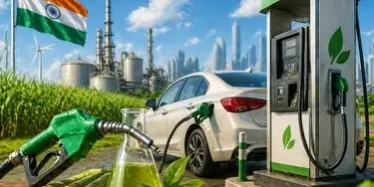
That fuel is E20 petrol blended with 20% ethanol, which became the only option available at nearly all of India’s 90,000 petrol pumps from April 2026. And on June 5, Petroleum Minister Hardeep Singh Puri took it a step further, launching E85, a blend with 85% ethanol, at a Delhi petrol station, calling it a milestone for clean energy. Watching the coverage, I found myself genuinely uncertain: Is this a triumph or a trap? So I went looking for answers in the government’s own documents, and what I found was more complicated than either the celebrations or the complaints suggest.
Ethanol blending shaping self reliance
The case for ethanol blending is real. India imports roughly 85% of its crude oil. Every litre of petrol that ethanol displaces is a litre we do not have to buy from the ever-changing global markets, especially now when West Asia tensions are keeping supply chains at bottlenecks and anxious. The government says the blending programme has already saved nearly ₹1.85 lakh crore in foreign exchange. NITI Aayog’s own life-cycle study found that sugarcane-based ethanol emits 65% fewer greenhouse gases than petrol. These are not small numbers.
Add to this the farmer angle. Ethanol is largely produced from sugarcane and surplus grain. Payments of over ₹40,600 crore have reportedly gone to farmers through the programme. For a country where agricultural distress has long been a crisis, a policy that creates steady, government-backed demand for farm produce is genuinely valuable. I do not think critics should dismiss this so casually.
But here is where things get uncomfortable.
The Bigger picture
The NITI Aayog’s own 2021 roadmap, the foundational document behind this entire programme recommended that E20-tuned vehicles be available in the market from April 2025, and that lower ethanol blends should continue to be available for older vehicles during the transition. Neither happened on schedule. The government made E20 mandatory across all pumps before a significant share of the fleet was compatible, and quietly removed E5 and E10 from most stations, leaving older vehicle owners with no alternative.
The same report projected a mileage loss of 6 to 7% for four-wheelers not calibrated for E20, and 3 to 4% for two-wheelers. It recommended pricing ethanol-blended fuel lower than regular petrol to compensate consumers. That recommendation was also not implemented for E20 the blended fuel was sold at the same price as the petrol it replaced, even though it delivers less energy per litre.
A survey covering over 42,000 vehicle owners across 316 districts found that 52% have spent ₹5,000 or more in additional fuel and repair costs since the E20 rollout. Nearly three in ten reported unusual engine wear. These are not just few complaints , these are consequences of rolling out a fuel blend without completing the necessary ground work, that were predicted long before by the government’s own experts and researchers.
The E85 Blend comes into the frame
Then there is the E85 question. E85 is not just a higher blend; it is an entirely different proposition. It cannot be used in regular petrol engines at all. It requires flex-fuel vehicles with specially upgraded injectors, fuel pumps, sensors, and engine calibration. Right now, the only mass-market car that supports E85 is the newly unveiled Maruti Suzuki Wagon R Flex Fuel, which is currently available only for commercial fleet operators. Hero MotoCorp has launched flex-fuel versions of the Splendor+ and HF Deluxe. For everyone else, which is nearly everyone: E85 is, at this moment, irrelevant.
The government has priced E85 at roughly ₹20 cheaper per litre than E20, and frames this as a consumer benefit. But E85 delivers about 25 to 30% fewer kilometres per litre than petrol. Brazil, which has run the world’s most successful ethanol programme for over four decades, uses a simple consumer rule: ethanol is only worth it if it costs less than 70% of petrol’s price. At that threshold, the mileage loss is offset by the savings. India has no equivalent transparency mechanism at pumps. Consumers are expected to calculate this themselves or simply trust the government’s framing.
What needs to be done
None of this means the policy should be scrapped, it means it needs to be done in the right order. Restore lower ethanol blends as an option for pre-2023 vehicles while the fleet naturally transitions. Price E20 lower than regular petrol, as NITI Aayog recommended five years ago. Display cost-per-kilometre figures at every E85 pump so consumers can make a real choice. Create a modest subsidy for middle-class vehicle owners to upgrade fuel system components on older bikes and cars. And reduce dependence on sugarcane: a crop that requires nearly 2,860 litres of water to produce one litre of ethanol by scaling up second-generation ethanol from crop residue and agricultural waste.
Brazil took four decades to build its ethanol ecosystem. India is trying to do it in four years. The ambition is admirable. But my neighbour’s bike is running on a policy that was not quite ready for him, and he, like most middle-class Indians, had no say in that decision.
The spirit of this transition is right. The sequence just needs to catch up.