Strategic Report: Defence & Security, including Defence Manufacturing Capability Building
Date: August 12, 2026
Location: Gyan Kunj, Swadeshi Shodh Sansthan, ITO, New Delhi 110002
Topic: Defence & Security, including Defence Manufacturing Capability Building
Proceedings of the Opening Ceremony
The session opened with the Deep Prajvalan, the ceremonial lighting of the lamp, signifying the transition from the darkness of ignorance to the illumination of strategic clarity.
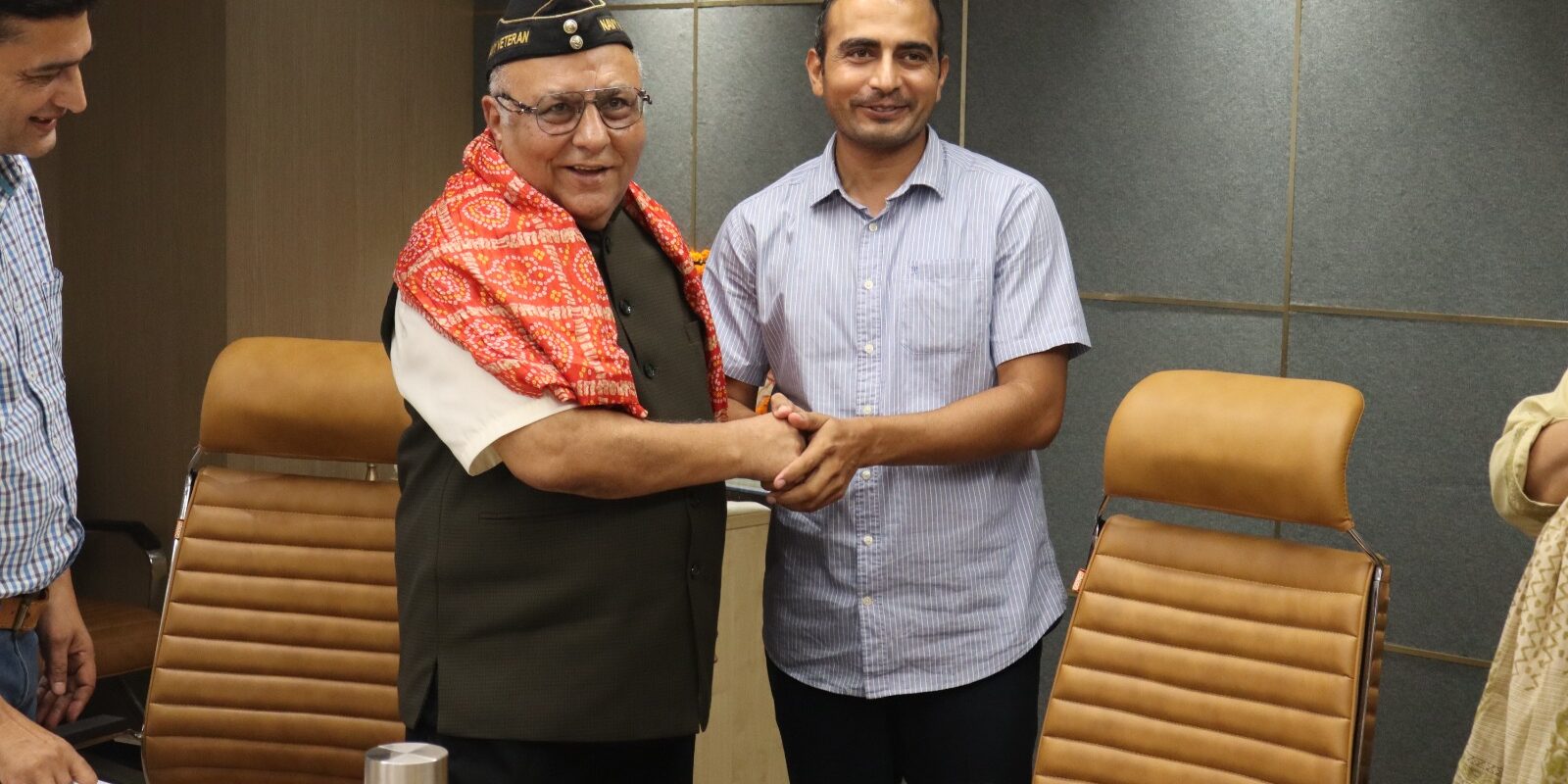
The formal welcome address was delivered by Professor Nandini Kapoor, who presented Cdr Dr Bhushan Dewan with Swadeshi literature, reinforcing the institutional mission of the Swadeshi Shodh Sansthan. The Rapporteur noted the presence of a diverse cohort of interns from Daulat Ram College (DRC). This marked the integration of academic research with national security policy.

Keynote Speaker Address: Cdr Dr Bhushan Dewan
Strategic Personalisation: Academic Linkages
Dr Dewan employed a personalised pedagogical strategy, mapping the interns’ research interests to critical defence paradigms. This approach emphasised that national security is a multidisciplinary endeavour:
- Economics: Linked to the analysis of non-tariff barriers. The Rapporteur noted the use of labour and environmental standards (e.g., child labour allegations in the Bhadohi carpet industry) as geoeconomic tools used by foreign powers to restrict Indian market access.
- Environment and “Blue Economy”: Dr Dewan underscored the strategic importance of the Exclusive Economic Zone (EEZ), which extends 200 nautical miles from the continental shelf. This area is critical for securing underwater minerals and fisheries, forming the backbone of the Blue Economy.
- Philosophy: Addressed as the foundation of the “Man Behind the Machine” doctrine, emphasising the human element in high-tech decision-making.
- Mathematics & Employment: Linked to precision ballistics and the stabilisation of the domestic industrial base through MSME participation and the TReDS (Trade Receivables Discounting System) scheme.

The Evolution of Modern Warfare and Technological Disruptions
The report identifies a decisive shift from imperialistic troop-heavy models to high-tech, technology-driven combat.
A. Network-Centric Warfare (NCW) and the Sensor-to-Shooter Loop
Modern victory is predicated on the Sensor-to-Shooter loop, where satellites, drones, and ground sensors feed real-time data into an integrated network. This enables automated target allocation, often bypassing human reaction times through AI-driven command systems.
B. Asymmetric Warfare and Anti-Ballistic Missile Defence (ABMD)
The Rapporteur noted the massive cost disparity in modern combat. A drone costing 10,000 can force a defender to use an interceptor missile costing 2 million. To counter this, advanced systems such as C-RAM (Counter Rocket, Artillery, and Mortar) and CIWS (Close-In Weapon System) are required to neutralise threats at split-second speeds.
C. Electronic Warfare (EW): The “Cat and Mouse” Game
Warfare is now a contest of ECM (Electronic Countermeasures) and ECCM (Electronic Counter-Counter-Measures). This includes the use of Stealth technology (radar-absorbent materials) and jamming techniques designed to blind enemy sensors.
D. Subsurface Warfare: The Physics of “Shadow Zones”
In underwater Sonar (Sound Navigation and Ranging), sound waves undergo refraction due to layers of temperature, salinity, and pressure. These physical shifts create “Shadow Zones”—blind spots where sound cannot penetrate—which submarines use to evade detection.
5. Atmanirbhar Bharat: The Strategic and Economic Imperative
The lecture posited that self-reliance is the only path to true sovereignty, shifting defence from a “cost centre” (salaries/pensions) to a “profit centre“ (manufacturing/exports).
A. Economic Synthesis: Nominal GDP vs. PPP
While India’s nominal GDP is approximately 4 trillion, its strategic weight is best measured in **Purchasing Power Parity (PPP)**, where it stands at approximately **14 trillion**. This PPP advantage allows India to achieve high-value strategic milestones at a fraction of the cost of Western counterparts.
Comparative Strategic Cost Efficiency:
| Program | Indian Equivalent (Approx.) | Western/US Equivalent |
| Mars Mission (MOM) | ~$10 Million | ~$100 Million |
| Software/IT (Hourly) | ~$20 per hour | $40 – $100 per hour |
| Labor/Manufacturing | Low-cost/High-Innovation | High-cost/Infrastructure-heavy |
B. Vulnerability Analysis: The “Broken Pin” Scenario
Dr Dewan highlighted the peril of import reliance through the “broken pin” anecdote: in a complex missile system, the failure of a single domestic supply link—even a small pin—can render a billion-dollar asset useless if the spare must be imported. This risk was exacerbated by the Ukraine-Russia conflict, which cut off critical spare parts for Soviet-era equipment. Furthermore, foreign “lock-in” remains a threat; for instance, refusal to share source code (the “black box” issue) prevents India from modifying imported platforms like the Rafale to suit local battlefield conditions.
The 5 Levels of National Defence Capabilities
To achieve sovereign immunity, India must ascend through five levels of industrial capability:
- Level 1: Basic Assembly: Integrating imported sub-systems (e.g., assembling CKD kits).
- Level 2: Component Manufacturing: Domestic production of major physical parts (hulls, airframes).
- Level 3: Design Authority: Ownership of software interfaces and source code for domestic modification.
- Level 4: Intellectual Property (IP): Full legal and technical ownership of underlying patents.
- Level 5: Complete Sovereign Ecosystem: A robust network of private giants and MSMEs capable of sustaining high-intensity production without foreign intervention.
Policy Frameworks and Ecosystem Enablers
The following instruments drive the transition to Atmanirbhar Bharat:
- DAP 2020: The Defence Acquisition Procedure, which prioritises domestic procurement.
- Positive Indigenisation Lists: A strategy where thousands of items (60,000+ identified across various tiers) are progressively banned from import to stimulate local manufacturing.
- iDEX (Innovations for Defence Excellence): A platform for startups to engage in solving high-end defence challenges.
- TReDS Scheme: A critical mechanism for MSMEs, allowing them to discount invoices and maintain the working capital required for long-cycle defence projects.
- FDI Reforms: The automatic route for Foreign Direct Investment is now capped at 74%, facilitating joint ventures without sacrificing national oversight.
8. Concluding Reflections and Formal Closure
Dr Dewan synthesised the lecture with a reflection on the “Dualistic Requirement of Combat.” He defined this as the balance between “Josh” (Valour/Aggression) and “Hosh” (Strategic Consciousness/Discipline). Technology, in this framework, serves as a form of discipline that moderates raw aggression.
Cultural and Ethical Warnings:
- Resource Exploitation: Referencing the film Avatar, Dr Dewan warned against the use of advanced technology for the mere exploitation of resources.
- Arms Lobbying: He cautioned against the global arms lobby, which thrives on prolonged conflicts and “marketing” war to sovereign nations.