
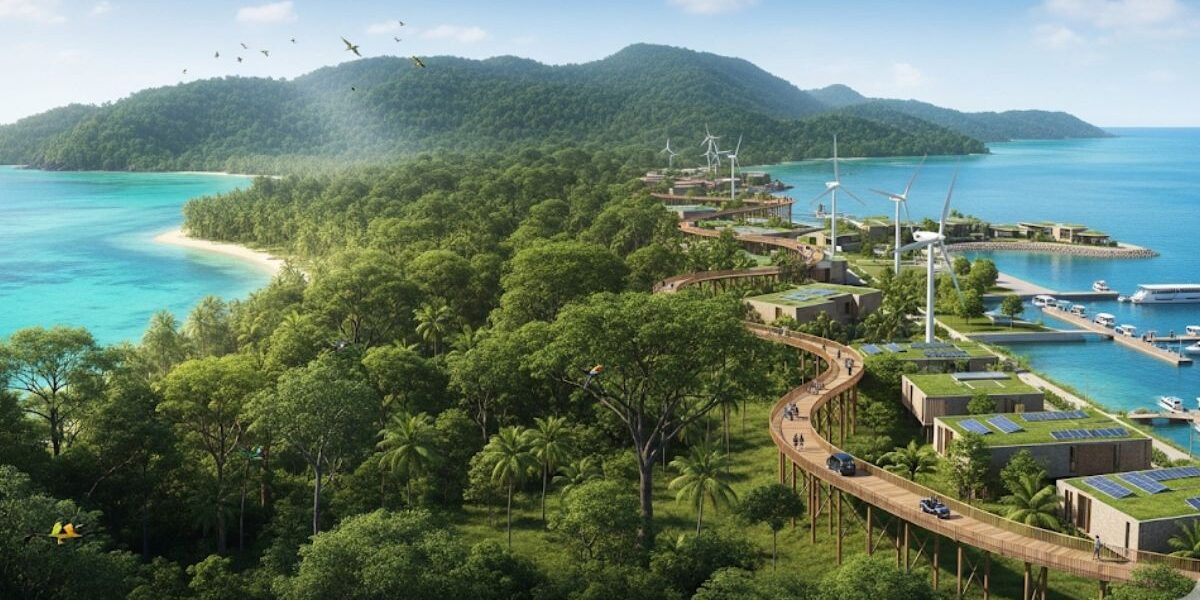
Geopolitical Blueprint: Transforming Great Nicobar Island into India’s Strategic Sentinel
By Leena
Research Associate, Swadeshi Shodh Sansthan.
Introduction
The Andaman and Nicobar archipelago, once viewed primarily as an isolated maritime outpost, is currently the site of independent India’s most ambitious geostrategic endeavour. Driven by NITI Aayog and executed by the Andaman and Nicobar Islands Integrated Development Corporation (ANIIDCO), a massive $9–$10 billion (approximately ₹72,000–₹81,000 crore) mega-infrastructure project is underway on Great Nicobar Island (GNI). In terms of national security, the strategic weight of this island is paramount and unparalleled.
However, as blueprints transition into heavy construction on the ground, GNI has become a critical flashpoint for an intense domestic debate. The project forces a high-stakes balancing act: securing India’s maritime frontiers against an expansionist superpower while navigating severe, deep-rooted environmental fractures and indigenous tribal vulnerabilities at the grassroots level.
1. The Strategic Imperative: Forward Deterrence and the Malacca Axis
The foremost driver behind the GNI project is its peerless value to national security, functioning as a direct strategy to project power and counter regional naval expansionism.
A. The “Choke Point” Advantage and the Malacca Dilemma
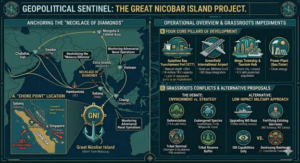
Great Nicobar Island is situated a mere 40 nautical miles away from the Malacca Strait, globally recognized as one of the busiest and most critical maritime choke points on Earth. This narrow corridor acts as the maritime jugular vein for East Asian economies:
- Trade Volumes: Approximately 30% of all international maritime trade transits through this strait.
- Energy Vulnerabilities: The strait carries the overwhelming majority of the energy resources and raw materials required to sustain major external economies.
By establishing a robust, permanent military infrastructure on GNI, India positions an effective sentinel at the mouth of the strait. In the event of a geopolitical crisis or a war-like situation, this forward deployment grants the Indian Armed Forces the direct capability to monitor, track, or interdict adversarial naval operations, turning an opponent’s shipping bottlenecks into a tangible strategic liability.
B. Fortifying the Forward Operational Base
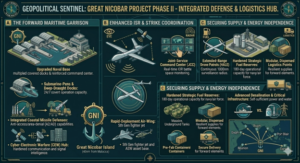
The GNI project serves as India’s ultimate maritime forward operational base to disrupt external encirclement. By embedding a state-of-the-art, dual-use military-civilian airport alongside advanced radar and electronic surveillance centers, the Indian Navy and Air Force can project power and exert sustained tactical pressure deep into Southeast Asia and the wider Indo-Pacific.
2. Institutional Policy Alignment and Logistics Deterrence
The development of GNI is not an isolated regional initiative; it is a vital operational component of India’s broader defensive doctrine, designed to anchor a network of strategic deepwater access points and multilateral security partnerships.
GNI bridges the geographic gaps between India’s key maritime checkpoints:
- The Sabang-Changi Axis: It links directly with India’s deep-water access at Sabang (Indonesia) and institutionalized logistics access at the Changi Naval Base (Singapore), completing a continuous maritime arc of deterrence across the eastern entry points of the Indian Ocean.
- Overcoming Logistical Impediments: Historically, a lack of domestic deepwater ports has been a severe commercial and logistical impediment to India. Currently, almost all of India’s international transhipment cargo is forced to route through foreign hubs like Colombo or Singapore, draining domestic revenue and creating strategic dependencies.
- The Transhipment Game-Changer: The development of the Galathea Bay International Container Transshipment Terminal (ICTT)—boasting a natural depth of over 20 meters—is designed to handle the world’s largest cargo vessels. This infrastructure turns GNI into a dual-purpose asset: an economic maritime hub that integrates India directly into global supply chains, backed by hard military deterrence.
3. The Core Dialectic: Ecological Deterioration vs. State Survival Imperatives
At the heart of the Great Nicobar Island project lies a fundamental conflict in governance: the trade-off between long-term ecological preservation and immediate national security imperatives. This tension represents a profound policy dilemma where two vital national interests directly collide.
- The Environmental Perspective (Ecological Deterioration): Conservationists and environmental legal bodies argue that the scale of the greenfield intervention will cause irreversible damage to a globally recognised ecological hotspot. The construction layout mandates the diversion of roughly 130 square kilometres of pristine tropical rainforest, requiring the phased felling of an estimated 7 to 9.6 lakh trees. Galathea Bay is globally recognised as a critical nesting ground for the endangered Leatherback Sea Turtle and the endemic, ground-nesting Nicobar Megapode bird. Critics argue that the destruction of primary rainforest cannot be mitigated by mainland afforestation, as the microclimates and endemic biodiversity are non-transferable. From this viewpoint, compromising ecological integrity for infrastructure introduces long-term systemic environmental instability.
- The Security Perspective (State Survival Imperative): From a realist strategic standpoint, national security and territorial integrity are the absolute prerequisites upon which all other state functions, including environmental governance, depend. Proponents of this view argue that the geographic window of opportunity to counter external naval dominance at the mouth of the Malacca Strait is fixed. Any delay or reduction in the project’s scope to accommodate environmental concerns is seen as a compromise on forward defence capabilities, leaving a critical maritime gateway vulnerable to external power projection.
4. Ground Reality: Statutory Disputations and Grassroots Friction
Despite its profound strategic justification, the project faces intense friction on the ground. Grassroots realities, legal challenges, and environmental concerns have sparked severe pushback, emphasising that national security often comes at an immense local cost.
Corroborating the Tribal Consent Dispute
A deeply troubling aspect of the grassroots data involves the island’s indigenous populations, specifically the Shompen (a Particularly Vulnerable Tribal Group, or PVTG) and the Southern Nicobarese. This intersection has emerged as a significant legal battlefield concerning compliance with the Scheduled Tribes and Other Traditional Forest Dwellers (Recognition of Forest Rights) Act, 2006 (FRA):
- The Quorum Deficit: Active legal challenges filed in the Calcutta High Court argue that the administrative “Gram Sabha” consent obtained to clear tribal reserve land was procedurally flawed and legally void. Critics highlight that these historically isolated communities do not read or speak administrative languages, nor do they comprehend complex modern legal concepts like “land diversion” or “statutory compensation”.
- Structural Jurisdiction: The legal challenge points out that the indigenous populations are traditionally represented through institutionalised Tribal Councils rather than the mainland system. The Shompen are an isolated hunter-gatherer community whose survival relies entirely on the integrity of the pristine forest.
- Demographic Influx Concerns: The rapid influx of hundreds of thousands of construction workers, followed by a projected civilian township population of up to 6.5 lakh people by 2050, presents an existential threat, risking cultural erasure and exposure to external diseases.
5. Strategic Resolution: Reconciling the Security-Sovereignty and Ecological Balance
Resolving the dialectic between hard frontier security and ecological preservation requires moving away from traditional greenfield industrial expansion in favour of a highly targeted, technology-driven defence framework. Policy analysts suggest that India can achieve identical maritime deterrence while minimising regional ecological degradation through three institutional mechanisms:
A. Implementing Asymmetrical Defence and Targeted Scaling
Instead of creating a resource-heavy, multi-billion-dollar commercial township that introduces vast civilian vulnerabilities and accelerates deforestation, India can scale up its Asymmetrical Anti-Access/Area-Denial (A2/AD) capabilities.
- Optimising INS Baaz: By prioritising the trebling of the existing runway at INS Baaz (Campbell Bay), the military can accommodate 5th-generation fighter detachments and long-endurance maritime surveillance assets without entering pristine rainforest reserves.
- Decentralised ISR Frameworks: Expanding low-impact forward sensor garrisons at INS Kohassa and INS Cardip allows for complete Maritime Domain Awareness (MDA) over the Malacca Strait via advanced radar and unmanned aerial vehicles (UAVs) rather than massive physical footprints.
B. Zoned Militarisation vs. Commercialisation
A critical resolution pathway involves decoupling necessary military installations from commercial expansion. By limiting the project layout strictly to essential dual-use logistics hubs and advanced electronic warfare centres, the state dramatically shrinks the overall land diversion requirement. This targeted approach achieves geopolitical enforcement goals while leaving the primary, ancient rainforest ecosystem intact outside the immediate military perimeter.
C. Statutory and Institutional Recalibration
To address the procedural and structural disputes surrounding indigenous rights, the local administration can formalise a transparent reconciliation framework:
- Direct Tribal Council Engagement: Moving past third-party administrative proxies, the state can establish direct, structured dialogue with the Tribal Councils to co-create sustainable perimeter security zones.
- Enforcing Absolute Buffer Basins: By legally cementing strict, zero-contact isolation zones for the Shompen community and utilising localised coral translocation models, the state can demonstrate that frontier fortification does not necessitate cultural or ecological erasure.
6. Environment vs. Security: Beyond a False Binary
The Great Nicobar Island Project has generated a significant debate between environmental conservation and national security. However, framing the issue as a simple choice between the two is misleading. Contemporary security studies increasingly recognise that ecological sustainability and national security are deeply interconnected. Environmental degradation, climate vulnerabilities, and biodiversity loss can themselves emerge as long-term security threats. Therefore, India’s objective should not be to choose between security and environmental protection, but to integrate both within a comprehensive strategic framework.
Theoretical Perspectives
From an Indian perspective, strategic thinkers such as C. Raja Mohan have emphasized that maritime security in the Indo-Pacific cannot be separated from sustainable management of maritime spaces. As India’s geopolitical footprint expands, environmental stewardship becomes an essential component of responsible power projection.
International Examples of Security-Environment Balance
Several countries have demonstrated that strategic military infrastructure can coexist with ecological preservation:
United States:Guam and Hawaii
The United States maintains significant naval and air force installations in environmentally sensitive island territories. Through environmental impact assessments, protected wildlife zones, and habitat restoration programmes, military preparedness is balanced with ecological conservation.
Singapore: Changi Naval Base
Singapore has expanded its maritime infrastructure while integrating sustainability measures, coastal protection systems, and rigorous environmental monitoring. The Changi model demonstrates how strategic infrastructure can be developed within strict environmental safeguards.
Australia: Northern Territory Defence Installations
Australia’s defence infrastructure in ecologically sensitive regions incorporates biodiversity assessments and indigenous consultation mechanisms before major projects are undertaken.
Why the Great Nicobar Project Need Not Harm the Environment
The strategic benefits of Great Nicobar can be realised through a calibrated development model that minimises ecological disruption:
- Concentrating infrastructure within carefully designated zones rather than large-scale land conversion.
- Utilising green construction technologies and renewable energy systems.
- Preserving critical nesting habitats for the Leatherback Sea Turtle and other endemic species.
- Maintaining strict ecological buffer zones around sensitive forests and tribal reserves.
- Employing satellite-based environmental monitoring and AI-driven ecosystem assessment tools.
- Adopting sustainable port operations that reduce marine pollution and habitat degradation.
The project should evolve as a model of “Green Strategic Infrastructure”, demonstrating that national security objectives can be pursued without compromising ecological integrity.
What India Should Do
To ensure a balance between strategic requirements and environmental responsibility, India should adopt the following measures:
- Prioritize Security-Centric Development
Focus primarily on military logistics, surveillance facilities, dual-use airports, and transhipment infrastructure while avoiding unnecessary urban expansion. - Strengthen INS Baaz as the Strategic Core
Rather than extensive greenfield construction, India can expand existing military facilities at INS Baaz and integrate advanced maritime surveillance systems, drones, and radar networks. - Establish a Great Nicobar Ecological Security Authority
A specialised institution comprising defence officials, environmental scientists, tribal representatives, and policy experts should oversee implementation and compliance. - Protect Indigenous Communities
Direct consultation with Tribal Councils must be institutionalised. The rights, culture, and health of the Shompen and Nicobarese communities should remain non-negotiable components of project planning. - Implement Continuous Environmental Auditing
Independent environmental reviews should be conducted periodically, with findings made publicly available to ensure transparency and accountability. - Promote a Blue Economy Strategy
Marine conservation, scientific research, sustainable fisheries, and eco-tourism can complement the island’s strategic role while generating economic benefits.
Towards a Model of Sustainable Strategic Development
Professor Amitav Acharya’s concept of a cooperative and inclusive Indo-Pacific suggests that great powers must balance strategic ambition with responsible governance. The Great Nicobar Project offers India an opportunity to demonstrate precisely this balance. If implemented thoughtfully, the island can emerge not merely as a military outpost but as a global example of sustainable strategic development.
Conclusion
The Great Nicobar Island project stands at India’s most complex geopolitical crossroads. It highlights a profound state dilemma: the urgent, undeniable requirement to build hard military deterrence against an expansionist naval superpower, contrasted against the ethical, constitutional, and ecological responsibility to protect the planet’s most vulnerable indigenous tribes and pristine ecosystems. The real challenge for India is not security versus environment, but security through environmental sustainability. A development strategy that protects biodiversity, respects indigenous rights, and minimizes ecological disruption while strengthening maritime deterrence will enhance India’s credibility as both a leading Indo-Pacific power and a responsible global actor. Great Nicobar can therefore become a symbol not only of strategic strength but also of sustainable statecraft.
References
- Press Information Bureau. (2026, May 1). Great Nicobar Project: FAQs [Press release]. Union Ministry of Home Affairs, Government of India.
- Ramesh, J. (2026, May 17). The Great Nicobar Island Project, in its present shape and form is a recipe for ecological disaster [Official Correspondence to Raksha Mantri Rajnath Singh]. Public Domain Transcript via ANI News.
- Unnithan, S. (2026, May 16). The dual-use Great Nicobar Island Project: Strategic maritime and economic hub vs. ecological footprint. India Today.
- Ministry of Ports, Shipping, and Waterways. (2023). Expression of Interest (EoI) Issued for International Container Transhipment Port (ICTT) at Galathea Bay, Great Nicobar Island [Press release]. Press Information Bureau, Government of India.
- NITI Aayog & Ministry of Shipping. (2021). Holistic Development of Great Nicobar Island in Andaman and Nicobar Islands [Press release]. Press Information Bureau, Government of India.
- Ministry of Defence. (2025). Strengthening Tri-Service Command Capabilities: Operational Infrastructure Scaling at INS Baaz, Campbell Bay [Press release]. Press Information Bureau, Government of India.
- Ministry of Environment, Forest and Climate Change. (2022). Statutory Clearances and Environmental Safeguards for the Mega Infrastructure Project at Great Nicobar Island [Press release]. Press Information Bureau, Government of India.
- Ganguly, S. (2026). India environment: The challenge of the balance. In Survey of India 2026 (Ch. 7). Hoover Institution Press.