
First National Webinar
“India–US FTA Framework and the Mother of All Deals”
Organised by: Swadeshi Shodh Sansthan, Karnataka Chapter | Date: 14 March 2026 | Mode: Online
This webinar deliberated on the evolving dynamics of India’s trade engagements with major global partners, analysing the economic and strategic implications of free trade agreements. It drew active participation from economists, academicians, and research scholars across Karnataka, Telangana, and Andhra Pradesh.
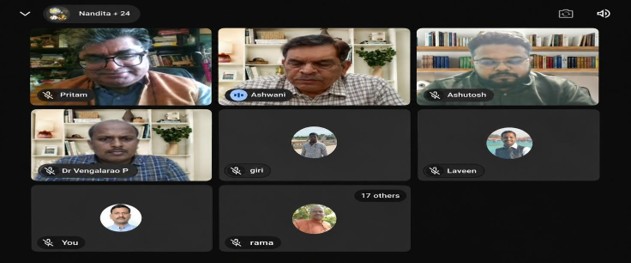
- Dr. Pritam Banerjee: Head of the Centre for WTO Studies, Centre for Research in International Trade, addressed both the India–EU trade negotiations (market access, regulatory standards, trade facilitation) and the emerging India–US trade framework (tariffs, regulatory alignment, digital trade, and services).
- Dr. Ashwani Mahajan: National Co-Convenor, Swadeshi Jagran Manch, delivered the keynote, reflecting on how India’s approach to trade agreements has evolved and stressing the need to weigh long-term impacts on domestic industry, employment, and national interest.
Second National Webinar
“Energy Security, the Green Energy Rebound Effect, and India’s Roadmap to Renewable Leadership”
Organised by: Swadeshi Shodh Sansthan, Karnataka Chapter | Date: 26 June 2026 | Mode: Online
This National Webinar brought together researchers, policymakers, academicians, industry professionals, and students from across the country — including Karnataka, New Delhi, Telangana, Bihar, Jharkhand, Punjab, and Maharashtra — to deliberate on ensuring India’s energy security while accelerating the transition to clean and renewable energy.
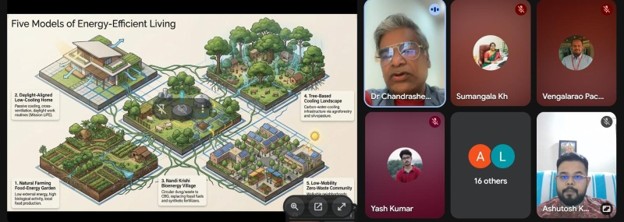 Keynote address by Dr. Chandrashekhar M. Biradar on “Five Models of Energy-Efficient Living”
- Opening Remarks: Convenor Ashutosh Kashyap opened by framing energy security amid geopolitical uncertainty and the need to understand the Green Energy Rebound Effect.
- Keynote I: Chandrashekhar M. Biradar presented a “Nature Positive Pathway” built on Clean Energy Generation, End-use Energy Efficiency, Energy Sufficiency, and Ecosystem Regeneration — introducing concepts such as “Nandi Krishi”, Living Solar Infrastructure, and Rural Energy Sovereignty.
- Keynote II: Shri Labanya Prakash Jena examined energy security through Reliability, Affordability, and Sustainability, and detailed the Direct and Indirect Green Energy Rebound Effects along with a policy roadmap covering carbon pricing, grid modernisation, and energy storage.
- Q&A Session: A 20-minute interactive Q&A session engaged participants on renewable deployment, rural energy systems, climate finance, and India’s long-term energy strategy.
Third National Webinar
“Temple Economy: Reviving India’s Indigenous Economic Institutions”
Organised by: Swadeshi Shodh Sansthan, Karnataka Chapter | Date: 23 August 2026 | Mode: Online
Welcome Address
Mr. Ashutosh Kashyap welcomed the participants, introduced the objectives of the Dattopant Thengadi National Webinar Series, and highlighted the relevance of Temple Economy in India’s indigenous economic thought. He also introduced Dr. S. Lingamurthy, Associate Professor at the Central University of Karnataka, noting his contributions to the field of temple economics.
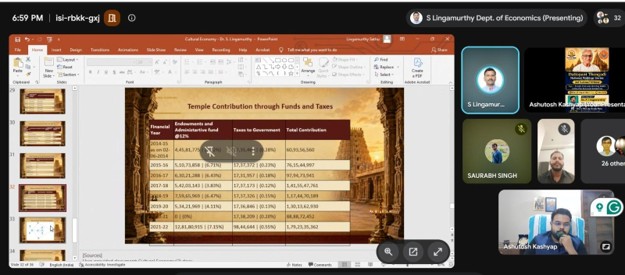
Temple Economy as an Indigenous Economic Model
Dr. S. Lingamurthy explained that temples have historically served as centres of finance, education, healthcare, trade,
employment, and social welfare. Drawing upon Kautilya’s Arthashastra, he highlighted the integration of Artha and Dharma as the foundation of India’s indigenous economic framework.
Cultural Economy and Regional Development
The speaker introduced the concept of the Cultural Economy, emphasising its contribution to traditional industries such as handicrafts, floriculture, textiles, food processing, and pilgrimage tourism. Case studies of Vemulawada, Ayodhya, Tirumala, and other temple ecosystems illustrated how temples stimulate employment, infrastructure development, and local economic growth.
Interactive Discussion
The webinar concluded with an engaging discussion on the use of Artificial Intelligence for preserving temple knowledge, temple governance, and future research opportunities in temple economics. Participants were encouraged to undertake empirical research on indigenous economic institutions and their developmental impact.