Session Detail
Date: 26th April 2026
Time: 10:00 AM to 11:00 AM
Moderator: Shri Gagan Kumar
Session: 1
Theme: A strong Advocate of Global Brotherhood
This session critically examined how India’s deeply rooted cultural values offer a more sustainable and compassionate model for global development compared to Western frameworks. The session was chaired by Shri Gagan Kumar, featuring Dr. Nagendra Kumar, Shri Satish Chawla, and Shri Dharmendra Dubey as the key speakers.
- Shri Gagan Kumar (Session Chair): The Flaws of Western Models and the Essence of Mutual Trust
Shri Gagan Kumar, a leading chartered accountant and advocate, challenged the global admiration for Western capitalist models.
- Critique of Capitalism: Using the United States as a prime example, he presented sobering statistics that challenge its status as a role model. He highlighted that despite being a $30 trillion economy, the US suffers from over 100% household debt, a broken family system with more than 21% single mothers, high rates of gun violence, and nearly 12% of its adult population relying on antidepressants.
- Economic Imperialism and the Dollar: He pointed out that Western nations have frequently caused global disruptions and bombed countries in the Middle East (like Iraq, Libya, and Syria) purely for economic benefits and to maintain the hegemony of the US Dollar.
- The Indian Alternative: In contrast, he recited the Vedic mantra “Sahana Bhavatu” (May we be protected and nourished together), explaining that the Indian ethos is about “us” rather than “me”. He stressed that true global brotherhood and fraternity rely heavily on mutual trust within society, trusting fellow citizens, doctors, and legal systems—which is the foundation India must rebuild to compete globally.
- Dr. Nagendra Kumar (IIT Roorkee): Moving Beyond Identities for True Brotherhood
Dr. Nagendra Kumar emphasized that India’s values are unmatched globally, drawing upon his international experiences where Western scholars asked him to explain concepts based on Indian knowledge traditions.
- War as a Human Tragedy: He stated that in the philosophy of Vasudhaiva Kutumbakam (the world is one family), a destructive war happening anywhere in the world is a crisis for all of humanity, not just an isolated geopolitical event. India’s advocacy for peace is a reflection of its core values, not a sign of weakness.
- Rising Above Micro-Identities: He urged the youth to realize that “charity begins at home”. To achieve global brotherhood, Indians must first rise above their rigid regional, linguistic, and caste-based identities to see the shared self in everyone.
- Mindful Prosperity: Addressing global challenges like climate change, he noted that economic prosperity alone cannot save the world if it creates “many Americas” that consume weak nations. Quoting Mahatma Gandhi, he reminded the audience: “There is enough for our need but not enough for anybody’s greed”.
- Shri Satish Chawla (Swadeshi Swavalamban Nyas): Family Values and National Self-Reliance
Shri Satish Chawla contrasted the fragmented modern lifestyle with the Indian ideal of a united family and nation.
- The Elon Musk Analogy: To illustrate the pitfalls of pure material wealth, he used the example of Elon Musk. Despite being the richest man globally, Musk suffers from a broken family structure, with estranged children and a highly disjointed personal life. Shri Chawla argued that true brotherhood starts with eating together as a family, which then scales up to treating the nation and the world as a family.
- Swarnim Bharatvarsh Foundation: He outlined the various verticals of the Swarnim Bharatvarsh Foundation, urging the youth to become “job providers” instead of “job seekers”. Noting that organized sector jobs only account for 17-18% of employment, he stressed that entrepreneurship is the only way forward.
- Reversing Brain Drain: He lamented that Indian brains trained on government subsidies are generating trillions of dollars in Intellectual Property (IPR) wealth for the US. He highlighted successful reverse-migration stories, like Sridhar Vembu setting up Zoho in rural India, as the model for “Brain Gain”.
- Shri Dharmendra Dubey (Tripura Central University): India’s Historical Role as a Global Advocate
Shri Dubey concluded the session by summarizing India’s continuous historical role in advocating for global welfare.
- A Legacy of Peace: He reminded the audience that from Emperor Ashoka spreading peace after the Kalinga war to Mahatma Buddha and Mahatma Gandhi’s principles of non-violence, India has always exported civilization and peace, not conflict.
- Knowledge for Welfare, Not Monopoly: He highlighted a stark difference in global mindsets. While the Western world created patent laws to monopolize economic benefits, the Indian tradition (like Ayurveda and Yoga) has never sought patents, focusing solely on giving knowledge for global welfare.
- He praised the Swadeshi Jagran Manch for being the voice of developing nations on global platforms (like the Doha and Cancun conferences), fighting against oppressive patent laws and ensuring equitable access during global crises like the vaccination drive.
Session Detail
Date: 26th April 2026
Time: 11:15 AM to 12:45 PM
Moderator: Dr. Madhur Mahajan
Session: 2
Theme: A Proponent of High Moral Values
Moderated by Dr. Madhur Mahajan, this session explored how India’s deeply rooted ethical values and philosophies are essential for building a truly prosperous and developed nation by 2047.
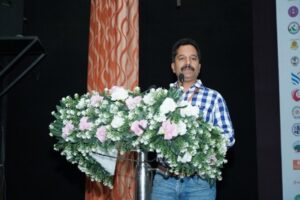
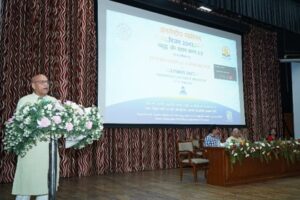
Dr. Madhur Mahajan (Moderator): The “Inside-Out” Philosophy Dr. Mahajan set the tone by citing Upanishadic philosophies like Isha Vasyam Idam Sarvam (the universe is pervaded by God) and Tat Tvam Asi, emphasizing that Indian values are fundamentally “inside-out”—focusing on love, non-violence, and seeing oneself in others. He noted that Pandit Deendayal Upadhyay’s “Integral Humanism” (एकात्म मानव दर्शन) provides the perfect blueprint for inclusive, balanced, and environment-friendly development.
Dr. Nisha Pandey: Dharma-Centric Governance Dr. Pandey discussed the need to shift society’s mindset from a “Right-based approach” (focusing only on what one gets) to a “Duty-based approach” (कर्तव्य बोध). She presented a comprehensive model for a developed Bharat based on five pillars:
- Dharma-centric governance (ethical impact and moral accountability).
- Inclusive economy (uplifting the most vulnerable, reflecting schemes like Ayushman Bharat).
- Ecological balance (respecting nature).
- Cultural grounding (integrating traditional knowledge systems).
- Inter-generational equity (sustainable infrastructure). She also drew strategic lessons on fair taxation, resource mobilization, and crisis leadership directly from the Valmiki Ramayana.
CA Anil Kumar Sharma: The Concept of “Shubh Labh” Shri Sharma addressed the modern conflict between economic development and environmental destruction. He critiqued the Western economic model based on the “YOLO” (You Only Live Once) mindset, which encourages the ruthless exploitation of nature for solitary gain. Instead, he advocated for the traditional Indian business philosophy of “Shubh Labh” (Auspicious Profit)—meaning wealth earned while keeping social and environmental costs to an absolute minimum, rather than chasing profit at any cost. He urged the youth to adopt Guru Nanak Dev Ji’s teaching: “Tirath karo, Naam japo, Vand chhako” (Work hard, remember God, and share with others) as a core economic principle.
Shri Amit Tiwari (OSD to the Governor of Punjab): Roots and Integrity Sharing his personal journey from a small village in Bundelkhand to becoming an aeronautical engineer, a DRDO scientist, an Indian Air Force officer, and currently an OSD, Shri Tiwari emphasized that moral values start at home. He stressed that regardless of how high one rises in their career, the honesty, integrity, and life experiences inherited from parents and grandparents are the true guiding forces that one must implement in their professional life.
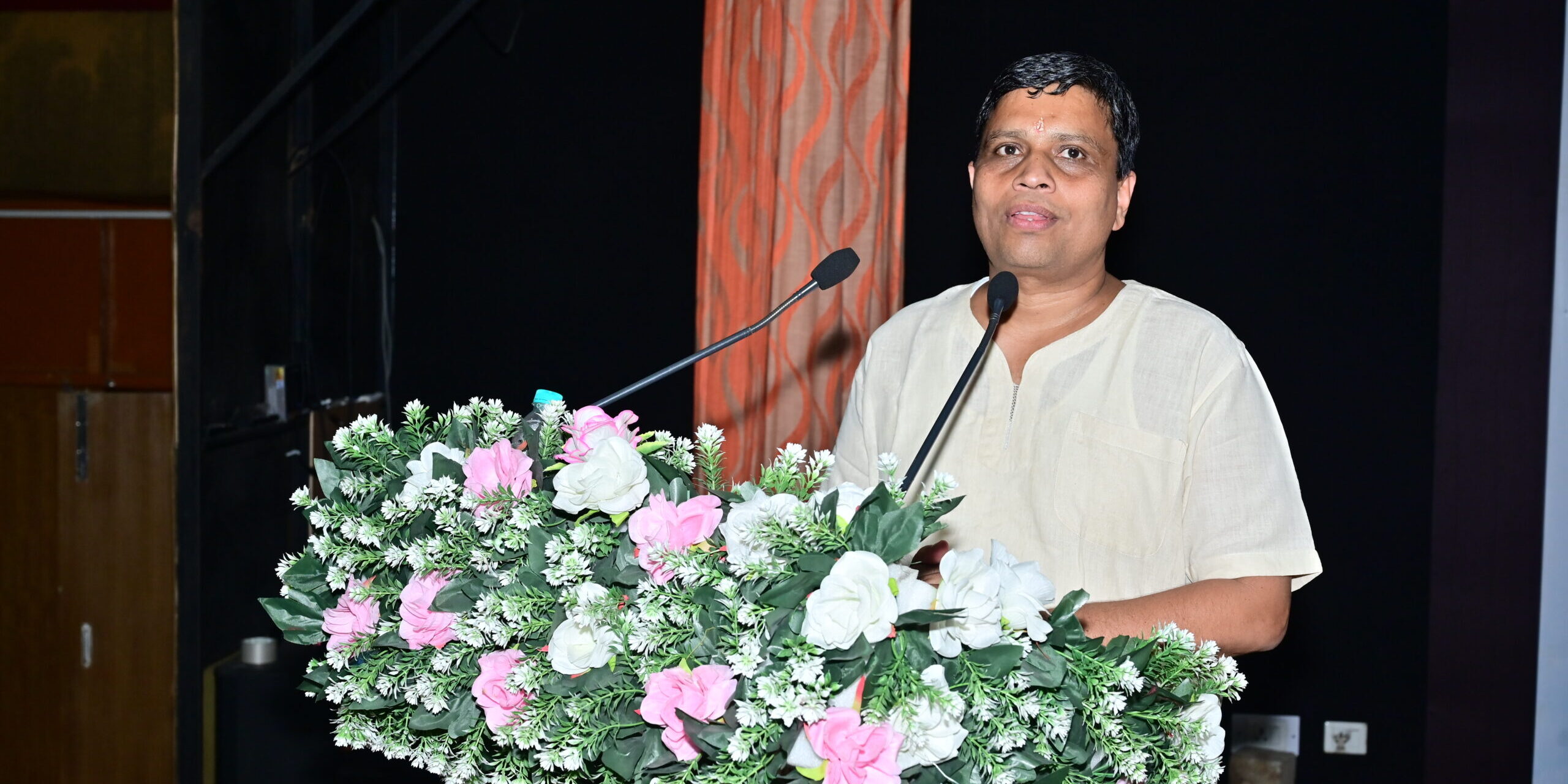
Acharya Balkrishna (Patanjali): Compassion-Driven Entrepreneurship Acharya Balkrishna delivered a highly motivational address, urging students to break free from the colonial mindset of merely seeking administrative jobs and instead focus on becoming job providers.
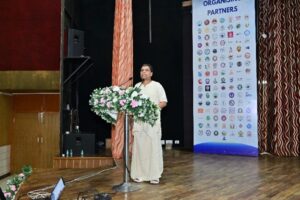
- The Origin of Patanjali: He revealed that Patanjali was not born from a corporate market survey, but from compassion. Years ago, local farmers approached him in distress because their Amla (gooseberry) crops were selling for just ₹5 a kilo and going to waste. By manually extracting juice and creating a market, they built a massive enterprise that today processes 1 lakh tons of Amla, economically uplifting millions of farmers across India.
- Unlocking Local Potential: He shared his recent efforts in Uttarakhand to combat rural migration by planting high-value Sandalwood (Chandan) and Agarwood in barren lands. He also discussed creating traditional bull-driven wooden extractors (Kolhu) for oil, which preserves cancer-fighting compounds that are otherwise destroyed in industrial iron mills.
- He advised the youth to rely on “Akhand Prachand Purusharth” (unbroken, fierce hard work) and warned them against chasing artificial validation through social media likes.
Shri Kashmiri Lal: Integrity Over Shortcuts. Concluding the session, Shri Kashmiri Lal emphasized that money and fame alone do not define success, noting that prominent global figures ultimately seek spiritual grounding.
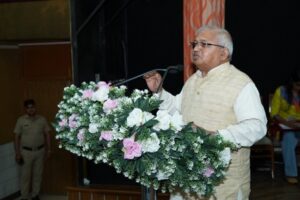
- He praised Sridhar Vembu (Zoho Corporation) as a role model who built a billion-dollar global tech company from a village, proving that true wealth comes from creating jobs.
- To highlight the importance of uncompromised integrity, he contrasted Cristiano Ronaldo, who famously rejected a lucrative Coca-Cola endorsement to promote water and health, with Volkswagen, which faced global disgrace for installing software to cheat on carbon emission tests. He challenged the students to pledge that they will earn their success through relentless honesty rather than shortcuts.
Session Detail
Date: 26th April 2026
Time: 2:30 PM to 4:15 PM
Moderator: Prof Pardeep Singh Chauhan
Session: 3
Theme: Industries Academia Conclave
Keynote Address: Sridhar Vembu on Rural R&D
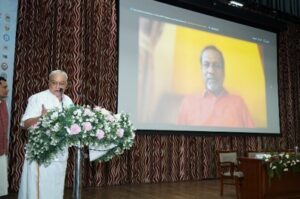
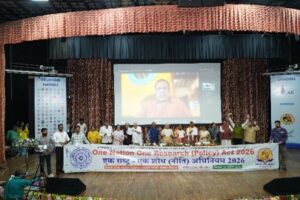
The session began with a major address by Shri Sridhar Vembu (Chairman of Zoho Corporation), who joined virtually. He discussed his successful “Tenkasi model,” which focuses on bringing technology-driven prosperity to rural Bharat.
- The Rural Economic Problem: He diagnosed the core issue of rural economies as a pervasive lack of value addition—farmers sell paddy at low prices but buy manufactured goods like smartphones and tractors at high prices, leaving them with no economic leverage.
- The Solution: Instead of relying on government cash transfers or migration to cities, he advocated for setting up cutting-edge Research and Development (R&D) centers in villages. He shared that his rural centers hire local talent from government schools, who are now building global products and achieving productivity levels higher than typical urban startups.
Release of the “One Nation, One Research Policy”
Following the keynote, the “One Nation One Research Policy” document was officially launched in the presence of the Honorable Minister Shri Dhan Singh Rawat.
- The policy aims to create a centralized national research database.
- The goal is to shift academic research away from just earning degrees and toward solving practical industry and societal problems (like agriculture, water crises, and disaster management), effectively connecting PhD research with product development.
Panel Discussion: Bridging the Industry-Academia Gap
The conclave then transitioned into a panel discussion featuring prominent industry leaders on how to align education with market needs:
- Dr. Shankar Venugopal (Mahindra & Mahindra): He introduced the “PRANA” framework (Productive Research, Reform of Curriculum, Alignment of Institutions, Nurturing Employment, Advancement through Investment). He heavily emphasized “Alignment”—aligning the interests of academia and industry through 5-to-20-year national technology roadmaps, and using AI to match students’ education with their true passions and strengths.
- Shri Mahesh Kaikini (Hero MotoCorp): He noted a critical disconnect: institutions are producing “exam solvers,” while the industry desperately needs “problem solvers”. He stressed that curriculums must teach students how to handle ambiguity, work in cross-functional teams, and make decisions under severe constraints.
- Dr. Bhavani Rao (Amrita Vishwa Vidyapeetham): She brought a unique perspective, arguing that all research should start and end with “compassion” and “respect”. She challenged the industry to mandate skill certificates (like welding or plumbing) to enforce the practical aspects of the National Education Policy (NEP). She also advocated for decentralized research spaces to encourage greater participation from women.
- Dr. Siddharth Sharma (Bharat Global Industrial Forum): He discussed his work in designing collaborative courses with universities that assure 100% employment by directly filling the specific manpower gaps identified by large corporate sectors.
- Shri Vikram Gupta (IVYCap Ventures): He highlighted the critical need for endowment funds to fuel the innovation ecosystem. Sharing his experience setting up India’s first endowment fund at IIT Delhi, he challenged students to commit to funding the education of future generations once they graduate and become successful.
- Engineer Tarun Goyal (IIA): Representing MSMEs, he suggested creating “mini Shark Tanks” and patent-showcasing platforms inside colleges. He also urged academia to focus on reverse engineering and backward integration to reduce India’s reliance on importing Original Equipment Manufacturer (OEM) parts from countries like China and Japan.