Session Detail
Date: 25th April 2026
Time: 10:00 AM to 11:30 AM
Session: 1
Moderator: Dr. Pooja Sharma
Theme: Environment-Friendly Lifestyle
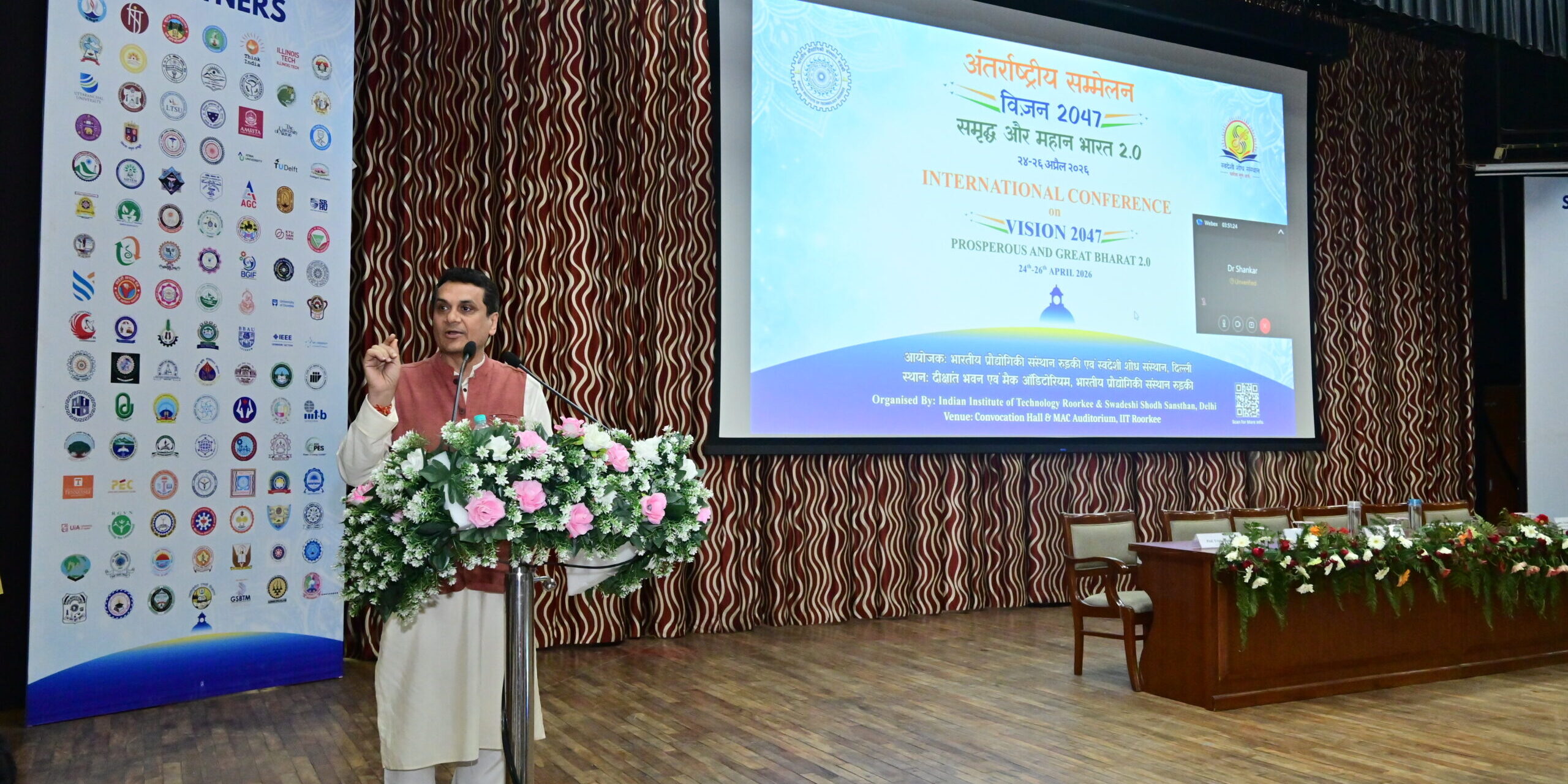
The first session of the second day of the conference was dedicated to the theme of an “Environment-Friendly Lifestyle” (पर्यावरण अनुकूल जीवन शैली). The session explored how daily habits, mindful consumption, and holistic national policies are essential for sustainable development and resource conservation.

Dr. Rajiv Kumar: Practical Daily Habits and Resource Conservation Dr. Kumar emphasized that environmental protection begins with small, daily lifestyle changes. He highlighted several key areas:
- Water and Energy Conservation: He pointed out the habit of serving full glasses of water to guests who only drink half, leading to wastage, and suggested adopting the traditional practice of serving water in a jug so people only take what they need. He also criticized the unnecessary use of air conditioning and lighting, urging a shift to alternative energy sources.
- Reducing Plastic and Petroleum Dependency: He warned against the pervasive use of plastics, which end up being consumed by stray animals like cows, severely impacting their health and the food chain. To save petroleum, he advocated for the use of public transport, carpooling, and dedicating at least one day a week to cycling or walking.
- Promoting Local Products: Dr. Kumar explained that buying locally produced goods significantly reduces the massive energy consumption and pollution associated with transportation, while simultaneously creating local employment.
- The “Bank Balance” Analogy: He beautifully compared natural resources to a “pocket money” allowance rather than a “bank balance”. He warned that if we mindlessly extract resources like an unlimited bank balance, we will face a crisis our future generations cannot survive. He urged citizens to develop a mindset where they give back to the environment as much as they take from it.
Prof. V.C. Srivastava: The Chemical and Ecological Cost of Consumer Choices Speaking from the perspective of a chemical engineer, Prof. Srivastava focused on the hidden environmental impacts of food and clothing:
- Embracing “Ugly” Produce: He noted that human eyes are optimized to pick the best-looking vegetables, but urged consumers to consciously buy imperfect or crooked vegetables. These imperfect vegetables are generally grown with fewer pesticides, insecticides, and herbicides, making them healthier for consumption and reducing the massive chemical burden on the soil.
- The Burden of Meat Consumption: He explained the ecological inefficiency of meat. A human eating 200 grams of grain directly utilizes the land’s output efficiently. However, producing 200 grams of meat requires feeding the animal roughly 2,000 grams of grain. He argued that meat production is a massive burden on cultivable land that could otherwise directly feed humans.
- Clothing and Crude Oil: Prof. Srivastava highlighted a lesser-known fact: there is not enough cotton in the world to clothe everyone, meaning the vast majority of modern textiles are derived from crude oil. He warned that our daily routines, including our fast-fashion clothing habits, are deeply dependent on fossil fuels, and urged people to minimize and restrict their clothing purchases to reduce this environmental impact.
Shri Deepak Sharma: Integral Humanism and Policy-Level Reforms Shri Sharma criticized the fragmented, Western model of development, advocating instead for Pandit Deendayal Upadhyay’s “Integral Humanism”, which views humans, nature, wealth, and science as an interconnected chain rather than isolated entities.
- Critique of the Green Revolution: Quoting M.S. Swaminathan, he noted that the intensive agricultural practices of the 1960s are not sustainable long-term. He shared alarming data: while urea usage was 1 kg per hectare in 1951, modern farming requires massive, heavily subsidized urea imports. Furthermore, excessive tractor farming has damaged topsoil, and the Green Revolution in North-West India led to the extraction of 172 cubic kilometers of groundwater per year, severely depleting the water table.
- Global Meat Industry Emissions: He presented data showing that 18% of global greenhouse gas emissions come from the meat industry—more than the combined emissions of all ships, cars, and planes (13%). He praised India’s cultural habits, noting that Indians consume the lowest amount of meat globally (roughly 7 pounds per person per year), compared to the US, where consumption is around 271 pounds per year.
Prof. Rajkumar Bhatt: Mindful Consumption for a $30 Trillion Economy Prof. Bhatt addressed the core challenge of Vision 2047: scaling India’s GDP to $30 trillion without collapsing the environment under the stress of resource extraction.
- Ecological Degradation: He shared sobering global statistics: since 1970, the earth has lost 60% of its wildlife, 75% of the land surface has been altered, 10 million hectares of forest are destroyed annually, and the oceans are suffering from severe acidification and “dead zones”.
- Circular Economy and “Mindful Consumption”: To combat this, he stressed the need for a circular economy supported by clean technology to extract maximum output from minimal inputs. Most importantly, he called for a shift from “mindless consumption” to “mindful consumption” based on the principles of reduce, reuse, and recycle. He noted that environmental protection acts alone are insufficient without a mass public movement and a fundamental change in daily habits.
Q&A and Innovative Solutions During the brief Q&A session, the discussion turned to food waste. A notable solution was highlighted: an IIT Roorkee student-led startup named Loopworm. Instead of letting food waste rot, this company uses it to breed specific insect larvae. These larvae are then processed into high-quality “insect protein,” which is sold to pharmaceutical companies and used as animal and fish feed, effectively turning a major environmental pollutant into a valuable resource.
Session Detail
Date: 25th April 2026
Time: 11:30 AM to 12:30 PM
Session: 2
Moderator: Dr. Rajendra Singh
Theme: An Indomitable Security System
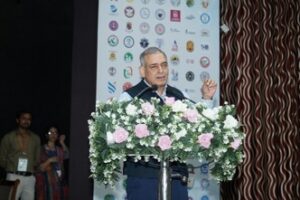
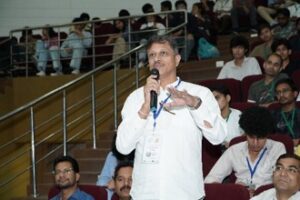
Moderated by Dr. Rajendra Singh, this session explored the concept of defense beyond traditional military might. The panel focused on comprehensive national security, water strategy, and digital warfare as essential components for a secure Vision 2047.
Shri Sanjay Kundu (Former DGP, Himachal Pradesh) on Water Security:
- The Indus Water Treaty (IWT): Shri Kundu delivered a critical analysis of the 1960 IWT, pointing out that India yielded disproportionate rights to Pakistan. India gave away 84% of the water from the western rivers (Chenab, Jhelum, and Indus) and even provided financial assistance for Pakistan to build its irrigation systems, severely restricting India’s own storage and usage rights,,.
- Strategic Leverage: He argued that water security is a critical weapon of national defense and comprehensive national power,. He advocated for revisiting the treaty, arguing that the original “cooperative spirit” outlined in the preamble is non-existent due to historical conflicts,.
- Future Actions: He praised the recent completion of the Shahpur Kandi dam to fully utilize the Ravi river’s water. He suggested building larger storage systems and eventually diverting northern river waters southward to states like Delhi, Rajasthan, Haryana, and Gujarat, which could resolve water crises and trigger a second Green Revolution,,.
Dr. Siddharth Khare (Faculty, IIT Roorkee & Founder, Bhoomi Pvt Ltd) on Digital & Space Warfare:
- Modern Warfare Shift: He highlighted that contemporary conflicts are no longer solely physical border clashes but heavily rely on digital technology and space intelligence,,.
- Geo-spatial Technologies: Dr. Khare discussed the critical need to leverage satellite remote sensing, drone technology, and Artificial Intelligence (AI) to enhance real-time border surveillance and water security,.
- Updating Intelligence: He noted that many current border maps are outdated. Securing India’s 15,000-kilometer boundary requires the youth to build cutting-edge spatial intelligence ecosystems and commercial satellite platforms,.
Prof. Somnath Sachdeva (VC, Kurukshetra University) on Indigenization and Future Threats:
- Comprehensive Power: As the session chair, he emphasized that defense must be strong enough to deter threats and resilient enough to absorb shocks from multi-domain attacks, such as cyber and space warfare,.
- Swadeshi Defense Manufacturing: He shared highly optimistic data, noting that India is currently the 4th largest military power. India’s defense budget has tripled in the last ten years, and indigenous equipment usage has grown from just 30% to roughly 65%,.
- Export Growth: He highlighted a paradigm shift where defense manufacturing is now an economic driver. India’s defense exports have surged nearly 30 times (from ₹686 crores to ₹24,000 crores) and now reach approximately 100 countries,.
- Emerging Threats: Prof. Sachdeva warned about preparing for future technological warfare, including laser-based weapons and quantum computing. He cautioned that quantum computers could instantly crack current high-security passwords, fundamentally changing the landscape of cyber security,.
Major Announcement: MoU for Drone Technology To conclude the session, Prof. Akshay Dwivedi announced a significant institutional collaboration. IIT Roorkee signed an MoU with the RP Foundation and SkyNet Solutions.
- This initiative establishes a DGCA-approved Remote Pilot Training Organization (RPTO).
- The center aims to go beyond basic drone flying, training the youth in the actual manufacturing and development of heavy-duty drones capable of serving as medical ambulances and transporting heavy equipment, perfectly aligning with both the defense and mobility needs of the nation.
Session Detail
Date: 25th April 2026
Time: 2:30 PM to 4:00 PM
Session: 3
Moderator: Dr. Sarabjeet Kaur
Theme: World’s Leading Economy:
This session went beyond surface-level economics, diving deep into historical missteps, current geopolitical threats, and the monetary strategies required for Vision 2047.
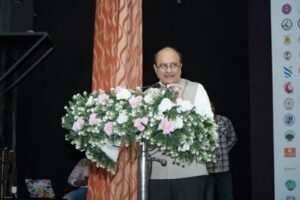
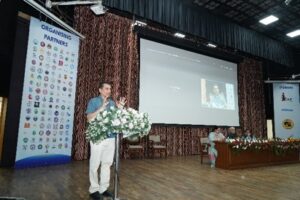
- Prof. Pradeep Chauhan (JNU): Correcting the Historical Economic Narrative
Prof. Chauhan argued that modern economic textbooks still teach a colonial narrative, incorrectly labeling India as historically “underdeveloped”.
- Pre-Colonial Might: Citing historical data, he noted that until 1500 AD, India and China collectively accounted for nearly 50% of the global GDP, with India alone contributing 20-25%.
- The British Drain: He referenced Dadabhai Naoroji’s book Poverty and Un-British Rule in India, explaining that India wasn’t inherently poor; poverty was manufactured by British policies that deliberately destroyed indigenous industries like textiles and dismantled the Indian education system (via Macaulay).
- Critique of Post-Independence Models: He strongly criticized the Nehruvian era for ignoring the village-based Gandhian model and instead adopting the “Mahalanobis Model” for the Second Five-Year Plan. He pointed out that this was merely a copy of the Soviet Union’s failed “Feldman Model,” which overly relied on heavy industry and the public sector.
- The Solution: To become a supreme economy again, India must abandon Western models that cause extreme inequality and environmental damage, and instead adopt Pandit Deendayal Upadhyay’s “Integral Humanism”—a model that integrates holistic human welfare with nature.
- Prof. Ram Singh (Director, Delhi School of Economics): Navigating Global Economic Shocks
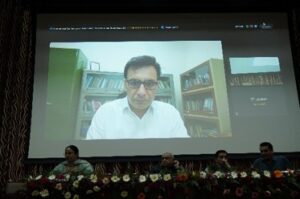
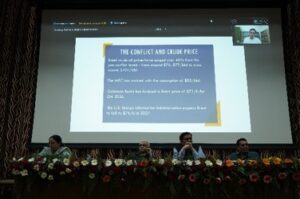
Joining virtually, Prof. Singh provided a real-time analysis of the monetary challenges India faces due to the fluid global order.
- The Oil Price Shock: He explained that the West Asia conflict has hit India through both supply disruptions and price shocks, with crude oil jumping 40% from $70 to over $100 per barrel in just five weeks. Assuming an average of $85 per barrel, India’s growth rate might face a slight sacrifice, settling around 7% instead of the targeted 8%.
- Defending the Rupee & FDI: Addressing the depreciating Rupee (which has been under pressure from high import bills and Foreign Portfolio Outflows), he projected optimism. He stated that Free Trade Agreements (FTAs) signed with 37 countries will boost inflows, and India expects Foreign Direct Investment (FDI) to cross $80 billion this fiscal year.
- Protecting MSMEs: He strongly argued against the RBI increasing the repo (interest) rates to control inflation. He noted that higher interest rates would severely damage MSME clusters (like ceramics in Gujarat and industries in Ludhiana) because, unlike large corporations, MSMEs lack the “working capital bandwidth” to absorb such shocks.
- De-dollarization: During the Q&A, when asked about trading oil in Yuan instead of Dollars, he noted that the US Dollar’s hegemony is actively declining (non-dollar trade is already around 50%). However, he advised that India shouldn’t explicitly join a bandwagon to destroy the dollar, but rather innovatively use banks like SBI to facilitate localized trade (e.g., with Iran or Africa) guided purely by India’s own interests.
- Shri R. Sundaram (National Convener, Swadeshi Jagran Manch): The Weaponization of Global Trade
Shri Sundaram warned that traditional economic theories of “cost competitiveness” are now irrelevant because superpowers have weaponized trade.
- Global Vulnerabilities: He pointed out that while the US uses its military and tariffs to control trade, China uses its massive manufacturing base to withhold essential raw materials like Active Pharmaceutical Ingredients (APIs) and rare earth minerals, directly threatening Indian industries.
- Exposing India’s Limitations: The ongoing global wars have exposed India’s lack of preparedness. For instance, he noted that even if India wants to import cheaper commodities, it lacks a robust domestic shipping industry, crew, and logistics players.
- The R&D Crisis: He highlighted a stark reality: India’s R&D expenditure is only 1/4th of China’s as a percentage. Given that China’s economy is four times larger, in absolute terms, India is spending only 1/16th of what China spends on R&D.
- Call to Action: He warned that relying on imports is dangerous, noting that imports from China have doubled to $100 billion. He asserted that true Swadeshi (self-reliance) and boosting domestic availability are the only solutions for the next 50 years.
- Prof. Ashwani Mahajan: India’s Dominance in Industry 4.0
Prof. Mahajan delivered a fiery speech condemning Western narratives designed to keep India subservient, while celebrating India’s indigenous technological triumphs.
- The PPP Reality: He argued that evaluating India merely as a 4.2trillioneconomyismisleadingbecauseIndiadoesn′toperateindollarsdomestically.WhenadjustedforPurchasingPowerParity(PPP),Indiaisactuallya∗∗16.85 trillion economy**, meaning it has the unmatched capacity to manufacture the cheapest goods globally.
- Calling Out the World Bank: He strongly criticized a recent World Bank “World Development Report” that mocked India’s goal of becoming a developed nation. The report audaciously advised India to stop wasting time and money developing its own technology and instead just use existing multinational tech. Prof. Mahajan questioned the World Bank’s “aukaat” (stature) to dictate this to India, firmly stating that India must build its own tech.
- Leapfrogging into Industry 4.0: He noted that while India missed the first three industrial revolutions due to colonial rule and poor government foresight, Indian youth are leading Industry 4.0.
- Space: ISRO provides the cheapest satellite launches globally, forcing even American companies to rely on India.
- Digital Payments: When the US threatened India with sanctions and SWIFT system exclusion for buying Russian oil, India boldly bypassed the threat using its indigenous UPI system, integrating it with Russia’s MIR to create an alternative payment network.
Session Detail
Date: 25th April 2026
Time: 4:00 PM to 5:00 PM
Session: 4
- Theme: Exporters Academia Conclave
- This conclave focused on translating the vision of “Make for the World” into a tangible reality by bridging the critical gap between academic research and export industries,. The session emphasized building an action-oriented ecosystem to enhance India’s global manufacturing and export footprint.
- Release of the “Make for World Policy 2026” Akshay Dwivedi introduced this comprehensive draft policy, which was formulated after extensive consultations with industry leaders, institutions like IIMs, and legal experts. He highlighted that while India possesses immense engineering capabilities, there is a dire need to match these with the specific standards and product needs of global markets,. He pointed out that academic curriculums currently lack the focus needed to teach students what specific countries require. Citing that Prime Minister Modi has signed over 100 MOUs with various countries, he urged academia and industry to align and fulfill these global trade opportunities. He stressed that students must realize their education should not merely be for seeking jobs, but for creating exportable, world-class products.
- K.K. Pant (Director, IIT Roorkee) Prof. Pant emphasized that to achieve a $35 trillion economy by 2047, India must target at least $3 trillion in exports. He stressed the need to upgrade India’s exports from traditional raw materials to high-value, indigenous technologies such as semiconductors, rare earth metals, and clean energy solutions,. Furthermore, he highlighted the massive global potential for local specialties, such as Himalayan honey (which benefits from the region’s unique biodiversity), herbal products, turmeric, and garlic,. His core guiding message for the youth and industry was to be “Vocal for Local, and make it Global”,.
- Shri Vijay Setia (Leading Rice Exporter) Sharing powerful, real-world examples of industry-academia collaboration, Shri Setia explained how studying post-harvest technology at IARI Karnal transformed his business. By applying academic research, he successfully reduced the rice aging process from 1 year to just 15 days through precise moisture and heat control, significantly increasing the value of the rice. He also utilized rice husk ash, which contains silica, as a highly effective, natural agricultural pesticide and repellent against crop diseases. Furthermore, he shared his successful collaboration with students from IIT Kharagpur to develop a unique “rice tea” made from the rice’s outer core and herbs; clinical testing showed it reduces cholesterol by 71%, and it is now moving toward human trials,.
- Shri Satish Kumar & Shri Anil Verma (Bharat Exporter Forum) They highlighted a glaring economic disparity: while India houses 18% of the global population, it contributes to a mere 1.8% of global exports. Shri Kumar pointed out the alarming statistic that out of 2.25 lakh registered exporters in India, only 75,000 are actively exporting,. Shri Anil Verma urged the creation of a shared national platform for MSMEs to resolve complex logistical and compliance issues, provide training for international certifications (like ISO and HACCP), and facilitate B2B networking,. They strongly demanded that students shift their mindset from being job-seekers to becoming export-oriented entrepreneurs, noting that with the right mindset, even innovative products like cow dung patties are currently being successfully exported,.
- Minister Shri Pradeep Batra Sharing his highly relatable personal journey, the Minister recounted how he started by helping at his grandfather’s small tea and samosa shop, “Prakash Sweets,” located right at the IIT Roorkee gate,. Through a relentless focus on quality, he scaled it into a massive brand with multiple outlets and factories that are now preparing for export to international markets,. He urged the youth to focus on quality and leadership in whatever field they choose. He offered a guiding mantra for success, driven by core principles: Duty, Discipline, Devotion, Dedication, and Discrimination (the wisdom to differentiate between right and wrong choices).
Session Detail
Date: 25th April 2026
Time: 5:30 PM to 6:45 PM
Moderator: Dr. Compesh Pannu
Session: 5
Theme: A Leader in Science and Technology
The final session of the day, “A Leader in Science and Technology,” was moderated by Dr. Kampesh Pannu, who set the stage by noting that while India’s Gross Expenditure on R&D has been increasing, it currently stands at roughly 0.66% of GDP. To achieve the Vision 2047 goals and become a global leader, this must be raised to the global average of 2% to 3%.
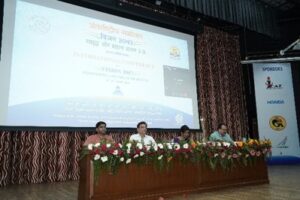
- Shri Mani Ranjan Kumar (Morgan Stanley): The Reality of Deep-Tech and “Patient Capital”
Shri Kumar, drawing from his 22 years of experience in global finance, explained that economic growth relies on three factors: labor, capital, and most importantly, productivity (Total Factor Productivity), which is driven purely by science and technology .
- The Patent Illusion: He brought a reality check to India’s innovation metrics. While patent filings in India have increased from 10,000 to about 1.1 lakh, China files around 40 lakh patents ,. Furthermore, a massive portion of the patents filed in India actually belong to foreign MNCs (like Qualcomm or Microsoft) operating out of Indian offices. The Intellectual Property is not Indian-owned .
- The Long Road of Deep-Tech: He warned that true technological breakthroughs require immense time and “patient capital.” Apple, founded in 1976, was almost bankrupt in 1997 and took 25 years to release the iPod ,. The 2-nanometer chips in modern phones are the result of 50 to 70 years of continuous relay-race-like R&D by a handful of global companies ,.
- Risk-Taking and Investment: He gave the example of Micron, a major memory chip manufacturer that recently set up a plant in Gujarat. The company was initially funded by a potato chip maker in Idaho who was willing to take a massive $1 billion risk . India needs a similar culture of high-risk, long-term capital commitment to build deep-tech.
- Scientific Method in Primary Education: Sharing an anecdote about his daughter designing a simple experiment in a New York 2nd-grade class to determine her brother’s favorite chocolate color, he stressed that the core scientific method (hypothesis, experiment, observation) must be actively taught from the primary school level ,,.
- Shri Rajat Mishra (Director, IID New Delhi): Ecosystems, Brain Gain, and Failing Fast
Shri Mishra emphasized that 2047 is only 21 years away, meaning the leaders of that era are already in the education system today .
- Leadership over Adoption: He challenged the institutions to aim for at least 5 Nobel Prizes in Science and Technology by 2047, won by Indians doing research within Indian institutions, rather than abroad ,.
- From Brain Drain to Brain Gain: He noted that 16% of the world’s AI engineers and over 20% of semiconductor/IC talent are Indian ,. To bring this talent home, India must build an ecosystem similar to Silicon Valley—not just relying on isolated geniuses, but creating clusters of talent linked with universities and risk-taking capital .
- Fail Fast and Fail Cheap: To innovate, the society and ecosystem must learn to respect failure. He explained that failing shouldn’t mean wasting 10 years and ₹500 crores; it means testing an idea in 10 weeks with ₹5 lakhs, failing quickly, learning, and iterating .
- Frugal Innovation: He championed “grassroots” or frugal innovation—creating highly effective, cost-efficient solutions tailored to specific local problems (like floods in Assam or terrain issues in Uttarakhand). He noted that if India can build quality products cheaply, they can easily be exported globally ,.
- Prof. Ravikant Mishra (SLIET Punjab): Instilling Scientific Temperament
Prof. Mishra, an expert in mathematics, emphasized that a scientific temperament and cross-disciplinary collaboration are required to turn ideas into final products ,.
- Mentoring Student Startups: He shared a powerful success story from his institute. Inspired by students who wanted to be “job providers” rather than employees, he secured a ₹95 lakh grant from the government . With this, he successfully mentored 15 student startups . He highlighted one 2nd-year BTech student who has already built an ₹8 crore company in Gurgaon, proving that with the right academic mentorship, youth can achieve massive success .
- Science for All: Recognizing the need for widespread logical thinking, he announced he is writing a book titled “Science for All Indians,” arguing that regardless of one’s background, everyone must understand the scientific method .
- Ms. Sonali Jha (Founder & CEO, Q Technologies): Product Thinking and Government Support
Ms. Jha shared her personal journey of leaving a lucrative 11-year career at Goldman Sachs in New York to return to India and build a product-based software company ,.
- Product Thinking Approach: She urged students to adopt a “product thinking approach” utilizing Lean/Business canvases, which focus on three core pillars: what value you are creating, how you will deliver it, and value appropriation .
- Global Success from India: Her approach paid off when her company was one of only three selected by Microsoft CEO Satya Nadella for a roundtable, and later won first prize in a tech pitching competition among 90 countries in Washington DC, securing Amazon as a client ,.
- Capitalizing on the Ecosystem: She highlighted that the current ecosystem for Indian innovators is incredibly supportive. Massive funds are now available, such as the ₹1 lakh crore R&D allocation and the ₹500 crore Quantum mission ,. She cited an agri-tech company named “Absolute,” which utilized an ₹18 lakh government grant to scale into a company with a ₹300 crore turnover ,.
- She concluded by advising young founders not to just hop from grant to grant, but to maintain a strong customer-centric focus, run small experiments, and tolerate failures to ultimately succeed ,.