
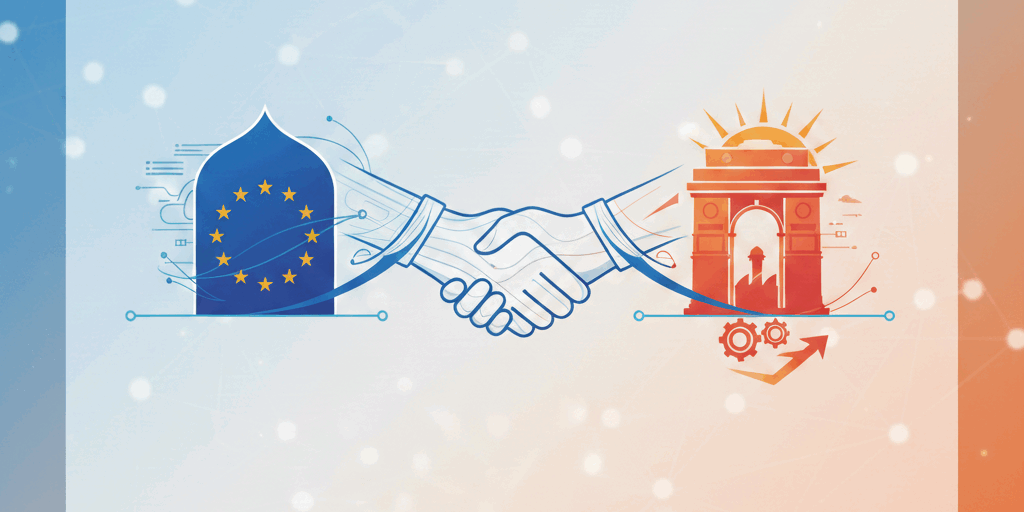
Vande Mataram” recently celebrated its 150th birth anniversary. Before being our national song, it was the song of struggle, the song that ignited rage, the song that united us in the face of partition. The song was all of these things and Swadeshi. It was the official slogan of Swadeshi movement; it served as a call to invoke and reinvigorate the domestic products and industries. One and a half centuries later we got ourselves “The Mother of All Deals”, which undeniably is greatest homage to Swadeshi Movement.
One could observe that while the global economic landscape is undergoing a tectonic shift, the world is reconfiguring its supply chain networks along with exploring new markets to safeguard their exports. Today industrial policy has returned to the forefront of national strategy and is working in tandem with diplomacy. For India, this moment is not merely about recovery but about a strategic leap. The recent conclusion of the EU-India Free Trade Agreement (FTA) heralded as the “mother of all deals”- presents a pivotal milestone. By connecting the world’s second and fourth largest economies, this pact does more than slashing tariffs. It provides the structural framework for India to transition from a capacity-driven economy to a capability-led global powerhouse, aligning perfectly with the vision of Viksit Bharat @2047.
With the EU granting duty-free access to 99.5% of Indian export lines, the agreement levels the playing field for India against competitors like Bangladesh and Vietnam. This is particularly transformative for labor-intensive sectors such as textiles and apparel, which have faced headwinds due to shifting global trade barriers. Currently a $7.2 billion trade, duty-free access is expected to catalyze a 15% growth in regions like Tiruppur. The removal of 10-12% tariffs means Indian garments will finally compete on price while maintaining their reputation for quality. Maneuvering away from protectionism, India has reciprocated by reducing tariffs on European machinery and chemicals by up to 44%. This lower cost of means of production is a silent revolution for Indian manufacturers, allowing them to upgrade technology without the traditional tariff tax on innovation.
With a median age of 28.4 years and a working-age population set to hit one billion by 2047, India’s greatest asset remains its demographic dividend. However, a young population is only an advantage if absorbed into productive, high-value employment. MSMEs, the backbone of the Indian ecosystem, stand to be the primary beneficiaries of this FTA. By providing “hassle-free” access to the 450-million European market, the deal encourages MSMEs to move beyond local supply chains and integrate into Global Value Chains (GVCs). As Union Commerce Minister Piyush Goyal noted, the textile sector alone could see the creation of 6-7 million new jobs. The challenge now lies in bridging the finance and credit gaps that often prevent these small units from scaling up to meet European demand.
It is high time for us to realise that in order to make the world go Swadeshi, the core of this transition is the shift from “making more” to “making better.” The Economic Survey emphasizes that sustaining manufacturing momentum requires a focus on strategically important and technology-intensive sectors. Acceptability of Swadeshi Products, in Europe is not about price but compliance. Europe consistently insists on adherence to quality and ESG (Environmental, Social, and Governance) norms. The implementation of Quality Control Orders (QCOs) is no longer a regulatory burden but a competitive necessity. Aligning domestic standards with international benchmarks will build the “brand equity” India needs to be a trusted global supplier. Our readiness to enter the market depends on the growth of Tier-2 and Tier-3 cities. They offer the land, labor, and lower operating costs required for large-scale manufacturing. However, we must move away from fragmented clusters toward integrated industrial ecosystems that foster R&D, industry-academia linkages, and rapid technology absorption. With logistics costs falling to approximately 7.97% of GDP, initiatives like PM Gati Shakti are the way to go. To maximize the FTA benefits, India must further rebalance its freight transportation, shifting bulk movement from roads to more cost-effective rail and coastal shipping routes.
The FTA includes a “Sustainability and Development” chapter, signalling that the future of trade is green, transparent, and ethically sourced. FTA certainly offers unprecedented opportunities; it also introduces sophisticated challenges. The EU’s Carbon Border Adjustment Mechanism (CBAM) and Deforestation Regulations (EUDR) act as “green” trade barriers. Indian exporters, particularly in steel and chemicals, will need to decarbonize rapidly to avoid new taxes that could nullify the gains from tariff eliminations. This is where capacity building becomes decisive. The government and think tanks must collaborate to provide MSMEs with the technical know-how to navigate these regulatory complexities.
As a vital pillar of the National Manufacturing Mission, this agreement serves as a rigorous laboratory for Indian firms to test their mettle against the world’s highest standards. The road to Viksit Bharat @2047 runs through the ports of Europe. In this context, while we all understand what Swadeshi is in its conceptual form, now is the time to adopt it in its essence, now would be the time to imbibe it, we have demography that awaits to be utilised, we have a market that needs to be flooded with Indian excellence, we have production capacity that is to be transformed to capability, and we have a leadership that understands global dynamics and swings into action when it is about safeguarding our interest. The EU-India FTA is more than a trade deal it is the modern evolution of Swadeshi. Today, Swadeshi means identifying our strengths and building on them. Today we are moving beyond self-reliance toward becoming strategically indispensable.
– Kartik Shyam Mogha, Research Associate