
Introduction
Russian President Vladimir Putin visited India from 4-6 December 2025 for the annual bilateral summit. Moscow and New Delhi completed twenty-five years of strategic relations this year. President Putin was welcomed with full national honours in New Delhi. If we look at the past of this strategic relationship, we find that it was Vladimir Putin in 2000, after becoming the President of the Russian Federation, who initiated this annual bilateral summit mechanism. India and Russia have a glorious past of friendship and deep ties. That is why the relationship between these two nations is described as a “time-tested friendship”. This is clearly visible in historical cooperation, especially during tough times such as the India-Pakistan War of 1971. In that war, it was only the USSR that came to protect India from the Pakistan-US alliance.
Beyond this, Russia has always supported India’s stance on the Kashmir issue at the United Nations Security Council and has vetoed discussions on this issue several times. In 1991, after the disintegration of the USSR, the scenario changed, and India attempted to improve relations with the West, the US, and Europe. However, at the same time, India did not abandon Russia, and Russia did not abandon India. A few years later, during President Vladimir Putin’s visit to India in 2000, the two countries established the “India-Russia Strategic Partnership”. This initiative set a new and enhanced framework for cooperation, effectively extending the older Indo-Soviet Treaty of 1971. However, with the resolution of the Russia–China border dispute in 2008 and the rise of China between 2010 and 2020, Russia’s tilt towards China began, which was natural due to similarities in governance, ideology, and immediate neighbourhood proximity. Now, the international scenario has changed after Donald Trump came to power in the United States. Trump wants to balance US trade with other countries, and for countries with high trade deficits with the US, he is imposing high tariffs on their goods and services so that they come to the negotiation table. Russia, India, and China are central to this approach. Another interesting aspect of President Trump’s policy is his desire to establish peace at the international level by acting as a mediator in various conflicts, such as between Russia and Ukraine.
To push for a peace deal between Russia and Ukraine, the US imposed high tariffs and sanctions on Russia from January 2022 to pressure President Putin to agree to negotiations. Along with this, President Trump also warned of imposing secondary tariffs on countries trading with Russia.
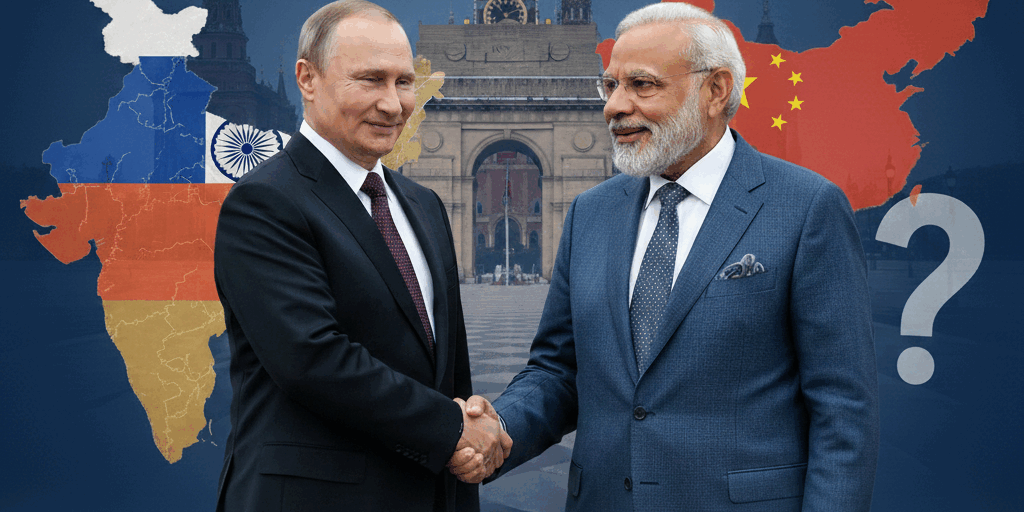
In the current scenario, President Putin’s visit to India may make China uncomfortable. The reason is that Russia is now giving India a status that was previously accorded mainly to China. Just before his visit, in an interview with Indian media, President Putin stated that both India and China are Russia’s closest friends. This statement became a topic of debate among experts, raising questions such as: Is Russia looking for another option? Is Russia using India to balance its relations with the US? Is Russia giving India first preference? Is Russia countering the narrative that China is more important to Russia than India? Does Russia want to avoid being seen as the “younger brother” of China? Is Russia trying to develop a new narrative for the West?
China’s Concern
China’s primary concern is that Russia is now giving equal importance to India and is also seeking alternatives for its exports due to overdependence on China. Another concern is that Russia may be using India as a balancer in its relations with the US. India maintains good relations with the US and has never publicly supported Russia’s invasion of Ukraine. India is also strategically important for the US and has emerged as a leading economy and a responsible global actor that believes in peace.
Through India, Russia may be attempting to improve its relations with the US, which have shown signs of improvement following the meeting between President Putin and President Trump in Alaska this year. India can play a supportive role in improving Russia-US relations, especially through its membership in multilateral forums such as the G20.
President Putin’s statement may concern China because many experts speculate that Russia is revising its preferences and giving greater importance to India. This speculation gains traction as Russia’s engagement with India has increased in recent months, with both embassies becoming more active. Another issue debated by experts and journalists is whether Russia wants to avoid being perceived as China’s “younger brother”. This is significant because Russia has a glorious past as a superpower during the Cold War and seeks to reclaim a similar status. To do so, Russia needs equal partners rather than hierarchical relationships. From China’s perspective, the concern lies in whether Russia wants to shape a new narrative being seen as India’s closest strategic partner rather than China’s junior ally.
Perhaps through this visit and statement, Russia is attempting to present a different image to the West. While the West often views Russia and China as a united bloc challenging Western dominance, it perceives India more positively as a nation that advocates peace, cooperation, Vasudhaiva Kutumbakam, and dialogue rather than conflict. Consequently, the West is more comfortable with closer India-Russia relations than with Russia-China alignment.
Conclusion
India-Russia ties, rooted in defence cooperation, energy security, and geopolitical coordination, provide Moscow with leverage and balance in Asia. Putin’s outreach to India reinforces Russia’s role as an independent power broker in the Indo-Pacific and Eurasia, which may subtly constrain China’s strategic space, particularly in South Asia. Although the visit does not signal a rupture in Sino-Russian relations, it highlights the limits of their alignment and introduces an element of strategic discomfort for Beijing.
At the same time, China is likely to interpret the visit pragmatically rather than confrontationally. Beijing recognizes that India–Russia relations are driven by historical trust and converging interests rather than an anti-China agenda. Nevertheless, the symbolism and timing of Putin’s visit underline India’s growing relevance as a multipolar actor and Russia’s intent to avoid overdependence on China. In this sense, while not an immediate cause for alarm, Putin’s visit to India does represent a subtle strategic concern for China, reflecting the fluidity and competitive balancing inherent in the evolving global order.
Dr. Reeta, Research Associate