President Xi Jinping’s Visit to the United States: Concerns for Bharat
by Dr. Reeta
Introduction
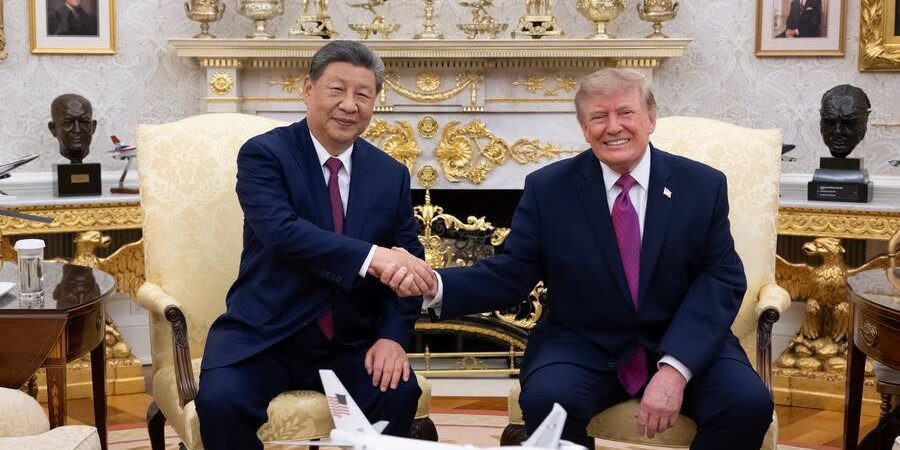
In this uncertain global order, Chinese President Xi Jinping’s three-day state visit (23-25th September 2026) is highly relevant and challenges several hypotheses advanced by numerous experts regarding relations between Beijing and Washington. The visit was particularly significant because it was the first visit by a Chinese leader to Washington in more than a decade and carried both diplomatic and strategic importance. The meeting took place against the backdrop of persistent tensions over trade, critical minerals, artificial intelligence, Taiwan, Iran and the broader strategic competition between the two powers. The visit began with a ceremonial welcome for President Xi by the US President Donald Trump at the airbase. The discussions primarily focused on managing the complex US-China relationship, trade, AI, Taiwan, and global conflicts. Amid strategic competition between the two, the visit marked an important effort from both sides.
Though President Xi’s state visit to Washington generated a degree of diplomatic warmth and an agreement to maintain dialogue between the two players, it could not resolve the structural sources of US-China rivalry. However, it can be explained as an attempt to establish a mechanism for managed competition and strategic stability between the two. The public remarks of leaders were characterised by diplomatic warmth and cordiality. In a statement before a formal meeting between President Xi and Trump, Xi announced a gift of Chinese pandas and also unveiled a new student exchange programme. This reflects China’s long-standing practice of “Panda Diplomacy” in which giant pandas are presented to other countries as a symbol of goodwill and a tool for international relations.
Major Takeaways
1. The transformation of the “Trade War” to “Managed Economic Competition”
During this meeting, Washington and Beijing agreed to extend their existing trade truce for another two months. It provides additional time for negotiations concerning tariffs, Chinese purchases, rare earth supplies and technology restrictions between the two powers. However, it should not be considered a settlement of the broader trade disputes, as core disagreements between Beijing and Washington remain, particularly regarding tariff levels, market access, critical minerals supply chains, Chinese industrial capacity, and US technology restrictions. Reuters rightly characterised the agreement as an extension of the existing truce rather than a durable economic settlement. Therefore, the visit demonstrates a shift from confrontation towards bargaining rather than from rivalry toward comprehensive economic partnership or cooperation.
2. Dialogue as a Mechanism for Managing Rivalry
During the visit, President Xi Jinping underlined the danger associated with the “Thucydides Trap”, which can become an issue or matter of conflict. The visit illustrates the distinction between competition and conflict. He also agreed to a stronger military dialogue and crisis-prevention mechanism. Such mechanisms will play an important role in discussing multiple potential escalation points, including the Taiwan Strait, the South China Sea, cyber capabilities, AI, and military technologies, between Beijing and Washington.
Thucydides Trap is a concept associated with political scientist Graham Allison and derived from the ancient Greek historian and realist Thucydides’ account of the “Peloponnesian War”, it explains the heightened risk of conflict when a rising power challenges an established or dominant power. This concept is frequently applied to explain US-China relations in contemporary international relations because China’s growing economic, technological, military and diplomatic influence is seen as a challenge to the long-established US dominance.
3. Taiwan Remains the Central Security Flashpoint
During the Chinese President’s visit to Washington, Taiwan remained one of the most difficult unresolved issues between the two despite the diplomatic warmth. Chinese state media reported that President Xi advised Trump to oppose Taiwanese independence and handle the Taiwan issue cautiously regarding a twelve-billion-dollar arms deal. But the details in this regard were not given to the public by the White House. As everyone is aware, China takes the Taiwan issue as a matter of concern for its sovereignty and security. Therefore, the visit also underlines an important contradiction between the US and China: economic stabilisation and diplomatic engagement can coexist with persistent strategic disagreement over sovereignty and security.
4. The New Frontier of US-China Competition: AI and Critical Technologies
Another highlight of President Xi’s state visit to Washington was the discussion of the growing importance of AI and critical technologies between the two powers. The reason behind this is that AI increasingly has implications for national security, military capabilities, economic competitiveness and global standards. Many analysts have previously underlined that AI governance and technology will remain a central issue on the agenda. It also demonstrates an important transformation, like US-China rivalry, due to a bilateral competition shift from trade and manufacturing toward AI technology, and could also shape the future economic and strategic power of the player.
And in the field of rare earths and critical minerals, China possesses significant leverage in parts of the global critical-mineral supply chains, while the US retains important leverage through advanced technologies and semiconductor-related restrictions. So, the economic relationship between the US and China is therefore characterised by mutual dependence combined with strategic vulnerability.
Concern for Bharat
1. The Possibility of US-China Accommodation
For Bharat, the biggest concern will be the growing US-China accommodation. Bharat has benefited in some sectors from the strategic and economic tensions between the US and China, which is called the “China Plus One” strategy. It is a strategy of multinational companies regarding investing in other Southeast Asian countries as an option for supply-chain diversification and to reduce excessive dependence on China. And if the tensions between the US and China moderate, some of the economic incentives for diversification away from China could weaken. Though it cannot be interpreted as Bharat’s strategic importance would automatically decline. Bharat’s importance derives from its market size, manufacturing potential, geography, Indo-Pacific position and role in institutions like Quad and BRICS.
2. Taiwan and Indo-Pacific: A Major Strategic Concern
However, in this state visit of President Xi to the United States, the Taiwan issue remains a consequential unresolved question between the two. For Bharat, if there is any change in the US position on Taiwan, it could have wider implications for the Indo-Pacific balance of power. Because Taiwan is not a simple bilateral issue between Beijing and Washington, a serious crisis could affect maritime trade, shipping routes, semiconductor supply chains, and the broader security architecture of East Asia, and Bharat cannot stay away from its effects.
3. Critical Minerals and Supply Chain Security
Rare earths and critical minerals are essential for electric vehicles, electronics, advanced manufacturing, aerospace and defence technologies of Bharat. China is a dominant player in global rare-earth mining and processing. Bharat’s ambitions in semiconductors, electronics, defence manufacturing, electric mobility, and advanced technologies need reliable access to critical minerals. So, any agreement between the US and China in this regard will affect Bharat’s supply chain security and impact Bharat’s dream or aim to become a prosperous nation by 2047.
4. AI and Technological Sector
The US-China competition in AI offers an important opportunity for Bharat. The continuing technological competition between Washington and Beijing could encourage companies to diversify research, manufacturing, and supply chains towards countries like Bharat, and it will help New Delhi grow faster and make advances in AI capabilities. But at the same time, for Bharat, the strategic requirement is therefore to move from being primarily a recipient of supply-chain diversification to become an independent player in critical technologies.
Conclusion
The frequent meetings of the Chinese President Xi Jinping and President Trump can be described as a new beginning in US-China relations. It can be explained as an attempt to institutionalise and manage competition between the two powers. The meeting can be summarised in three points: first, economic interdependence continues to encourage negotiations; second, strategic rivalry remains deeply embedded over Taiwan, technology and regional security. Third, both leaders recognise the cost associated with uncontrolled escalation and therefore have incentives to preserve high-level dialogue. The visit underlines a model of “managed strategic competition”.
In regard to Bharat and the world, Xi’s visit to Washington was all pomp but little progress too. No agreements were signed. For Bharat, this visit can be seen as China’s effort to balance between the West and Russia. Though Bharat needs to keep an eye on every development between the US and China and make itself ready with another option. The trade war or rivalry between the US and China cannot be solved completely in a single meeting; it will take a series of negotiations on each issue.
The visit also underlines the relevance of Bharat’s strategic autonomy. New Delhi need not view the developments in US-China relations through a binary lens. However, Bharat has the capability to manage its engagements with Washington and Beijing while protecting its national interest. Bharat is able to strengthen its position in the Indo-Pacific, BRICS and the Global South by pursuing calibrated engagement with China. Chinese President’s state visit to Washington suggests that Bharat’s future foreign policy requires strategic flexibility, diversified partnerships and issue-based diplomacy rather than alignment with any single major power.
References
- Reuters, “Four/Five Takeaways from Trump’s Summit with Xi in Washington”, 24 September 2026. Reuters report
- Al Jazeera, “Trump-Xi summit: Four key takeaways from the Washington, DC, meeting”, 24 September 2026. Al Jazeera analysis
- Council on Foreign Relations, “Ten Issues to Watch at the Trump-Xi Summit in Washington”, September 2026. CFR analysis
- Atlantic Council, “The Four Issues Our Experts Are Watching Ahead of This Week’s Trump-Xi Summit”, September 2026. Atlantic Council analysis
- White House, “Fact Sheet: President Donald J. Trump Secures Historic Deals with China”, 17 May 2026. White House fact sheet