Decoding 18th BRICS Summit: Relevance and Major Takeaways
by Dr. Reeta
Introduction
Currently, the world is going through an era where the balance of power is changing rapidly. New centers of economic power have emerged. Technology is deciding the path of the world, and the Global South is not only a group of developing countries anymore, though bacame a power centre that is demanding its say in the global decision-making process. In this changed scenario, the role and importance of BRICS is growing day-by-day. A forum which was founded as a platform of dialogue between the emerging economies has become a broad international platform. India is a founding member of BRICS, and in 2026 it will get its presidency for the 4th time. At the 2025 Rio de Janeiro Summit, the BRICS countries supported India’s chairship of the 18th summit in 2026. For India, it’s not a diplomatic responsibility, though it is received at a time when its size is bigger, its agenda is warsed like never before, and expectations of the Global South have also increased. The scope of BRICS widened from economic cooperation to technology, sustainability, development, and global governance. So, the 2026 BRICS summit is not only an international meeting but an opportunity to understand India’s role and importance in this dynamic world order.
Although the foundation of BRICS began with the four emerging economies, its identity has changed throughout time. Today, this platform is not limited to economic cooperation or trade cooperation, but it has emerged as a powerful platform due to its member countries’ geographical situation, energy resources, markets, and technical capabilities. This diversity is the biggest strength and challenge too. Because among several different countries, with their interest is not easy to draft a common agenda. And the question is: how can we move forward with such different countries as a group?
Evolution of BRICS
With this, the idea of BRICS emerged. BRICS started as an economic idea, not as an organization. In 2001, economist Jim O’Neill used the term for the fastest-growing economies, including Brazil, Russia, India, and China. At that time, BRIC was not a formal organization, but due to the economic capability and global influence of these four countries, this idea spread rapidly and became a part of discussion worldwide. After this, economic and political communication between these four countries increased. In 2006, during the United Nations (UN) meeting, the first formal meeting of Foreign Ministers of these four countries took place. From here, BRIC moved forward as a structured, diplomatic platform. When the world financial crisis shook economies globally, it raised another big question: whether the emerging economies were getting representation according to their increasing economic growth. And the BRIC countries started stressing reform in the international financial institutions. After this, the first leaders’ summit of BRIC took place in Russia on 16th June 2009. It was an important opportunity for the BRIC. From here, there was a discussion on cooperation in the economy, financial governance, science, education, energy, international trade, and terrorism. It means the formation of BRIC was not only due to the weight of the member countries, but behind this was a demand for an existing global order in which the voice of emerging countries would be predominant. If 2009 gave a formal nature to the BRIC, then 2011 expanded it geographically and politically when, during the third BRIC summit in China, South Africa was formally added to the group. With this, “S” was added to BRIC and became BRICS. It expanded BRICS’ footprint from Asia and Eurasia to Africa.
At the 2011 summit, there was a focus on cooperation against terrorism and the need to reform the international financial system. From here, BRICS identity was not only a group of emerging economies but strengthened political dimension of it. In the BRICS journey, 2012 was an important turning point; the 4th BRICS summit took place in New Delhi on 29th March. At this summit, there was a possibility of an idea for a BRICS financial institution for the financing of infrastructure development projects. And in the next two years, it became a reality. In 2014, the 5th BRICS summit took place in Brazil, where an agreement regarding the foundation of the New Development Bank (NDB) was signed. At the same summit, the treaty of Contigent Reserve Agreement (CRA) was also established. The objective of the CRA was to provide finance for infrastructure and sustainable development projects. With this, the role of BRICS has upgraded from a dialogue forum to a political economy corporation. It means that now BRICS is not saying that reform should be done in global financial institutions but has established a mechanism for institutional development on its own level.
18th BRICS Summit and New Delhi Declaration
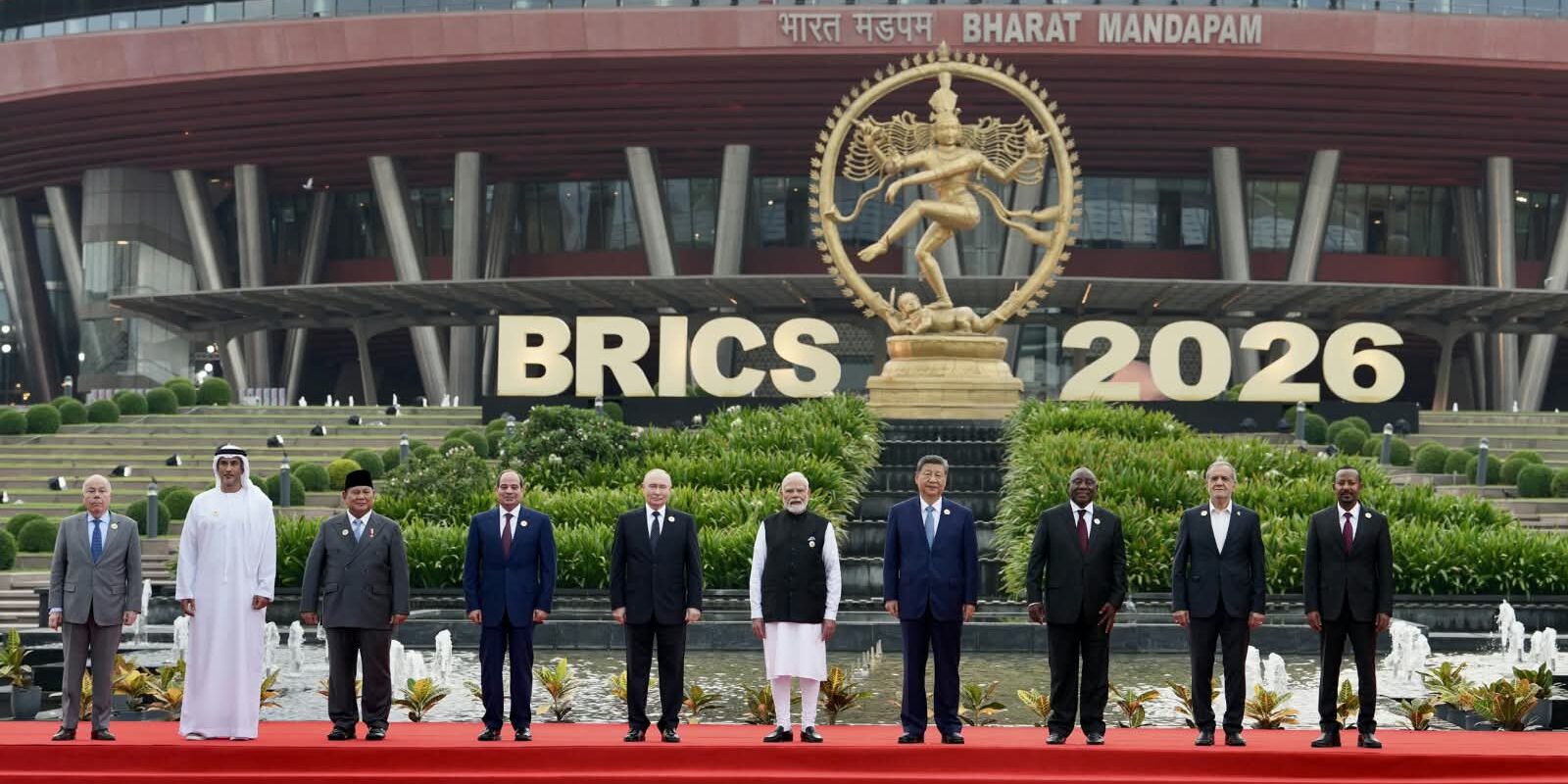
The 18th BRICS summit was hosted by India on 12th and 13th September 2026 in New Delhi. The summit marked an outstanding moment in the evolution of BRICS as a platform for the Global South. At this summit, 11 member states were present, including Brazil, Russia, India (host), China, South Africa, Iran, Egypt, Ethiopia, Indonesia, UAE, and Saudi Arabia. In addition to member states, delegations of seven partner countries also attended the summit, including Kazakhstan, Malaysia, Vietnam, Nigeria, Uganda, Cuba, and Belarus. The summit was also relevant specifically in the gradual stabilisation of India-China relations. The background of geopolitical fragmentation made this summit more important. For India, the summit was an opportunity to advance its strategic autonomy while managing competition and selective cooperation with China. The summit strengthened India’s multi-alignment strategy. As Prime Minister Modi stated that BRICS is not an anti-US alliance but a non-Western platform through which developing and emerging economies can influence global governance.
The New Delhi Declaration reaffirmed the BRICS commitment to a more representative, fair and inclusive global order, with stronger multilateralism and greater participation of emerging and developing economies in global decision-making. The group proposed reforms in the United Nations, including the Security Council. And also argued that the developing countries must have a greater voice in international institutions. China and Russia reiterated support for the aspirations of Brazil and India to play a greater role in the UN, including its Security Council.
Major Strategic Gains for India
The BRICS presidency strengthened India’s leadership of the Global South, strengthened India’s diplomatic profile, and supported its long-standing emphasis on a more representative and multipolar global order. It underlined a greater influence on the BRICS agenda. Thus, India’s BRICS strategy can be characterised as “cooperation where interests converge, competition where interests diverge, and dialogue to prevent competition from becoming conflict”. India’s presidency success can be analysed with the New Delhi Declaration and the presence of the heads of member states
| Area | Major Takeaway for India |
| Doplomacy | Enhanced India’s Global South leadership |
| Strategic Autonomy | Expanded India’s room for multi-alignment |
| China | Created an additional platform for structured engagement |
| Trade | Opportunity to promote balanced intra-BRICS trade |
| MSMEs | Better access to trade finance and international markets |
| Technology | Expanded cooperation in AI, digitalization |
| Agriculture | Greater cooperation inclimate-resilient and digital agriculture |
| Youth and education | More opportunities for skills, research and academic mobility |
| Energy | Cooperation in smart grids, storage and hydrogen |
| Global governance | Stronger Indian advocacy for reform in Global South representation |
BRICS Summit: In the Lens of India-China Relations
. This summit succeed to break the ice and Xi’s present in New Delhi started a dilague between India and China and chose dilague with healthy competition. BRICS also provides India and China with an institutional space for selective cooperation despite strategic competition. While disagreements persist over the boundary, Arunachal Pradesh, Pakistan, trade imbalance, technology and regional influence, both countries share interests in global economic governance, development, climate cooperation and Global South representation. Xi’s visit to after seven year itself tells a story of new normalisation between these two. The body language of both the leaders were very positive and shows their willing to normalise the relations despite disagreements. So, this summit gives a chance to Modi and Xi to sit together and think beyond rivalry and disagreement.
For India, the key strategic lesson is therefore “managed competition” with China competing where interests diverge, cooperating where interests converge, and preventing rivalry from escalating into conflict. India should use BRICS to strengthen its Global South leadership while maintaining military preparedness, economic diversification, strategic partnerships and an independent foreign-policy outlook. Overall, the summit signifies not an India-China partnership, but a pragmatic effort to manage competition while preserving channels for dialogue and cooperation.
Conclusion
The 18th BRICS Summit marked an important stage in India’s efforts to strengthen its global influence, strategic autonomy and leadership of the Global South. India’s Presidency demonstrated its capacity to provide leadership within an increasingly diverse grouping while maintaining consensus among members with differing geopolitical interests. By prioritising trade, technology, sustainable development, innovation, agriculture and human-centric cooperation, India used BRICS as a platform to advance its developmental and diplomatic priorities.
A major strategic gain for India was the opportunity to pursue strategic autonomy without strategic isolation. Rather than treating BRICS as an anti-Western bloc, India advocated a more inclusive and multipolar framework focused on reforming global institutions and strengthening the representation of developing countries. This approach enables New Delhi to simultaneously deepen partnerships with the United States, Europe, Japan and Australia while maintaining institutional engagement with China and Russia. The Modi-Xi interaction on the sidelines of the summit was particularly significant for India-China relations. However, it should be understood as cautious stabilisation rather than strategic rapprochement. Continued emphasis on peace and tranquillity along the border indicates that border stability remains the foundation for broader normalisation.
References
- Ministry of External Affairs, Government of India, BRICS India 2026 and official summit/outcome documents.
- BRICS 2026 Official Portal, Government of India- information on India’s BRICS Chairship and the 18th Summit.
- Associated Press (AP), “India’s Modi and China’s Xi seek to reset ties on BRICS sidelines”, September 2026.
- Reuters, “India-China relations, from conflict to cautious thaw,” September 12, 2026.
- Indian Express, “BRICS summit: What trajectory of China-India ties means for the grouping”, September 12, 2026.
- PIB, Government of India, Rio de Janeiro Declaration- Strengthening Global South Cooperation, July 2025, including support for India’s 2026 BRICS Chairship.
- BRICS Brazil Official Portal, Leaders’ Declarations and previous BRICS summit documents.