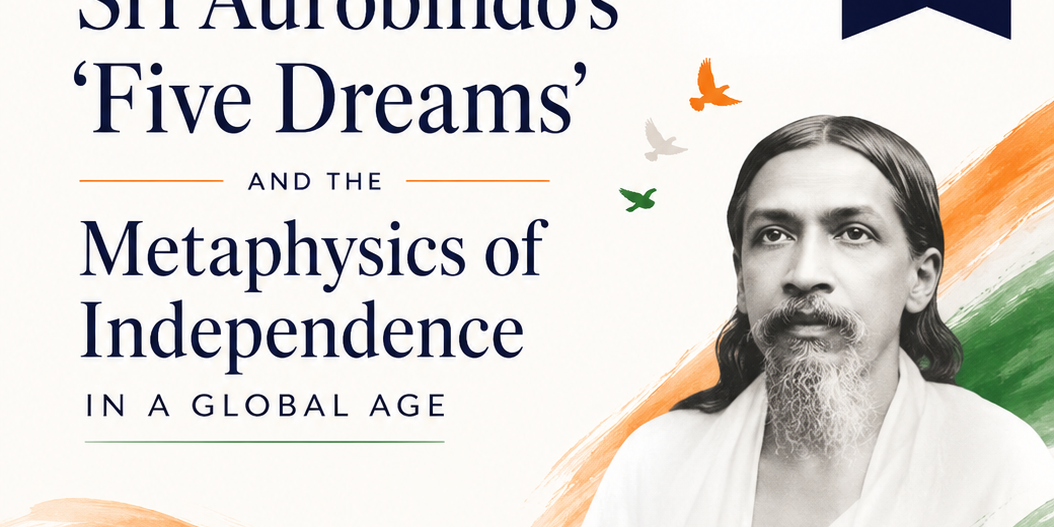
Sri Aurobindo’s ‘Five Dreams’ and the Metaphysics of Independence in a Global Age
Anushka Verma
Abstract: The speech by Sri Aurobindo on the first Independence day in 1947 was not only a political speech, but a metaphysical re‑conception of independence, what independence should actually mean. He made five key aspects of freedom in his speech, the liberation of India, the revival of Asia, the formation of a world union, India’s spiritual gift to humanity and the evolution of consciousness. This article perceives these dreams as a multi-dimensional ontology of freedom in which independence has not only been exhausted by sovereignty or decolonisation but also in civilizational, planetary and spiritual terms. Based on reading his 1947 speech and later reception and current Independence discourses and India’s global positioning, we argue that Sri Aurobindo is in fact advocating a “metaphysics of independence” by the very nature of the way that freedom is achieved through changes in nationhood, regional solidarity, world order, spiritual culture and consciousness in the world.
This study is structured in the context of his philosophy to analyse whether these dreams are fulfilling, distorted or delayed in a world of global competition, technological advancement and disjointed identities. Because it frames independence as a five-fold, ongoing process rather than a historical event, the article also calls for a rethinking of India’s post-colonial trajectory and its obligations towards itself, Asia, humanity, and the future of human consciousness in the twenty-first century.
Keywords
Sri Aurobindo – Five Dreams – Metaphysics of freedom – Independence Day discourse – Civilizational destiny – World‑union – Spiritual evolution – Higher consciousness
Introduction
Sri Aurobindo’s Independence Day message of August 1947, which has been called the “Five Dreams” broadcast, is unique in both the history of Indian nationalism and the development of twentieth-century political thought. It was delivered to All India Radio, Tiruchirapalli, on the eve of India’s formal independence and speaks of what Sri Aurobindo calls a “personal declaration of the aims and ideals” that he had in mind in his youth and made up of five interlinked dreams of freedom.
The work makes Independence Day look like not just a constitutional event but a stage in the history of anti-colonial struggle, a point in which India, Asia and humanity are participating. Independence, then, goes beyond a nation to the regionally connected, world-connected, spiritual culture and consciousness. The paper’s first step is to put the broadcast in the context of Sri Aurobindo’s philosophy. Then it examines each dream as a discrete but connected document of freedom, and then they are left to their partial fulfillment, distortion and long-term latency as we turn to a time of geopolitical rivalry and technological surge, and a fractured world of ideas, to move on. It suggests that by setting independence as a five-fold unfinished business rather than a completed historical event, Sri Aurobindo can lead to a significant rethinking of India’s post-colonial trajectory and responsibility towards Asia, humanity and human consciousness.
Historical and Philosophical Context of the 1947 Message
Sri Aurobindo’s involvement in politics began with his early participation in revolutionary nationalism during the first decade of the twentieth century, at which time he formulated a notion of freedom that went beyond the scope of constitutional self-government. In his nationalist writings and speeches he regarded freedom not merely as a political right but as a spiritual duty grounded in dharma and in the deeper destiny of India as a “spiritual nation”. Nevertheless, by the time of the 1947 broadcast Sri Aurobindo had mostly withdrawn from open political activity and was living in Pondicherry, focusing his attention on the development of Integral Yoga and an evolutionary philosophy of consciousness.
The fact that he had this dual background makes it possible to understand why the message of the Five Dreams links the actual attainment of political independence with the various global movements which had for a long time occupied Sri Aurobindo. In the opening of the broadcast it is famously stated that
“August 15th is the birthday of free India; it marks for her the end of an old era and the beginning of a new age. But we can also make it a significant date in a new age beginning for the whole world by means of our lives and actions as a free nation in regard to the political, social, cultural and spiritual future of humanity.” (Sri Aurobindo, 1947)
Independence is thus at once seen as an event of major importance in world history, India’s emergence as a free nation acting as a catalyst for global transformation.
In Sri Aurobindo’s integral philosophy, the idea in question is not an exaggeration but rather a result of his metaphysical view of evolution. As he sets out in works such as The Ideal of Human Unity and The Life Divine, he holds that the evolution of nature is ultimately a process leading to the psychic and spiritual unification of the human race, ending in a supramental transformation of consciousness. Political and social developments, such as nationalism and internationalism, are thus seen as manifestations of a deeper teleology of unity. The Five Dreams give a concise expression of this evolutionary outlook by linking India’s national liberation with the revival of Asia, world-union, India’s spiritual mission and a further stage of evolution beyond the mind.
The First Dream: National Freedom and Unity Beyond Partition
Sri Aurobindo referred to his first dream as being “a revolutionary movement which would create a free and united India”. In the broadcast he stated that “India is now free but has not attained unity”, specifically mentioning the division of British India into two dominions and the communal violence which took place at the time of independence. He cautions that “the old division of society into Hindus and Muslims appears to have become a permanent political split in the country”, and includes the clear judgment that “the partition must end; unity must and will be achieved, since it is necessary for the greatness of India’s future”. (Sri Aurobindo, 1947)
The fact that these formulations show national independence, in other words the end of colonial rule, to be only a partial realization of the first dream means that the metaphysical aspect of that dream goes beyond mere sovereignty and consists instead in a deeper unity of the national organism which extends past communal fragmentation and political division. Independence in this view is a process of becoming rather than a fixed state, and its completion involves what might be described as an ontological de‑partitioning of the Indian self. Since Sri Aurobindo asserts that unity “must and will be achieved”, he gives national unity a quasi‑necessitarian character, as though it were required by the inner law of India’s being.
At the same time, Sri Aurobindo does not specify a definite constitutional structure for this unity. He notes that unity could “arise naturally as a result of a growing recognition of the necessity not only for peace and concord but also for common action … regardless of the form taken, the exact form may therefore be of a practical rather than a fundamental significance.” This implies that the metaphysics of national independence places greater emphasis on substantive unity, that is, on mutual recognition, common action and solidarity rather than on the particular institutional arrangements by means of which it is expressed. Independence thus has a relational character, being based on the practices of common action which overcome division yet allow for pluralism.
The Second Dream: Asian Resurgence as Civilizational Freedom
The second dream of Sri Aurobindo was about “the resurgence and liberation of the peoples of Asia and her return to her great role in the progress of human civilisation”. In his speech of 1947, he stated that “Asia has arisen; large areas are now completely free or are at the present moment being liberated”, and added that the parts which are still under colonial rule are advancing “through all the struggles towards freedom”. Thus the dream places India’s independence within a broader process of decolonisation and civilizational resurgence, connecting national freedom with the liberation of Asia as a continental and cultural entity.
This second dream goes beyond the modern nation-state in the realm of metaphysics. In this view, freedom means recovering and reasserting Asia’s “great role” in human civilisation, a role which had been disrupted and eclipsed by European imperial expansion. Sri Aurobindo’s perspective is that the liberation of the Asian peoples is not only the freedom of political autonomy but also the revival of cultural and spiritual resources by which Asia will contribute to a more balanced world civilisation. This implies that independence is civilisational and not only territorial.
When viewed in the context of Sri Aurobindo’s other works, the notion of Asian revival becomes a bridge between national freedom and world union. The first dream is to make India’s political and spiritual self-determination a reality, but the second takes this dream to a wider place in the world from the political and spiritual sphere in which the free nations of Asia regain the freedom to change the trajectory of human history. Asia is not a geopolitical bloc or a competition between the western world but rather a group of ancient civilizations which can give up the ethical, spiritual and cultural aspects of civilization which have been overlooked for so long. In this sense, Asia’s revival is not about replacing one hegemony with another, but the reunification of diverse civilizational voices that together will form the basis of a more harmonious and truly universal human order. So the second dream is a bridge connecting the recognition of national identities with the eventual victory of a society with diversity, and not domination.
The Third Dream: World-Union and the Planetary Dimension of Freedom
This dream describes Sri Aurobindo’s vision of “the development of an international spirit and organisation” that could lead to “the formation of a world-union.” And while this is the most political of his five dreams, the philosophy of independence is not only in line with internationalism but in line with the world’s philosophy. He spoke of it quite clearly in his dream and said:
“The beginnings of that international spirit and organisation have been made, but as yet they are little more than beginnings.” (Aurobindo, 1947)
It is important to understand that Sri Aurobindo was not getting too excited about the United Nations as we know it, but that a world-union needs more than diplomatic structures. From his evolutionary perspective, he wrote that human history’s growth of social groups (families to tribes, cities to nations) has been slow and gradual and each step was fought against the self-centered forces of division. The nation-state is just a step forward from a smaller one, he said. In other words, this third dream portrays world-union not as a dream-like prospect but as the inevitable next step in an evolutionary process. He writes,
“a necessary step in the progressive self-realisation of the spiritual principle in humanity,” Sri Aurobindo (1997)
What sets Sri Aurobindo’s vision in contrast to liberal cosmopolitanism or socialist internationalism is that the world-union needs to be founded on something more than economic ties or cooperative agreements. He said that “a mere administrative and political unity would not be enough” and that the real thing needed to be “a spiritual and psychological unity.” On a global level this would mean freedom from war, from empire and from what he called ‘the nation-ego’, that false sense of collective identity that fuels selfishness and conflict. But this freedom would not be constructed or forced, but rather be organic. It would be generated by ‘a change in the consciousness of humanity’ which in turn would allow for an evolutionary change that made unity feel natural, not imposed.
Today the relevance of this dream is complex. On the one hand, post-1947 history has witnessed a massive development of global governance, from the United Nations to regional entities (the European Union) to the wide web of treaties and organisations which govern trade, human rights and environmental protection. Economic globalization has created mutually beneficial interdependencies that constrain unilateral action. On the other hand, the nation-ego persists and in certain respects has intensified, great-power competition has resurged, multilateral institutions face legitimacy crises, and the very vocabulary of “world order” has acquired nostalgic rather than prospective connotations. The dream of world-union, hence, appears simultaneously more necessary than in 1947, awaiting the psychic and spiritual conditions that Sri Aurobindo considered indispensable.
The Fourth Dream: India’s Spiritual Gift to Humanity
The fourth dream is perhaps the most striking and controversial part of Sri Aurobindo’s metaphysics of independence, his belief that “the spiritual gift of India to the world” would be “an essential element in the future creation of humanity.” In the broadcast he makes this point in a very direct manner,
“For I was certain and in this I have not been mistaken that a spiritual rebirth of humanity must be the inevitable eventual aim of the evolutionary process.” (Aurobindo, 1947)
India is at this point not just a geographical or political place but a spiritual one in world history that should be able to preserve and share in the world the practices of inner transformation which can only solve the crisis of modern civilization. The dream must be interpreted with care to avoid appropriation of nationalism and lazy dismissal. Sri Aurobindo rejects any claim of Indian superiority, he says,
“All nations have their part to play in the total advance of mankind; each has something to contribute to the common stock.” (Aurobindo. 1947)
India’s contribution is not based on new technologies of consciousness developed over thousands of years, it is based on the discovery of the infinite and the absolute in spirit and the release of the human mind and life into the spiritual infinite. So the gift is not in itself a gift but belongs to us, in the sense that it touches on all aspects of human existence that have been largely ignored in modernity’s instrumental rationalization. The metaphysics of independence that is being applied here is not so clear and easily misunderstood.
India’s freedom matters in a practical sense as well. A self-governing, self-respecting nation could make this spiritual contribution and also demonstrate this spiritual contribution without the distortions of colonial subordination. But the dream is more than the nation, the dream is about what Sri Aurobindo terms the spiritual future of mankind, a consciousness that is rising beyond the mental ego that currently dominates human life. Independence in this sense, in this register, is freedom from the spiritual impoverishment of a civilization “whose ideals are centred in the body and the vital life” and the way to what he describes as a higher and deeper experience and truth. The purpose of this dream today is about blurring the line between dismissive secularism and uncritical spiritualism.
On the one hand, the global institutionalization of Indian spirituality, the spread of yogic practices and the study of contemplative traditions, all point to some fulfillment of this dream. And the language of mindfulness and well-being has become a global language. In India, which is becoming ever more material (and cultural) based on spiritual and cultural resources, commercialization, trivialization and the reduction of spiritual disciplines to stress-management techniques are very different from Sri Aurobindo’s visions. The dream’s latency is because spiritual insight can not be integrated with economic, political and scientific structures, the persistence of what he termed “the divorce of spirit and life” that characterizes modernity is still anchored in the dream. We are able to say the gift has been given but not received, pieces are scattered but the transformative integration is on its way.
The Fifth Dream: The Evolutionary Ascent of Consciousness
The fifth and final dream reveals the metaphysical infrastructure underlying all the others,
“an evolution in human consciousness which would raise man to a higher level and begin the solution of the problems which have troubled him throughout his history.” (Aurobindo, 1947)
This is Sri Aurobindo’s most obvious appeal, summarizing The Life Divine and decades of practice in Integral Yoga in a single sentence. The problems that “troubled” humanity, war, exploitation, alienation, the hungry search for satisfaction that fuels discontent are rooted in the structure of mental consciousness itself, with its parts and instrumental rationality. Sri Aurobindo tells us,
“with measured confidence, that this is the last dream which I have evolved slowly through the years and which is now, I believe, beginning to take shape in the earth-consciousness”. (Aurobindo, 1947)
The qualifier “I believe” and “beginning” speak to both epistemic humility and the incremental, experimental nature of spiritual evolution. Sri Aurobindo has to see that while teleological philosophies promise results, the transformation he fantasizes about is a process and can only be achieved through practice and togetherness.
At this point in time, there can be no freedom in freedom from the structures of ignorance and egoism that have been the basis for human possibility. The metaphysics of independence becomes, then, its most radical extension. Where the first four dreams concern transformations in social and political form, the fifth is about subjectivity itself. This “higher level” of consciousness has the sense of integral knowledge, that is, it is what the mind is to unite, what matter is to unify and to make the individual and the universal one without losing.
In Sri Aurobindo’s technical vocabulary, this would be the birth of the so-called “supramental” or “gnostic” consciousness, a kind of being-with-world participation no longer bound by the subject-object dichotomy at all. Contemporary readers might be surprised that this dream is the most distant from our reality, and therefore vulnerable to the possibility of esoteric abstraction. But Sri Aurobindo insists that it is so,
“In a change of consciousness the necessary change can be made in the world.” (Aurobindo, 1947)
Without it, he insists that external arrangements, well intended as they may be, will be undermined by the egoistic structures they were designed to transcend. Instead of solving human problems, technology has extended our ability to destroy and manipulate, cognitive capitalism has pioneered sophisticated techniques of attention capture that have been against the liberation of consciousness rather than for the liberation of consciousness, the fragmentation of identities and the celebration of difference, often serves to support rather than to dissolve egoic fixations. The fifth dream waits not as impractical idealism, but as the submerged condition of possibility for any meaningful transformation.
Partial Fulfilment, Distortion and Continued Latency
The seventy-plus years since Sri Aurobindo’s broadcast allow for a provisional assessment of the five dreams’ path, not to make any verdicts but to glimpse how metaphysical possibilities work out in history.
The first dream is the most complex. India remains independent; partition continues to take shape as well as other partitions and communal mobilizations that could have taken place in Sri Aurobindo’s absence. Yet the institutional and imaginative possibilities for unity have also increased. Economic integration, federal arrangements, and the reality of a truly national public sphere, although contested, suggest that ‘common action’ emerging from the differences is developing in ways not anticipated in 1947. The ontological de-partitioning Sri Aurobindo envisioned, however, is still aspirational, not just a goal, but it remains a critical standard and intermittent achievement.
The second dream of Asian resurgence has been somewhat realized in ways that make it difficult to understand simple stories. Asia’s economic and geopolitical renaissance is no less than a reality, the “return” of civilizational powers like India and China to world history and global dominance transforms the distribution of power. But such a renaissance has often taken forms that lack the spiritual-cultural content Sri Aurobindo thought so crucial. Such state-driven developmental nationalism, consumerist modernization and militaristic competition are Western in nature, not Asian in nature. The dream’s distortion is in the reduction of civilizational freedom to the status of great power, its latency is in the unrealized capacity for real different modernities to be articulated.
The third dream of world-union has perhaps been the most discouraging. The institutional systems Sri Aurobindo tentatively welcomed have been fragile, the nation-ego has reappeared more and more, and the humanity that might have developed from the horrors of the twentieth century is often forgotten. But the objective interdependencies of climate change, pandemic disease and financial contagion that make isolation impossible also create conditions for real solidarity, even if we do not like them. The dream’s latency here is not absence, but presence, the contradictions of the present can force recognition that idealistic appeals could not.
The fourth and fifth dreams are linked in the present moment. The globalization of spiritual practices is real diffusion, the trivialization and commodification is structural distortion. Meanwhile, consciousness studies, contemplative neuroscience and phenomenological philosophy intersect in unexpected ways with Sri Aurobindo’s top concerns to suggest new idioms to express what he experienced in his life. The latency of these dreams might be less a problem of the absence of the dreams than an issue of their incomplete translation, at least to the practices and institutions which can provide spiritual enlightenment to our life.
Conclusion: Reinterpreting the Five Dreams in the Context of Vision 2047
Sri Aurobindo’s Five Dreams, as a metaphysics of independence, broke through in a way the usual commemorations of 15 August do not. Where Independence Day discussions are often a celebration of the past, of sacrifice in the end, freedom in the end, destiny in the end; the Five Dreams focus on the future. Independence is not an end in itself but something that is being realized in the process of human, national, civilizational and spiritual transformation. Freedom in this vision is not a possession but a practice, not a status that can be set and we are not only the state of mind but a state of life that is being created. Such a re-position of our modern society has implications for India as well.
Sri Aurobindo’s polemic against triumphalist nationalism reminds us that political sovereignty is incomplete without real national unity based upon our mutual recognition and our common purpose. In the face of globalization and competition for the soul of the Earth, he sees India’s leadership as ethical, cultural and spiritual, not strategic. Against the fragmentation of world-union he sees it as not just a world-building utopia but an evolutionary imperative for mankind. Against the commercialization of spirituality and the utilitarian logic of modern civilization, he confirms the need for a profound transformation of consciousness that can bring science, politics, economics and culture together to meet the spiritual needs of all human beings. In doing so, Sri Aurobindo offers a concept of freedom that transcends politics and metaphysical idealism and integrates institutions and consciousness development in our lives.
In the current scenario relating it with Vision 2047, India’s hundred years of independence resonates beyond development targets or economic achievements. The vision of a prosperous and great bharat, technologically advanced and globally popular country, is based on the philosophy of prosperity that is not only the accumulation of material wealth but the integration of human capacities, social justice, cultural confidence and spiritual maturity, and not only on prosperity but on the development of a nation and humanity.
Economic growth, scientific innovation, digital transformation and strategic strength are all the things that Sri Aurobindo wants to pursue. However, in Sri Aurobindo’s vision they are only meaningful if they are also linked to the development of the nation and the people. So a truly developed India is one that combines material wealth and ethical duty, civilizational confidence with openness to the world and technological productivity with the development of higher consciousness. The growing power of India in global governance, the revival of Asia, multipolar collaboration and acceptance of Yoga and Indic knowledge systems is also evidence that some of Sri Aurobindo’s vision is becoming relevant again.
At the same time, the continuing division of communities, political conflicts, ecological crises, technological disarray and human loss of focus in society all show us that the Five Dreams are still not complete. Their relevance is that they provide a framework for considering our accomplishments in terms of their immediate utility and their contribution to the evolution of humanity. Sri Aurobindo ended his 1947 broadcast by saying,
“That is a large programme and the time is short. But in the Indian view of time, what is a hundred years?”
That is what is coming back to me the most in the present day, India’s hundred years of independence. Vision 2047 can then be interpreted not only as a developmental roadmap, but also as an opportunity to pursue the greater vision of the Five Dreams that brings about a positive and inclusive Bharat that is at the heart of the world economy and the moral, cultural and spiritual upliftment of the common man. In that sense, the metaphysics of independence is still unfinished but the hope is strong. It is still calling on India to transform political freedom into civilizational leadership, national development into global responsibility and material development into real human potential.
References
Aurobindo, S. (1947, August 15). Message of August 15, 1947 (The Five Dreams). Sri Aurobindo Ashram.
Aurobindo, S. (1997). The complete works of Sri Aurobindo (Vol. 21). Sri Aurobindo Ashram Publication Department. (The Life Divine)
Aurobindo, S. (1997). The complete works of Sri Aurobindo (Vol. 25). Sri Aurobindo Ashram Publication Department. (The Human Cycle, The Ideal of Human Unity and War and Self-Determination)
Aurobindo, S. (1997). The complete works of Sri Aurobindo (Vol. 26). Sri Aurobindo Ashram Publication Department. (The Synthesis of Yoga)
Aurobindo, S. (1997). The complete works of Sri Aurobindo (Vol. 36). Sri Aurobindo Ashram Publication Department. (Autobiographical Notes and Other Writings of Historical Interest—contains the 1947 Independence Day Message)
Chauhan, P. S., & Kaur, S. (2025). Vision 2047: Prosperous and Great Bharat. Swadeshi Swavlamban Nyas.
Chatterjee, P. (1993). The nation and its fragments: Colonial and postcolonial histories. Princeton University Press.
Heehs, P. (2008). The lives of Sri Aurobindo. Columbia University Press.
Mohanty, J. N. (2000). The concept of consciousness in Sri Aurobindo’s philosophy. Oxford University Press.
Reddy, V. A. (2000). The grand synthesis: An introduction to Sri Aurobindo’s philosophy. Sri Aurobindo Centre for Advanced Research.