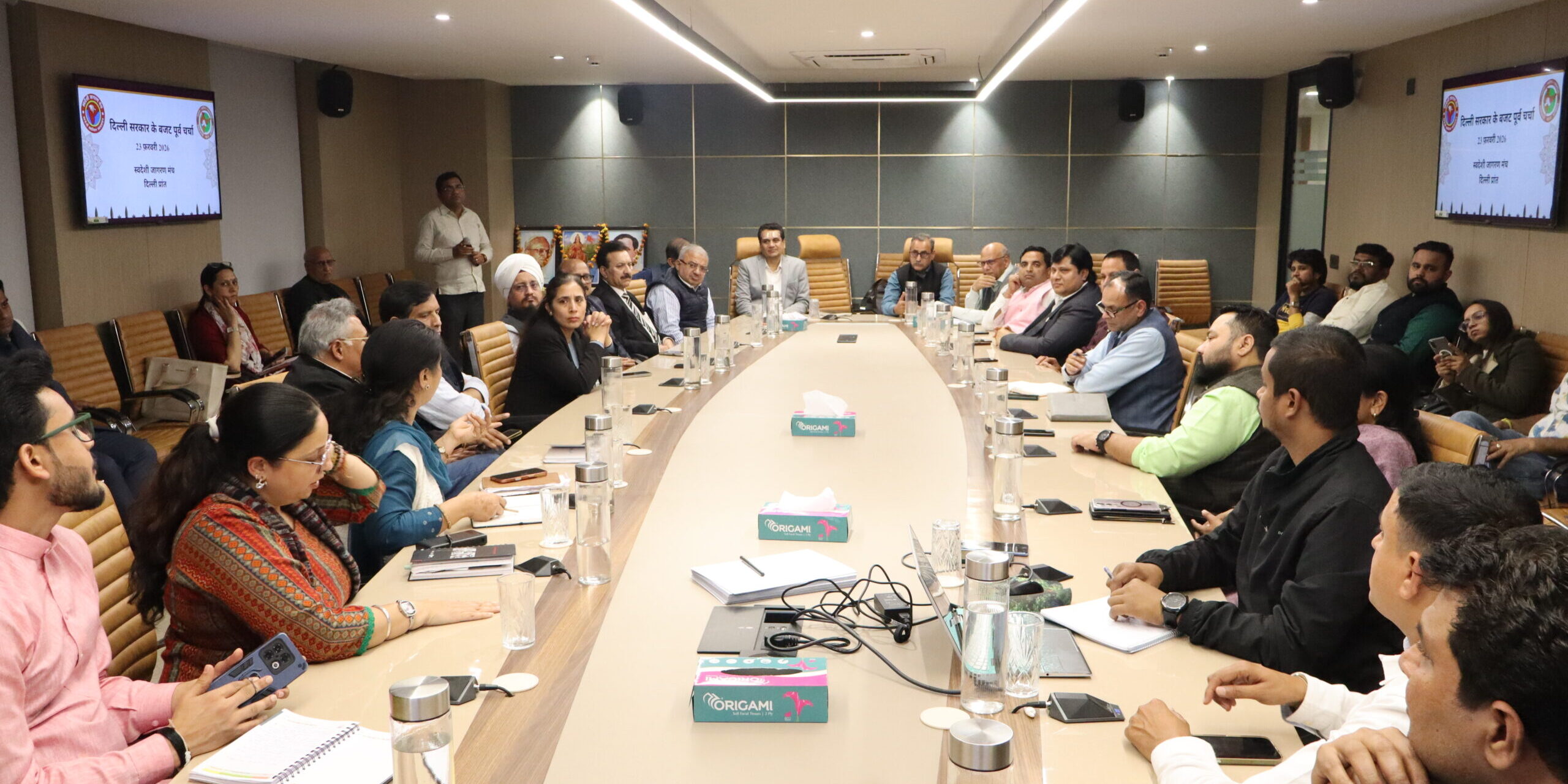
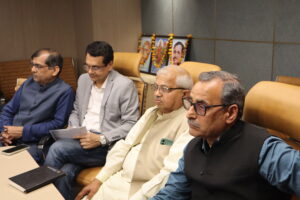
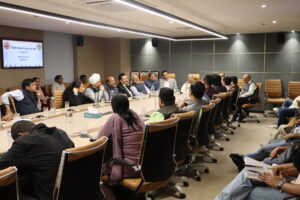
Event Name: Pre-Budget Discussion for the Delhi Government (दिल्ली सरकार के बजट पूर्व चर्चा).
Date: February 23, 2026.
Organizer: Swadeshi Jagran Manch, Delhi Prant.
Objective: To gather comprehensive inputs and suggestions from chartered accountants, advocates, professionals, and social workers to draft a formal proposal for the Delhi state budget.
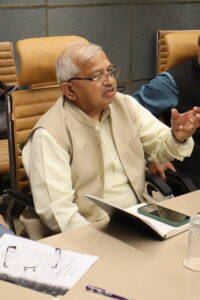
Detailed breakdown of every speaker’s points and suggestions presented during the meeting:
- Deepak Sharma Ji
- Highlighted that Delhi’s unique demography consists of slums, unauthorized colonies, gated societies, and rural villages, all of which must be considered in the budget.
- Suggested transforming Delhi into a world-class, pollution-free city (referencing Beijing’s transformation) by shifting focus away from large manufacturing toward a knowledge-based, AI, and service economy.
- Emphasized the need to upgrade basic infrastructure like drainage and sewerage systems.
- Advocate Surendra Gambhir
- Pointed out a severe lack of attention to sanitation and road maintenance in industrial areas, such as Vishwas Nagar.
- Argued that since these areas generate substantial revenue, the government must provide them with basic upkeep.
- Advocate Rakesh Kumar
- Highlighted instability in GST administration, noting that GST Commissioners are frequently transferred or burdened with multiple charges before they can understand the department.
- Suggested that Commissioners be appointed for a minimum of two years with independent charges.
- Demanded that vacancies for Additional and Special Commissioners be filled to clear a massive backlog of appeals pending since 2017.
- Criticized the abrupt suspension of GST registrations without notice, particularly near month-end to meet budget targets, which severely disrupts trade.
- CA Mukesh Jain
- Warned that major wholesale markets (like Gandhi Nagar) and industries are migrating out of Delhi to the NCR due to an unfavorable business climate.
- Suggested that the government provide relaxations and a better environment to retain local businesses.
- CA Rajendra Arora
- Supported the call for permanent GST Commissioners, noting that out of a ₹1 Lakh Crore budget, over ₹50,000 Crore could be seamlessly collected via proper GST administration.
- Strongly proposed a VAT Amnesty Scheme to clear pre-2017 litigation, which could instantly generate thousands of crores for the government.
- Advised the implementation of Mobile Squads to check e-way bills and catch tax evasion, similar to the system in Uttar Pradesh.
- Suggested reducing the intra-state e-way bill threshold from ₹1,00,000 to ₹50,000 to better regulate the movement of goods.
- CA Satish Gadh
- Requested the implementation of faceless GST assessments to prevent the harassment of small traders.
- Suggested creating a social security fund via the Traders Welfare Board.
- Called for a dedicated finance commission for women, subsidized loans for women’s Self-Help Groups (SHGs), and financial aid for critical women’s health issues like breast cancer.
- Proposed that the government subsidize OPD consultation charges for senior citizens according to CGHS rates.
- Advocated for libraries dedicated to higher education students, water line upgrades, mini-stadiums in every assembly, and an extension of the Namo Bharat Rapid Metro to Shamli.
- Anuradha Bharwal
- Suggested establishing a medical customer care helpline for pre-ambulance health emergencies.
- Proposed collecting house tax from lower-tier residential categories (C, D, E, F) to significantly increase revenue.
- Urged the government to strictly regulate Paying Guest (PG) accommodations, specifically to protect female university students from exploitation.
- Suggested aligning AI and sports with youth entrepreneurship programs.
- CA Sandeep Sharma
- Echoed the need for a VAT Amnesty Scheme.
- Suggested a One-Time Amnesty Scheme for water bills for homes up to 100 sq. yards, noting that current waivers only clear surcharges while leaving enormous principal amounts (₹1.5–2 Lakhs) pending.
- Ayan Bhatnagar
- Noted that the structure of Women’s Self-Help Groups is weak in Delhi.
- Recommended providing technical and marketing support to these groups so they can sell products online and compete in larger markets.
- Advocate Sumit
- Expressed deep concern over environmental degradation, specifically criticizing the conversion of green spaces and parks (e.g., Yamuna Sports Complex) into banquet halls.
- Urged the government to prioritize environmental health over revenue collection.
- CA Umesh Pandey
- Argued that small vendors fear compliance more than tax rates, deliberately keeping their turnover under ₹40 Lakhs to avoid GST registration, which stunts economic growth.
- Strongly advised the government to increase its Capital Expenditure (CapEx) to 30-40%, arguing that building assets (like property) generates sustainable recurring revenue, unlike purely revenue-based spending.
- Unidentified Speaker (Focusing on Infrastructure & Education)
- Suggested setting up a High Power Committee to resolve “Ease of Doing Business” issues.
- Proposed restructuring the Delhi Jal Board with independent experts and unbundling water supply and distribution to ensure 24/7 clean water.
- Recommended providing tablets and extra classes to government school students up to the 12th grade.
- Highlighted civic issues like the lack of community centers, child play areas, and unhygienic streets caused by stray animals.
- Dr. Sarabjeet kaur ma’am
- Called for stabilizing soaring real estate prices and bringing unauthorized colonies under the house tax net.
- Suggested expanding electric vehicle (EV) subsidies beyond the current 27,000-vehicle limit and promoting public transport to cut pollution.
- Recommended making AI studies compulsory for 9th-12th grade students in government schools to boost Delhi’s knowledge economy.
- Lalit
- Discussed the “NEEV” school entrepreneurship program, which gives ₹2,000 seed money to students.
- Suggested pooling this money into a common team bank account rather than individual accounts so funds aren’t lost if a student drops out.
- Advised hiring genuine field experts (like Swadeshi volunteers) for student mentorship rather than paying random speakers for mere formalities.
- Sushma (Street Vendors Association)
- Advocated for the strict implementation of the 2014 Street Vendors Act by creating dedicated legal vending zones with a specific budget.
- Requested Ayushman healthcare cards for hawkers and a dedicated office space/staff in MCD zones to resolve vendor disputes.
- Vinod
- Stated that restarting property registries on Power of Attorney would instantly generate thousands of crores in stamp duty revenue for the government.
- CA Vikas Sharma
- Suggested conducting GST awareness programs for small vendors who unknowingly cross the ₹40 Lakh limit purely due to digital UPI transactions.
- Recommended drastically revising circle rates closer to actual market values, which would vastly increase stamp duty collections.
- Proposed renting out underutilized government properties as co-working spaces for tech industries to earn rental income.
- Prof. Pradeep Chauhan sir
- Vision for a World-Class Global City: He mentioned coming prepared with notes specifically on how to make Delhi a “world-class competing global city” because the city deserves it. However, he emphasized that achieving this status requires fixing fundamental basic amenities first.
- Tackling Pollution & Climate Change: He pointed out that Delhi’s global reputation is taking a hit due to severe pollution. He suggested studying cities like Beijing, which successfully transformed their highly polluted environments in just 3 to 4 years. He noted that with a “double engine” government, there is no shortage of funds to execute such a transformation.
- Upgrading Basic Infrastructure: To truly become world-class, he stated that Delhi urgently needs a highly modern drainage and sewerage system, along with clean, well-maintained roads and streets.
- Transitioning to a Knowledge Economy: He agreed with previous speakers that Delhi cannot sustain heavy industrialization. Instead, it must be developed as a Service, Knowledge, and AI-driven economy. He urged the government to establish modern technical institutions and AI centers to boost employment.
- Decriminalizing Tax Compliance: Addressing the concerns of the traders, he shared that they had previously discussed decriminalizing tax non-compliance with the Finance Minister to remove fear among honest taxpayers, adding that GST portal systems are steadily improving.
- Boosting Capital Expenditure (CapEx): He strongly supported the idea of increasing the government’s capital expenditure. Drawing on economics, he highlighted the “multiplier effect,” explaining that building assets will multiply the state’s recurring income and drastically increase employment.
- Improving Local Governance: Finally, he stressed that many administrative failures, as well as rampant issues like the sale of adulterated (fake) food, stem from poor governance. He urged for immediate improvements in both local and institutional governance.
- CA Anil Sharma
- Pointed out that ₹40,000 Crore of the ₹1 Lakh Crore budget goes purely to administrative expenses, urging the government to reduce these costs.
- Stressed that pollution is an NCR-wide issue requiring a unified approach. Proposed developing Delhi as a “non-industrial” city focused on services and culture.
- Advised the government to heavily rely on private CSR funds to expand EV charging stations.
- Recommended empowering Resident Welfare Associations (RWAs) financially—similar to the old ‘Bhagidari’ scheme—to maintain parks and local security.
- Kashmiri Lal
- Concluded the session by insisting that a portion of the budget be unconditionally reserved for the most marginalized and essential workers of the city—such as gig workers, Blinkit delivery drivers, domestic helpers, and ragpickers.
- Suggested forming an independent group to audit previous budgets to see what was actually implemented versus what was merely promised.
- Vote of Thanks
Dr. Sarabjeet Kaur delivered the final vote of thanks to officially conclude the pre-budget discussion.
- She extended her gratitude to all the present dignitaries and participants for their valuable suggestions.
- Special thanks were given to Kashmiri Lal Ji, Pradeep Chauhan Sir, and Surendra Gambhir Ji for their presence and guidance.
- She also specifically thanked the Swadeshi Jagran Manch for successfully organizing such a wonderful and constructive event.