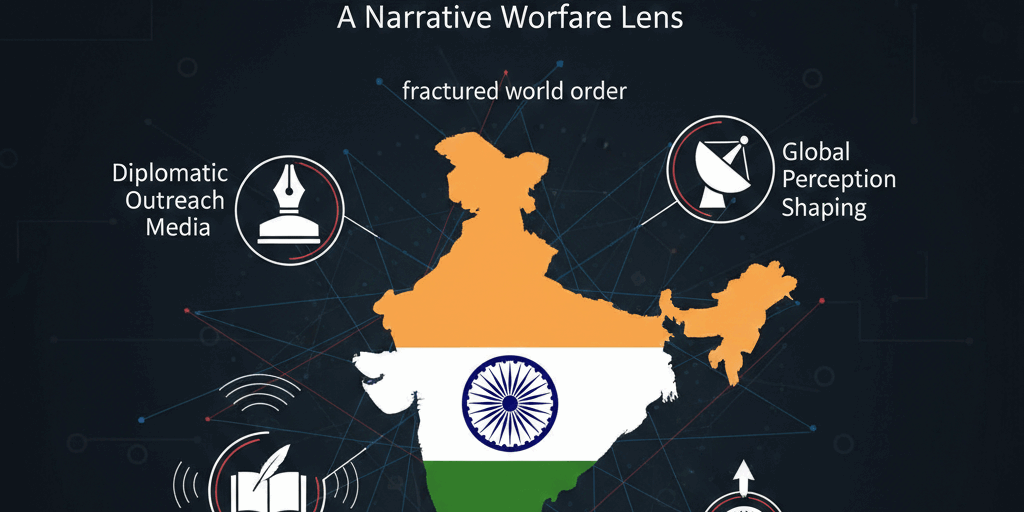
Bharat’s narrative warfare strategy post the Operation Sindoor employed military messaging, diplomatic lobbying, and global media engagement to delegitimise Pakistan’s terror links. How did global media frame the conflict, and how did it influence international perceptions?
Abstract
The paper aims to examine how Bharat strategically used international institutions and foreign media after the Operation Sindoor. This article examines how Bharat applied diplomatic lobbying and engagement with the international media to disrupt Pakistan’s terror funding post the Operation Sindoor. The article subsequently observes how the portrayal by the international media changed public perception of it globally. This study concerned the evolution of war narrative adopted by Bharat in general and the antagonistic relations of Bharat with Pakistan. The article examines Bharat’s diplomatic outreach and media presence, which aims to shape global perception and counter any disparaging narratives.
Keywords
Strategic Communication, Diplomatic Narratives, Global Media Framing, Counterterrorism Discourse, Information Warfare and Perception Management
Introduction
Narrative warfare refers to the stories, symbols, and messages deliberately used to distort or sway public perception, thereby legitimizing political or military actions on one side, while undermining such legitimacy for their adversaries on the other, without the use of physical force. It is thus the realm of information, wherein people’s, societies’, and international actors’ understanding of events and conflicts is shaped in divergent ways.
Operation Sindoor is not an act of aggression but a punitive and pre-emptive counterterrorism action in accordance with India’s long-held policy of self-defence in terms of international law. It also focuses on the unity of the military forces, uniting different branches and intelligence agencies into seamless coordination. Operation Sindoor is presented as a model of judicious military response with moral responsibility, affirming India’s global narrative as a great power committed to combating terrorism while upholding humanitarian values.
Foreign media coverage substantially affected international opinion. The conflict was framed differently by Western and Middle-Eastern trends: Pakistan entertained the narrative of “being an economic victim of aggression,” whereas Bharat laid stress more heavily on “Accountability before Aid.” These opposed narratives were enlarged by media interactions with foreign correspondents and think tanks, and facetted institutional as well as public perceptions.
Operation Sindoor
The Press Information Bureau reports Operation Sindoor as a well-coordinated and intelligence-led counterterror raid conducted by the Indian Armed Forces in May 2025. The operation was planned as retaliation for the April 22 Pahalgam terror attack that resulted in the death of 26 civilians. According to the statement, the operation was based on multi-agency intelligence inputs, which had identified nine functioning terror camps distributed along the Line of Control and Pakistan-occupied territory. The camps, belonging to groups like Lashkar-e-Taiba and Jaish-e-Mohammed, were specifically targeted when they were struck by the airstrikes.
The press release highlights the operation’s accuracy and discipline, noting that the Indian troops went out of their way to prevent civilian casualties and collateral damage, thus highlighting India’s respect for humanitarian norms even in war.
Pakistan’s Narrative Warfare and Strategic Nexus After Sindoor
Following the Operation Sindoor by Bharat, only a handful of countries openly supported Pakistan, condemning the operation in the strongest terms and calling for restraint from Bharat. The foreign ministry of Turkey described the strike as “provocative,” stating that this could lead to war and supported Pakistan’s call for an inquiry into the April 22 terror attack. Azerbaijan expressed concern about civilian casualties and pledged its support to Pakistan. A broader analysis, however, pointed out that although more than 50 Muslim-majority countries remained neutral or supportive of Bharat’s counterterrorism stand, only Turkey and Azerbaijan ever consistently supported Pakistan, a stance influenced by pre-existing political-military alliances[1]. It also reported that The Times of India reported that China assisted Pakistan militarily in crucial aspects, such as satellite intelligence, drone technology, and other weapon systems[2] during the four-day conflict, implying a strategic nexus aligning Pakistan with China and Turkey.
Bharat Narrative Strategy after Operation Sindoor
Global Diplomacy: Bharat’s Post-Sindoor Outreach Campaign
The international reaction to the Pahalgam terror attack and the subsequent SINDOOR operation appeared overwhelmingly sympathetic toward India. The UK, France, Russia, Israel, the U.S., Japan, and the EU condemned these heinous acts, affirming India’s right of self-defence. While France and Israel, and the UAE voiced outright solidarity with India, Russia and Qatar wished for restraint alongside condemnation. Saudi Arabia, Iran, and the other Gulf States condemned terrorism and supported India’s interests, in what can be seen as emerging strategic ties; Sri Lanka, the Maldives, and Palestine condemned the “heinous act” with the EU reiterating that terrorism can never be justified. The U.S. urged restraint and acknowledged the justification for India’s actions, with India holding firm on mediation talks, asserting Kashmir is a bilateral issue.[3]
International media broadly portrayed the Operation Sindoor as a strategically measured and intelligence-driven counterterror operation. The New York Times led with: “Bharat Launches Missile Strikes Inside Pakistan After Kashmir Attack,” noting Bharat’s prior intimation to the U.S. and emphasising precision targeting of terror infrastructure. CNN warned that both nations were “on the brink of wider conflict,” while The Washington Post described Bharat’s strike as a “measured show of force.” The BBC highlighted the targeted nature of the strikes, focusing on terror camps rather than military installations, and stressed concerns over potential escalation[4]. Meanwhile, The Wall Street Journal, Financial Times, The Guardian, and others echoed Bharat’s framing of the operation as a legitimate response to terrorism. Regional outlets like The Times of Israel emphasized Bharat’s right to self-defence. However, critical perspectives emerged, as Al Jazeera and China’s Global Times focused on alleged civilian casualties and perceived Bharat aggression. Overall, the article underscores a global media narrative that largely accepts Bharat’s justification while flagging risks and diverse geopolitical stances.[5]
All-Party Delegations as Instruments of Bharat’s Post-Sindoor Narrative
To isolate Pakistan for its supposed terrorism support and project a global image of its counter-terrorism measures, Bharat employed diplomacy, documents, and data as part of its multi-pronged narrative campaign following Operation Sindoor. The objective of this joined-up campaign was to develop a robust, fact-based case that resonated with the masses and institutions worldwide.
All party delegations sent abroad in May 2025, Asaduddin Owaisi emphasize the Bharat message that Pakistan was the aggressor, not the victim of terrorism. During the delegation’s visit to Saudi Arabia, Kuwait, Bahrain and Algeria, he said There are 240 million proud Bharat Muslims; Pakistan’s narrative is false propaganda. If Pakistan stops funding terror groups, there will be stability in South Asia.
As the appointed leader of one of the all-party delegations sent to the Americas, Congress MP Shashi Tharoor articulated Bharat’s narrative with emphasis on sovereignty, unity, and counterterrorism: Tharoor affirmed that when national interest is at stake, political differences take a back seat, stating, “I see no politics in it… when the nation is in crisis and the central government seeks the help of a citizen … I will not be found wanting. Jai Hind!
Their role during the delegations served to align domestic political credibility with Bharat’s international messaging strategy, enhancing the country’s diplomatic narrative before foreign governments, media outlets, and global public opinion.
Effects and Efficiency
Bharat succeeded in presenting the global community with a rational, fact-based case through diplomacy, paperwork, and facts.
The policy sought to shape global opinion and policy beforehand instead of responding to them. Bharat made it more difficult for Pakistan to secure international approval without addressing the fundamental issue of state-sponsored terrorism by connecting briefs with legal and economic ideas. The “terror economics” theory provided a logical reason as to how to interpret the big picture of the actions of Pakistan and place Bharat on the platform of a responsible state committed to upholding standards for security and world norms. For example, the Resistance Front (TRF) was declared a Foreign Terrorist Organization (FTO) and a Specially Designated Global Terrorist (SDT) on July 17, 2025, by the U.S. Government, in response to the April 22, 2025, Pahalgam massacre, wherein 26 innocent lives were lost.[6] It is considered a front of the Pakistan-based terrorist organization Lashkar-e-Taiba. The designation was welcomed by the Indian Minister of External Affairs, S. Jaishankar, as it represents a major step in the counterterrorism cooperation between India and the U.S. Also, the designation aims at blocking any financial and logistical support that may be available to TRF[7]. Also bearing the brunt of international opinion of terror proxies sponsored by Pakistan, the act had China among many others, condemn the strike. The designation places severe restrictions on both bona fide and financial sorts on TRF. It stands as a strong endorsement of an increasing international consensus in bringing to justice cross-border terrorist organizations.
Role of Foreign Media
How do media narratives downplay Pakistan’s support for terrorist groups
With less severe or neutral vocabulary
Western media rarely refer to pro-Pakistan groups as “terrorists” themselves. Instead, they refer to them as “militants,” “gunmen,” or “assailants.” This wording reduces attacks to appear less grave and less pre-planned, particularly those which occur in Bharat and elsewhere, where civilians are the targets. Following the Pahalgam terror attack, for instance, large news networks such as BBC, CNN, and Reuters referred to the attackers as “militants,” which framed the topic away from terrorism and towards broader political concerns.
Framing attacks within a larger political context
The media rarely label terrorist attacks as what they are; instead, the media frame them within the context of larger geopolitical issues, such as the Kashmir dispute. This thinking places assaults at the centre of intense political debates and can make violence acceptable by stating that it is part of a just struggle or resistance. After some articles, news stories might mention these political contexts, which might distract the reader from the assault itself.
Selective reporting of sources
When reporting about Pakistan, foreign media often depend a lot on domestic sources or stringers who can be pressured by the government or lack access to sensitive materials. This resulted in news articles that support the Pakistani official narrative and omit or minimise information that the government supports terrorists.[8]
Foreign Media Coverage of Bharat’s Delegations
Global perceptions of worldwide events, including Bharat’s foreign and defence policy steps post the Operation Sindoor, are extremely influenced by Western media outlets like the BBC, CNN, and The New York Times. Overall, their coverage is marked by a conservative, neutral attempt to balance various perspectives rather than to support any one version.
Asian Media Coverage
South Korea and Japan: There was limited coverage. Bharat’s delegations had high-level meetings with officials and think tanks, yet major general-interest newspapers such as The Japan Times and the Asahi Shimbun were largely silent. Coverage by Korean newspapers tended to be more directed at cultural exchanges rather than the Bharat anti-terrorism narrative.
Indonesia, Malaysia, Singapore: Very little press coverage was given. The delegations stressed regional stability and counterterrorism, but the local press had its eye on home issues.
China: Maintain its stance with caution. Since the delegations were not covered by state media, Beijing could claim neutrality.
Middle East Media Coverage
Qatar: The Peninsula, Doha News, and Al Jazeera featured Bharat’s zero-tolerance stance against terrorism. The coverage also focused on Bharat’s diplomatic approach and engagement with think tanks.[9]
Saudi Arabia & Kuwait: The visit was briefly reported by state-run media such as Saudi Gazette and Kuwait Times, but was ignored by major dailies like Arab News and Al Arabiya.[10]
Bahrain: Coverage was sparse. A brief statement was issued by the Bahrain News Agency, with most local outlets not mentioning Pakistan-sponsored terrorism.[11]
European Media Coverage
France & Italy: On the other hand, despite the encounter with representatives of parliamentary groups, the visit got no attention from the French and Italian mass outlets such as Le Monde, France24, and Corriere della Sera.
UK: Meetings with MPs and diaspora groups took place, but no mention was made by the media, be it the BBC or The Guardian.
Russia: The state media (RT & Rossiyskaya Gazeta) paid special attention to the delegations, talking mostly about defence cooperation and joint work against terrorism.[12]
EU Headquarters (Brussels): The series of diplomatic engagements. But the European press appeared more concerned about issues of trade and strategic partnerships, essentially touting the Bharat line on the counterterrorism issue.
Analysis and Discussion
Effectiveness of Bharat’s narrative warfare
Bharat’s strategy has been characterized by a distinct, unapologetic approach confronting terrorism with measured force and using diplomatic efforts, evidence-based reports, and economic sanctions to pressure Pakistan into accounting for itself. Use of multi-party envoys and dossiers, satellite imagery, and FATF enforcement reasons has given credibility to Bharat and globalized its counter-terror narrative. Yet, though they have elevated the salience of Bharat’s security issues and attracted some international backing, these moves have not necessarily been followed by effective action against Pakistan, e.g., blacklisting at FATF or overt multilateral condemnation. The power of the narrative is, therefore, incomplete, strong in forming coalitions and influencing discourse, but constrained by the dynamics of global power equations and institutional resistance.
The tension between geopolitical interest and institutional neutrality
Geopolitical tensions, particularly the China-Pakistan grouping, make Bharat’s task more difficult since powerful states can gag or weaken moves against Pakistan. The rivalry highlights the limitations of institutional channels to contain state-sponsored terrorism when influential actors have competing interests. A recurring issue is the tension between the geopolitical interests of Bharat and the institutional neutrality of international institutions such as the UN, the IMF, and the FATF. The greater Bharat’s efforts to use these institutions to target Pakistan and push its anti-terror agenda, the greater the chances that their neutrality and bureaucratic hesitation will lead to diluted or non-committal reactions.
The role of media in legitimising or delegitimising nation-states in conflict
The media plays a very important role in legitimizing or delegitimizing state actions during conflict. Western media also characterize Bharat’s counter-terrorism campaign as escalatory and dismissive of Pakistani support for terrorism, thus encouraging false equivalence and victimhood narratives. Inadequate positive reporting of Bharat’s diplomatic and evidence-based campaign detracts from its ability to sway global public opinion. Conversely, Pakistan’s swift, emotive interventions and media activism tend to punch above their weight, projecting themselves to shape narratives and inform policy debates.
How can Bharat improve its strategies to counteract the global spread of false narratives.
- Strengthen Regulatory Frameworks
Comprehensive Legislation: Enact and enforce legislation clearly defining and criminalizing malicious deepfake production and dissemination, bot-enabled disinformation, and false news, weighing this against safeguards of freedom of speech and the press.
Platform Accountability: Make social media companies responsible by compelling them to maintain rigorous content moderation policies, algorithmic transparency, and expedient take-down of definitively false content.
There should be a law in Bharat to make the creation and distribution of deepfakes, disinformation, and fake news a penal offence, but ensuring that freedom of speech and expression as given to the citizens under Article 19(1)(a) is protected. There should be a stronger content moderation framework for social media platforms, with the principles of algorithmic transparency and the timely removal of harmful content. A co-regulatory structure consisting of government agencies, technology companies, and independent bodies can be developed to prevent misconduct while protecting democratic freedoms.
- Encourage Digital and Media Literacy
Public Awareness Campaigns: Implement countrywide campaigns to inform citizens, particularly in rural and remote regions, about critical thinking, source checking, and the risks associated with misinformation.
- Harness the Potential of Emerging Technology
AI and Fact-Checking Tools: Use artificial intelligence and machine learning to automatically detect and label dubious content in real time, such as deepfakes and bot-generated disinformation.
Blockchain for Content Provenance: Use blockchain technology to timestamp and digitally sign authentic information, making it easier to distinguish original content from manipulated material.
Automated Hate Speech Detection: Enhance and modify automated technologies to identify sophisticated, context-based disinformation in Bharat’s multilingual context.
- Develop Multi-Stakeholder Coordination
Government-Industry Partnerships: Increase collaboration between government agencies, technology companies, and civil society organisations to share intelligence, best practices, and coordinate responses.
International Cooperation
Exchange information across borders, conduct joint programs, and exchange intelligence with international partners to combat international networks of disinformation.
Conclusion
Information warfare is presented in the form of Bharat’s Sindoor operation and the narrative warfare involved. Bharat’s interventions are plausible and spine-chillingly problematic to the extent that they allow it to gain international legitimacy for security operations and shape narratives on terrorism around the world.
The Operation Sindoor illustrates the importance of narrative diplomacy in initiating future wars. Today, coalition formation, swift intervention, and moulding global opinion based on facts are as crucial as employing force. Bharat’s experience bears out that while bold, evidence-based diplomacy can get security concerns on the world agenda, it might not necessarily be sufficient to offset vested geopolitical interests or media biases. The operation also shows the growing significance of cyber disinformation and the need for robust counter-narrative efforts to avoid and counter false narratives. The next wars will see far greater reliance on information warfare, and it is thus imperative that states invest in both offensive and defensive narrative capacity.
References
- The Guardian. “India Defends Airstrikes in Pakistan as ‘Necessary Response’ to Terror Attack.” The Guardian, May 2025.https://www.theguardian.com/world/2025/may/08/Bharat -pakistan-airstrike-terror-attack
- BBC News. “India ’s the Operation Sindoor and Its Global Diplomacy Campaign.” BBC, May 2025.https://www.bbc.com/news/world-asia-Bharat -65512021
- Al Jazeera. “Pakistan Condemns Bharat ’s Strike, Calls It an Act of Aggression.” Al Jazeera, May 2025. https://www.aljazeera.com/news/2025/5/8/pakistan-condemns-Bharat -strike
- “India Tells IMF to Link Loans to Anti-Terror Financing Compliance.” Reuters, May 2025.https://www.reuters.com/world/Bharat -urges-imf-tighten-loan-conditions-pakistan-2025-05-09
- Carnegie India. “India ’s Narrative Power and Strategic Communication.” Carnegie Endowment for International Peace, 2022.https://carnegieBharat .org/2022/11/10/Bharat -s-narrative-power-and-strategic-communication-pub-88352
- “Pakistan’s Grey Listing: Bharat ’s Case at FATF.” Observer Research Foundation, 2023.https://www.orfonline.org/research/pakistans-grey-listing-Bharat s-case-at-fatf/
- “Countering State-Sponsored Terrorism in South Asia.” Centre for Strategic and International Studies, 2024.https://www.csis.org/analysis/countering-state-sponsored-terrorism-south-asia
- Hindustan Times. “India ’s Diplomatic Offensive Post-Sindoor Targets Global Opinion.” Hindustan Times, May 2025.https://www.hindustantimes.com/Bharat -news/Bharat -diplomatic-offensive-post-sindoor-101684218230973.html
- Foreign Affairs. “Narrative Warfare in the Age of Hybrid Conflict.” Foreign Affairs, January 2024.https://www.foreignaffairs.com/articles/world/2024-01-15/narrative-warfare-age-hybrid-conflict
- Digital War Journal. “The Role of Narratives in the Russia–Ukraine War.” Digital War 3 (2022): 25–37https://doi.org/10.1057/s42984-022-00054-5
- “Bharat ’s Strike Escalates Regional Tensions with Pakistan.” The New York Times, May 2025.https://www.nytimes.com/2025/05/08/world/asia/Bharat -pakistan-sindoor.html
- Brookings Institution. “Soft Power, Smart Strategy: India ’s Global Image.” Brookings, 2023.https://www.brookings.edu/articles/soft-power-smart-strategy-Bharat s-global-image/
- “Kashmir Strikes: Bharat ’s Counterterror Narrative Under Global Scrutiny.” Deutsche Welle, May 2025.https://www.dw.com/en/Bharat -kashmir-strikes-global-narrative/a-68720392
- The Diplomat. “How Bharat Is Weaponizing Diplomacy and Media Post-Terror Attacks.” The Diplomat, 2025. https://thediplomat.com/2025/05/Bharat -weaponizing-diplomacy-post-sindoor/
- Institute for Defence Studies and Analyses (IDSA). “Strategic Messaging and Military Diplomacy in South Asia.” IDSA Journal, 2024. https://www.idsa.in/journal/strategic-messaging-military-diplomacy
- AIR News. (2025, May). Operation Sindoor: India receives strong international support against terrorism. https://www.newsonair.gov.in/operation-sindoor-india-receives-strong-international-support-against-terrorism/
- Business Today. (2025, May 15). Western media pro-Pakistan, cannot be trusted: British expert blasts anti-India narrative on Op Sindoor. https://www.businesstoday.in/india/story/western-media-pro-pakistan-cannot-be-trusted-british-expert-blasts-anti-india-narrative-on-op-sindoor-476380-2025-05-15
- VIF India. (2025, June 3). Narrative shaping amid battlefield losses: How Pakistan skewed the story of Operation Sindoor. https://www.vifindia.org/article/2025/june/03/Narrative-Shaping-Amid-Battlefield-Losses-How-Pakistan-Skewed-the-Story-of-Operation-Sindoor
- (2025). Operation Sindoor: How world media covered India’s retaliation of Pahalgam terror attack. https://www.news18.com/world/operation-sindoor-how-world-media-covered-indias-retaliation-of-pahalgam-terror-attack-9326645.html
- (2025). How international media amplified Pakistan’s fake narratives against Bharat during Operation Sindoor. https://hindupost.in/media/how-international-media-amplified-pakistans-fake-narratives-against-bharat-during-operation-sindoor/
- (2025). International media responds to India’s Operation Sindoor. https://www.ap7am.com/en/100386/international-media-responds-to-indias-operation-sindoor
- The AIDEM. (2025). Op Sindoor and Indian media’s flawed framing of faith and foreign policy. https://theaidem.com/en-op-sindoor-and-indian-medias-flawed-framing-of-faith-and-foreign-policy/
- Samvada World. (2025). Operation Sindoor and the media war: Global bias, propaganda and defending national sovereignty. https://samvadaworld.com/analysis/operation-sindoor-and-the-media-war-global-bias-propaganda-and-defending-national-sovereignty/
- (2025, May 22). Biased reporting of Western media on Operation Sindoor: Accomplice to injustice. https://organiser.org/2025/05/22/293481/bharat/biased-reporting-of-western-media-on-operation-sindoor-accomplice-to-injustice/
- (2025). No live coverage: India clamps down on media amid Operation Sindoor. https://pragativadi.com/no-live-coverage-india-clamps-down-on-media-amid-operation-sindoor/
- The Federal. (2025). Operation Sindoor: Mixed bag from global media. https://thefederal.com/category/news/operation-sindoor-mixed-bag-from-global-media-185593
- (2025). NSA Ajit Doval criticizes foreign media’s coverage of Operation Sindoor, demands proof. https://www.newsmobile.in/nation/nsa-ajit-doval-criticizes-foreign-medias-coverage-of-operation-sindoor-demands-proof/
- Hindustan Times. (2025). Turkey, Azerbaijan back Pakistan after Operation Sindoor; Qatar urges restraint. https://www.hindustantimes.com/india-news/turkey-azerbaijan-back-pakistan-after-operation-sindoor-qatar-urges-restraint-101746616080495.html
- com. (2025). India-Pakistan war: Over 50 Muslim countries, but only Turkey and Azerbaijan support Pakistan – Here’s why. https://www.india.com/news/world/india-pakistan-war-there-are-over-50-muslim-countries-but-only-turkey-and-azerbaijan-support-pakistan-heres-why-7810188/
- Times of India. (2025). Chinese support to Pakistan during Op Sindoor. https://timesofindia.indiatimes.com/blogs/ChanakyaCode/chinese-support-to-pakistan-during-op-sindoor/
- (2019, July 26). 20 years of Kargil War: India, Pakistan remain tense over Kashmir. https://www.bbc.com/news/world-asia-49101016
- Al Jazeera. (2019). 20 years of Kargil war: India and Pakistan remain tense over Kashmir. https://www.aljazeera.com/news/2019/7/26/20-years-of-kargil-war-india-pakistan-remain-tense-over-kashmir
- The Print. (2019). International media does balancing act between India and Pakistan on airstrike. https://theprint.in/diplomacy/international-media-does-balancing-act-between-india-and-pakistan-on-airstrike/198910/
- (2016). URI surgical strikes and international reactions. https://www.idsa.in/publisher/issuebrief/uri-surgical-strikes-and-international-reactions
- S. Department of State. (2025, July). Terrorist designation of The Resistance Front. https://www.state.gov/releases/office-of-the-spokesperson/2025/07/terrorist-designation-of-the-resistance-front
- AIR News. (2025). EAM Jaishankar welcomes US move to designate TRF as global terrorist group. https://www.newsonair.gov.in/eam-jaishankar-welcomes-us-move-to-designate-trf-as-global-terrorist-group/
- Times of India. (2025). Pahalgam massacre: US designates TRF a terrorist organisation. https://timesofindia.indiatimes.com/india/pahalgam-massacre-us-designates-trf-a-terrorist-organisation-lets-designation-under-review/articleshow/122681972.cms
- Press Information Bureau. (2025, May). Official Operation Sindoor report. https://static.pib.gov.in/WriteReadData/specificdocs/documents/2025/may/doc2025513554301.pdf
- Atlantic Council / Riaz, A. (2024, August 2). A violent crackdown has put Bangladesh at a crossroads. https://www.atlanticcouncil.org/blogs/new-atlanticist/a-violent-crackdown-has-put-bangladesh-at-a-crossroads/
- Rohde, D. F. (2024, July 26). Bangladesh student protests turn into ‘mass movement against a dictator’. The Guardian. https://www.theguardian.com/world/2024/jul/26/bangladesh-student-protests-mass-movement-against-dictator
- Al Jazeera. (2011, January 17). Tunisia: A media‑led revolution? Al Jazeera Opinion. https://www.aljazeera.com/opinions/2011/1/17/tunisia-a-media-led-revolution
- Al Jazeera. (2020, December 17). Remembering Mohamed Bouazizi: The man who sparked the Arab Spring. Al Jazeera. https://www.aljazeera.com/features/2020/12/17/remembering-mohamed-bouazizi-his-death-triggered-the-arab
- Worth, R. F., & Kirkpatrick, D. D. (2011, January 28). Al Jazeera’s role in Arab world’s protests. NDTV. https://www.ndtv.com/world-news/al-jazeeras-role-in-arab-worlds-protests-446274
[1] India.com. (2025). India-Pakistan war: Over 50 Muslim countries, but only Turkey and Azerbaijan support Pakistan – Here’s why. https://www.india.com/news/world/india-pakistan-war-there-are-over-50-muslim-countries-but-only-turkey-and-azerbaijan-support-pakistan-heres-why-7810188/
[2] Times of India. (2025). Chinese support to Pakistan during Op Sindoor. https://timesofindia.indiatimes.com/blogs/ChanakyaCode/chinese-support-to-pakistan-during-op-sindoor/
[3] Press Information Bureau. (2025, May). Official Operation Sindoor report. https://static.pib.gov.in/WriteReadData/specificdocs/documents/2025/may/doc2025513554301.pdf
[4] Samvada World. (2025). Operation Sindoor and the media war: Global bias, propaganda and defending national sovereignty. https://samvadaworld.com/analysis/operation-sindoor-and-the-media-war-global-bias-propaganda-and-defending-national-sovereignty/
[5] News18. (2025). Operation Sindoor: How world media covered India’s retaliation of Pahalgam terror attack. https://www.news18.com/world/operation-sindoor-how-world-media-covered-indias-retaliation-of-pahalgam-terror-attack-9326645.html
AP7AM. (2025). International media responds to India’s Operation Sindoor. https://www.ap7am.com/en/100386/international-media-responds-to-indias-operation-sindoor
[6] U.S. Department of State. (2025, July). Terrorist designation of The Resistance Front. https://www.state.gov/releases/office-of-the-spokesperson/2025/07/terrorist-designation-of-the-resistance-front Times of India. (2025). Pahalgam massacre: US designates TRF a terrorist organisation. https://timesofindia.indiatimes.com/india/pahalgam-massacre-us-designates-trf-a-terrorist-organisation-lets-designation-under-review/articleshow/122681972.cms
[7] AIR News. (2025). EAM Jaishankar welcomes US move to designate TRF as global terrorist group. https://www.newsonair.gov.in/eam-jaishankar-welcomes-us-move-to-designate-trf-as-global-terrorist-group/
[8] Business Today. (2025, May 15). Western media pro-Pakistan, cannot be trusted: British expert blasts anti-India narrative on Op Sindoor. https://www.businesstoday.in/india/story/western-media-pro-pakistan-cannot-be-trusted-british-expert-blasts-anti-india-narrative-on-op-sindoor-476380-2025-05-15
HinduPost. (2025). How international media amplified Pakistan’s fake narratives against Bharat during Operation Sindoor. https://hindupost.in/media/how-international-media-amplified-pakistans-fake-narratives-against-bharat-during-operation-sindoor/
[9] Al Jazeera. (2025, May). India launches global diplomatic drive after cross-border strikes. https://www.aljazeera.com/news/2025/5/15/india-launches-global-diplomatic-drive-after-cross-border-strikes
[10] Saudi Gazette. (2025, May). India’s all-party delegation visits Riyadh, focuses on defence and counterterrorism cooperation. https://saudigazette.com.sa/article/634520/India-Saudi-defence-talks
[11] Bahrain News Agency. (2025, May). India-Bahrain ties reaffirmed in parliamentary meet. https://www.bna.bh/en/IndiaBahrainparliamentaryvisit.aspx?cms=q8FmFJgiscL2fwIzON1%2BDlVR9Vf%2FJ5EAWxdxUmtx8kM%3D
[12] Rossiyskaya Gazeta. (2025, May). India delegation in Moscow: Strategic and defence ties in focus. https://rg.ru/2025/05/20/india-delegation-moscow-defense.html
By Leena