
Abstract
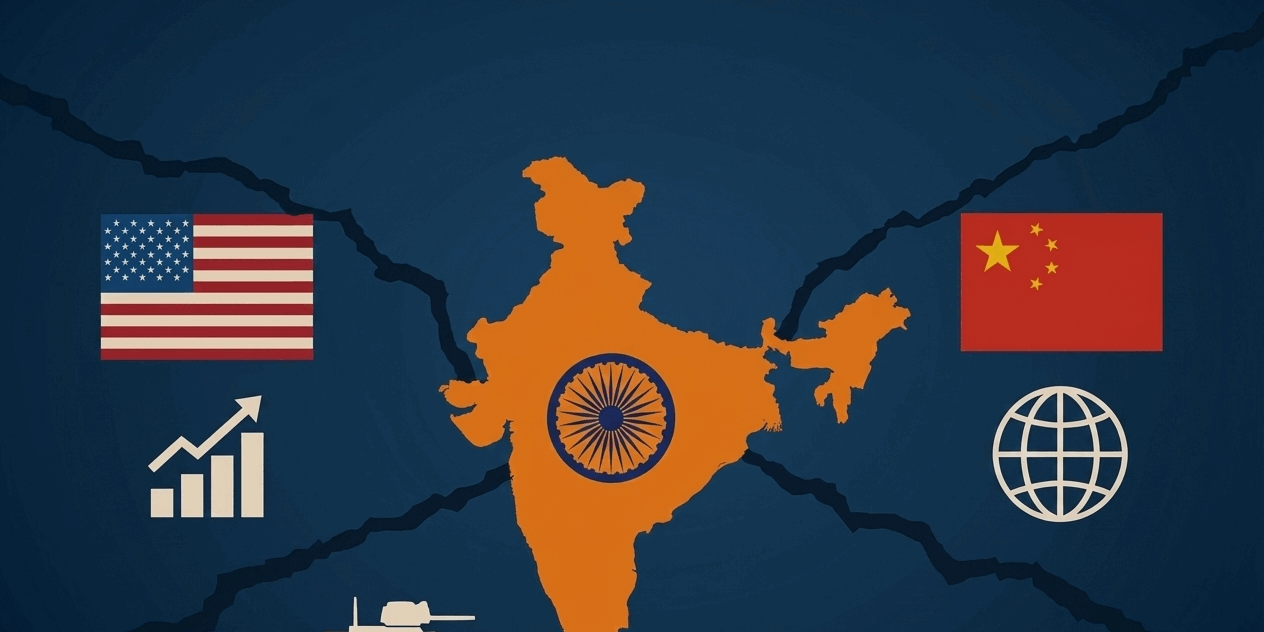
India’s contemporary foreign policy reflects a distinctive strategy of strategic diversification in an increasingly fragmented and multi-aligned world order. Moving beyond the binaries of Cold War non-alignment and post-Cold War strategic autonomy, India has adopted a pragmatic approach that combines issue-based partnerships, flexible alignments, and calibrated hedging across competing power centres. This article conceptualizes the “Indian Way” of strategic diversification as a deliberate effort to expand diplomatic, economic, technological, and security options while avoiding overdependence on any single bloc or power. It argues that India’s engagement with diverse platforms- ranging from the Quad and strategic partnerships with the United States, Japan, and Europe, to continued cooperation with Russia, participation in BRICS and the SCO, and deepening ties with the Global South- illustrates a multi-layered strategy shaped by both material interests and civilizational self-perception.
The study situates India’s approach within the structural realities of a transitioning global order marked by great-power rivalry, economic decoupling, and contested norms. Drawing on policy documents, elite discourse, and recent diplomatic practices, the article demonstrates how strategic diversification enables India to pursue national interests in defence modernization, energy security, supply-chain resilience, and technological sovereignty without sacrificing decision-making autonomy. The article further contends that India’s strategy is not merely reactive but normative, offering an alternative framework to alliance-centric models of order-building. By foregrounding flexibility, pluralism, and strategic patience, India seeks to shape a multipolar equilibrium rather than align exclusively with any hegemonic project. The Indian Way of strategic diversification thus represents a significant contribution to understanding middle and rising power behaviour in the evolving multi-aligned world order.
Key Words: Strategic Diversification, Multi-aligned World Order, Cold War, Operation Sindoor, Nonalignment, Strategic Autonomy.
As the United States reevaluates its global commitments and questions the existing international order, its long-standing allies and partners are beginning to explore alternatives to foreign policy strategies that heavily rely on Washington. Canada, South Korea, and the European Union have all expressed interest in strengthening ties with a broader group of countries. Qatar, Saudi Arabia, and the United Arab Emirates are reinforcing other partnerships to hedge against US uncertainty; for example, Saudi Arabia signed a Strategic Mutual Defense Agreement (SMDA) with Pakistan in September 2025. Such efforts aim to reduce countries’ vulnerability to sudden shifts in any single bilateral relationship and to give them greater options and autonomy in foreign policy decision-making.
While many of these countries are only now embarking on a path of diversifying their foreign relations, New Delhi has long pursued this strategy. Maintaining a balance with various partners while avoiding complete commitment to any one country or bloc has been a cornerstone of Indian foreign policy since gaining independence from British colonial rule in 1947. This policy has been given different names over time- non-alignment, dual alignment, multi-alignment, even omnidirectional engagement- but the approach has remained the same. When successful, this strategy has shielded India from having to acquiesce to the decisions of any single partner and has allowed it to leverage relationships between countries to strengthen its own position.
During the Cold War, New Delhi sought to balance its relationships with the United States and the Soviet Union, as well as with several smaller countries and non-aligned countries, fearing that one or both superpowers might prove unreliable or exert undue pressure when needed. In the post-Cold War era, New Delhi has maintained its overall policy of avoiding complete dependence on any single partner. Like an investor managing a complex investment portfolio, India has continuously adjusted the balance of its relationships as new opportunities and risks have emerged. At times, this has meant significantly increasing its engagement with certain partners- as seen in its alignment with the United States on security, economic, and technological issues in the last two decades.
However, the pressures emanating from a potential second Trump term are now prompting New Delhi to adjust the weight of the United States in its portfolio of partners. The US President Donald Trump’s imposition of tariffs of up to 50 percent, calls for dialogue with Pakistan, and demands to reduce oil imports from Russia have raised doubts about American reliability. These actions have also raised the question of whether India has become too closely aligned with Washington. For many Indian policymakers, the uncertainty created by Washington’s actions has further underscored the importance of diversification and strengthening other partnerships- not only with US allies like France and Japan, but also with US adversaries like Russia.
As diversified foreign policies become a global norm, New Delhi’s experience offers crucial lessons for a world being shaped beyond American unipolarity. India’s strategy of multiple partnerships helped it maximize its autonomy amidst Cold War great power competition and has continued to do so in the US-led global order that emerged after the collapse of the Soviet Union. But policymakers considering diversification in their foreign relations must also understand the challenges of this strategy. New Delhi has learned that it requires constant cultivation, evaluation, and balancing of diverse relationships. A portfolio of diversified partnerships offers less security against aggression than formal alliances, which is why India has had to increase its defense spending, develop a nuclear deterrent, and at times exercise restraint toward rivals. Without learning from India’s experiences, countries contemplating similar strategies today risk replacing over-reliance on one country with over-reliance on several.
Interdependence after Independence
India’s foreign policy approach was forged at a time when, much like today, transformative technologies and great power competition were reshaping global dynamics. India came into existence in 1947 after the partition of British India, at a time when the nuclear age had dawned, and intense competition was emerging between the United States and the Soviet Union. The leadership of independent India had to be wary of the temptations of a new form of colonial dominance, and they aspired to self-reliance. However, they soon recognized that partnerships with other countries, or a degree of dependence on them, would be necessary to secure military supplies, economic aid, and technological cooperation. Yet they feared that an alliance with either the Soviet or American bloc would become a straitjacket rather than a security blanket. New Delhi, therefore, hoped that multiple partnerships would safeguard India’s autonomy and prevent any single country or bloc from imposing its will on India.
India’s first prime minister, Jawaharlal Nehru, welcomed aid from the United States, which hoped that a democratic India could serve as a counterweight to communism in Asia. In the early 1950s, New Delhi leveraged American concerns about China’s “going communist” to secure economic and food aid. Nehru also reached out to Russia, but initially, the Soviet Union showed little interest in New Delhi. Soviet leader Joseph Stalin believed that India was too closely aligned with Western countries.
The consequences of the United States’ lack of a solid partner to counterbalance China soon became apparent. Aiming to establish a peaceful neighborhood, New Delhi sought dialogue with China rather than containment, which angered American policymakers. They criticized India for recognizing the Chinese communist regime and for not fully supporting the United States and its United Nations allies during the Korean War of 1950-1953. American lawmakers denounced India’s non-alignment as immoral and tantamount to siding with the Sino-Soviet bloc. They attempted to tie aid to conditions that would require India to limit its ties with the communist bloc or grant the US access to raw materials and critical minerals such as manganese. Ultimately, in 1951, the US Congress passed a food aid bill for India that did not condition aid on India changing its foreign policy or surrendering resources, but it did stipulate that New Delhi would not provide strategic materials to the communist bloc.
Geopolitical shifts in the mid-1950s gave New Delhi greater diplomatic leeway. Eager to expand its influence among countries not aligned with either the United States or the Soviet Union, Moscow offered India diplomatic, economic, and military assistance- on terms acceptable to India, including support for India’s public sector industrialization- and accepted India’s refusal to align with either bloc. Nehru believed that if India had better relations with the Soviet Union, the United States would take India more seriously. Indeed, the Eisenhower and Kennedy administrations decided to strengthen ties with New Delhi. The US wanted to ensure that democratic India did not fail while communist China was succeeding. With both Moscow and Washington showing interest in working with New Delhi, Indian policymakers felt their strategy had been vindicated. By balancing the two superpowers against each other, they obtained economic aid, military supplies, and technological expertise, which not only strengthened nation-building but also enhanced India’s autonomy through the diversification of dependencies.
Aid with String Conditions
But diversification did not provide immunity. In 1962, India suffered a humiliating defeat after a Chinese attack under the pretext of a border dispute. During the war, Moscow sided with its ally China rather than India. The United States and its allies provided India with military aid, but New Delhi found that this aid came with string conditions: Washington subsequently pressured India to compromise with Pakistan over the disputed territory of Kashmir, limit its defense budget, and cease purchasing weapons from Moscow. If the US had been India’s only option, India might have had no choice but to accede to these demands after the war. But growing Sino-Soviet differences made Moscow willing to engage with India again. This entire experience, far from reducing India’s distance from alliances, only reinforced the understanding that any single partner could be unreliable or exert undue pressure.
The 1965 war with Pakistan also underscored the utility of India’s diversified strategy. When China threatened to intervene on Pakistan’s behalf, New Delhi again turned to the US. Washington warned Beijing against intervention, but it also suspended military and economic aid to both India and Pakistan to pressure them into a ceasefire. Despite this, India continued to receive Soviet military supplies, which New Delhi policymakers saw as a vindication of their multi-partner approach.
Prime Minister Indira Gandhi, who came to power in 1966, sought to further expand India’s portfolio of partners. She reached out to countries like Australia, Japan, and Singapore, which shared India’s concerns about China. Concerned about declining US interest in India and Soviet leanings toward Pakistan, Gandhi also attempted to normalize relations with China in the late 1960s, though this proved unsuccessful. Moscow offered New Delhi a formal treaty for closer ties and increased aid, but Gandhi declined, wary of becoming overly dependent on any single partner. It was only in 1971, when India needed to deter Chinese intervention in another war with Pakistan, that New Delhi entered into this treaty- at a time when Washington had adopted a policy of engaging with Beijing rather than containing it, which further pushed India towards the Soviet Union.
The Soviet Union provided India with military supplies and diplomatic support during the war with Pakistan, but its assistance also had limits- Moscow pressured Gandhi to meet with the Pakistani leader and avert war, and later rejected India’s request to issue a public warning to deter the United States from intervening. To counterbalance potential over-reliance on the Soviet Union, Indian policymakers sought to improve relations with Washington in the 1970s. But the United States no longer needed a counterweight against China and was not particularly interested in India economically. Therefore, India sought other partners, including developing countries, and emphasized pursuing a nuclear program that would serve as an independent deterrent.
This approach persisted despite domestic political upheaval. When the Indian National Congress was voted out of power in 1977, and the Janata Party came to power, New Delhi continued its diversified foreign policy. Prime Minister Morarji Desai criticized Indira Gandhi for making India overly dependent on the Soviet Union. He proposed a program of genuine non-alignment, under which India would maintain relations with the Soviet Union while improving ties with the United States, normalizing relations with China, and strengthening its domestic economic and military capabilities. Gandhi continued this policy after her return to power in 1980.
However, Indian governments faced a problem in their diversification efforts: many potential partners- especially in the West- did not consider India sufficiently important for their own purposes, and therefore had limited interest in engaging with New Delhi. As a result, India remained largely dependent on the Soviet bloc throughout the 1970s and 1980s. When the Soviet Union collapsed in 1991, India had no alternative plan. Facing foreign policy and financial crises, New Delhi had to rebalance its portfolio of partners once again.
Leaning Towards Washington
In the post-Cold War era, India’s rebalancing has meant investing in new partners and revitalizing old relationships. In 1992, India established full diplomatic relations with Israel- something it had previously refrained from doing due to its ties with the Arab world and solidarity with the Palestinian cause. India also reactivated partnerships in East and Southeast Asia, including with countries like Japan and Singapore, whose strong economies could support India’s growth. New Delhi’s liberalization reforms and subsequent nuclear tests in 1998 strengthened its economic prospects and defense capabilities. These steps also increased global interest in India and opened up more options for New Delhi in terms of partners- including, once again, the United States.
As in the twentieth century, India’s foreign policy approach in the twenty-first century has remained largely unaffected by which party has been in power in New Delhi. In 2003, the foreign minister of the Bhartiya Janata Party-led coalition government described the driving forces behind India’s strategy as “a desire for balance, a policy of non-interference, and independent action”. That government, and the subsequent Congress-led coalition government, strengthened ties with the United States while also exploring possibilities for economic and multilateral cooperation with China. India also joined issue-based groupings- such as the Quad with Australia, Japan, and the United States, and BRICS with Brazil, Russia, China, and South Africa, and the SCO.
The current BJP-led coalition government has also continued the policy of diversification. Since coming to power in 2014, Prime Minister Narendra Modi has reached out to a wide range of partners for diplomatic support, defense equipment, markets for Indian goods and services, raw materials (including energy and critical minerals), investment, employment, and technology. Like previous governments, the current administration has actively sought to reduce over-reliance on any single partner in key sectors. For example, Russia’s share of India’s defense imports, based on value, was 76 percent between 2000 and 2004, but this decreased to 36 percent between 2020 and 2024.
Although India’s overall approach has remained consistent, the depth and breadth of its partnerships have evolved as the country’s interests and available allies have shifted. In the early 2000s, India saw potential in a closer partnership with China, but following military standoffs in 2013, 2014, 2017, and especially in 2020- when a deadly clash occurred on the disputed border for the first time in 45 years- New Delhi adopted a more cautious stance. With rising tensions, India began to look for ways to counterbalance Beijing rather than seeking closer ties with China, balancing its growing relationships with the United States and Europe. Russia, which has itself increased its dependence on China, has become a less relevant strategic partner than before. While New Delhi will not sever its ties with Moscow, the benefits of close relations with Russia have diminished due to India’s prioritization of access to and development of advanced technologies.
Conversely, over the past decade, the Modi government has further expanded defense and security, economic, and technological cooperation with the United States, based on a shared desire to counter China’s growing assertiveness. This Indo-US strategic alignment has resulted in more advanced military exercises- such as the recent anti-submarine warfare exercise near the Diego Garcia Island in the Indian Ocean- and increased technological cooperation, including Google’s plan to establish a $15 billion artificial intelligence center in India.
However, the tilt toward Washington does not mean abandoning diversification. Even as it moves closer to the US, India has deepened other partnerships to maintain balance. The Modi government has invested in relationships with Indo-Pacific partners such as Australia and Japan, which share India’s concerns about China. It has also revitalized ties with traditional European partners such as France, Germany, and the United Kingdom, and made new overtures to other parts of Europe. To counterbalance the West’s growing influence, New Delhi has also sought opportunities in the developing world. For example, India has sold anti-ship missiles to the Philippines, forged an economic agreement with the United Arab Emirates to boost trade, recently concluded an FTA with Oman and New Zealand, and is working to secure critical minerals like lithium from Argentina.
Learning from the Past
India believes this strategic diversification has been beneficial. The ability to choose from among multiple countries has helped it counter rivals and gain advantages from partners. It has also provided India with security when a partner’s foreign policy priorities shifted. When Moscow abandoned India during the 1962 war with China, when Washington did the same during the 1971 war with Pakistan, or when Russia remained neutral during the 2020 Sino-Indian border clashes in the Himalayas, New Delhi was able to turn to other options.
Most importantly, drawing support from multiple sources has been crucial in building India’s domestic capabilities, which has made it a more attractive partner. For example, India’s space sector has benefited from partnerships with multiple powers. In the 1960s, France and the United States enabled India’s access to expertise and technology; later, when Washington imposed export controls, the Soviet Union supported India’s space ambitions. Today, India is a strong player in the space sector itself- it has sent an orbiter to Mars, helps launch satellites for other countries, and is collaborating with NASA on an observation satellite and with the U.S. Space Force on a proposed semiconductor manufacturing facility.
Policymakers have also learned that this approach requires pragmatism rather than complete autonomy. Although leaders desire complete control over their decisions, fulfilling India’s objectives often demands restraint or compromises. For example, India did not condemn Russia’s invasion of Ukraine in February 2022 or refrained from public criticism when Trump imposed tariffs on India, because it prioritized maintaining beneficial partnerships over expressing dissent. At the same time, India’s foreign policy does not completely free it from having to choose sides. In critical and emerging technologies, when faced with the choice between Chinese or Western infrastructure, India chose the West- not to please the United States, but to avoid increasing its vulnerability to a rival like China.
India has also experienced the downsides of diversification. When it failed to manage its diverse relationships properly, it ended up satisfying no one and alienating everyone. During the early stages of the Vietnam War, the US wanted India to be less critical of its actions, while Moscow was dissatisfied that India wasn’t criticizing the US more. Furthermore, in areas where India has not developed its own capabilities, diversification can make it dependent on multiple partners. In such cases, India becomes vulnerable not only to the shifting priorities of individual countries but also to broader geopolitical rivalries and risks. The Middle East is an example, where several mutually conflicting countries are key diplomatic partners for India, providing oil, natural gas, investment, military equipment, and employment.
Diversification sometimes also leads to suboptimal choices. In its desire to avoid complete dependence on any one country, the Indian military procures defense systems from multiple countries, some of which are incompatible with each other. Buying defense equipment from Russia may limit India’s ability to acquire more advanced technology from the US. Although this does not maximize military effectiveness, India has persisted with this approach to maintain its strategic autonomy.
A greater drawback is the questionable deterrent capability of diversification compared to formal alliances. For example, the question arises whether China would have attacked India in 1962 if India had been under the security umbrella of the Soviet Union or the US. Recognizing this deficiency, New Delhi entered into an air defense agreement with Washington in 1963 and a treaty with Moscow in 1971- both of which included provisions for consultation in the event of a Chinese attack. These agreements signaled to Beijing and provided India with security in exchange for relinquishing some autonomy. In recent years, India has moved closer to the United States to counter China’s rise, but it will likely refrain from a formal alliance with Washington, believing that its conventional and nuclear capabilities can compensate for any lack of deterrence without being bound by such an agreement.
Ultimately, strategic diversification is a high-maintenance policy. Indian leaders must constantly assess how each relationship affects their other partnerships. For example, India has had to limit its ties with Iran to remain in the good graces of Israel, the United States, and the Gulf states. Sometimes this balancing act goes awry. In September 2025, the Indian army participated in a Russian military exercise that simulated a nuclear attack on Europe- angering European Union member states just as Brussels was trying to finalize a trade deal with New Delhi. Following this, at least two countries, including Poland and Romania, initiated diplomatic and defense talks with India’s rival, Pakistan.
Ready for Rebalancing
Beyond India, many countries are now trying to design foreign policies that allow them to hedge against risks without limiting themselves. They should learn from India’s successes- how it strengthened its national security, accelerated domestic development, and navigated the unreliability of partners by balancing among them. At the same time, they should also analyse the potential weaknesses of diversification- such as sensitivity to the shifting priorities of multiple partners, missed opportunities for cooperation due to prioritizing autonomy, and less resilience compared to a strong alliance.
Despite these shortcomings, India’s experience encourages it to stick with a policy of multi-alignment rather than a great-power alliance. Amid the unpredictable pressures from the United States during Trump’s second term, India is now pursuing even greater diversification. This strategy will differ from the Cold War era, when India could balance between the Soviet Union and the United States. Today, the comprehensive rivalry with China means such clear-cut options are not available. Instead, India has made concrete overtures to Europe- including accelerating trade agreements with the United Kingdom and the European Union. It is deepening defence and economic security partnerships with Australia and Japan; exploring new cooperation with South Korea, particularly in areas such as shipbuilding; and improving relations with Canada. At the same time, it is trying to stabilize relations with China while maintaining its partnership with Russia- exemplified by Modi’s meeting with Xi Jinping and Vladimir Putin at the SCO meeting in China in August 2025.
Yet, while pursuing strategic diversification, New Delhi does not want to completely overhaul its partnership with Washington. India will continue to seek to maintain and even strengthen its ties with the United States in certain areas. New Delhi understands that its relationship with Washington is instrumental in enhancing its capabilities and increasing its leverage with rivals and partners alike. For example, American investment has been essential to India’s efforts to boost its semiconductor manufacturing industry. What New Delhi gains from working with the United States is precisely what makes it an attractive partner for Washington and the many other countries that want to diversify their own partnership portfolios.
Countries seeking to diversify their foreign policy strategies will likely find themselves in a similar position to India. Rather than disengaging from the United States- whose power and influence remain significant- they can mitigate risks and enhance resilience by cultivating closer ties with a variety of partners and accelerating the development of their economic and security capabilities. But countries pursuing such a strategy will not only experience the benefits and drawbacks of diversification; they will also make the entire web of international relations far more complex. Any geopolitical shift could trigger a chain reaction, as countries simultaneously rebalance their respective diversified partnership portfolios. As countries move beyond alliances toward multi-alignment, their ability to manage multiple relationships will determine whether a diversified world leads to greater security and stability or is plagued by recurring upheaval.
–
Dr Rakesh Arya
Research Associate, Swadeshi Shodh Sansthan, New Delhi