A FORTNIGHTLY NEWSLETTER 1 to 15 January, 2026
A Fortnightly Newsletter 1st to 15th January, 2026

A Fortnightly Newsletter 1st to 15th January, 2026
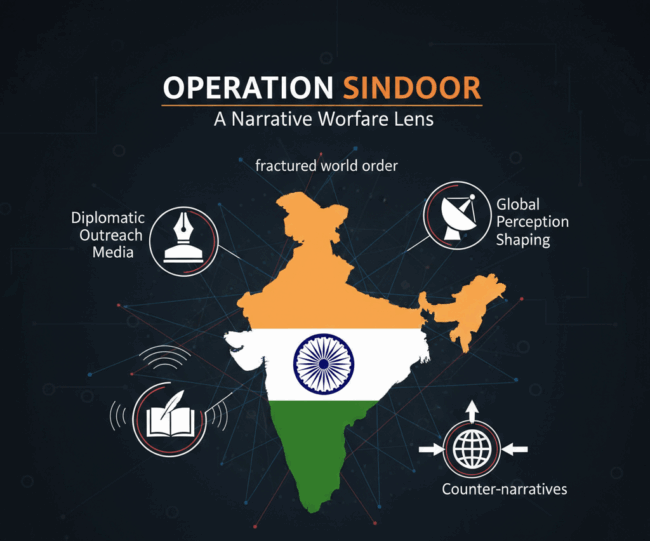
Bharat’s narrative warfare strategy post the Operation Sindoor employed military messaging, diplomatic lobbying, and global media engagement to delegitimise Pakistan’s terror links. How did global media frame the conflict, and how did it influence international perceptions? Abstract The paper aims to examine how Bharat strategically used international institutions and foreign media after the Operation…
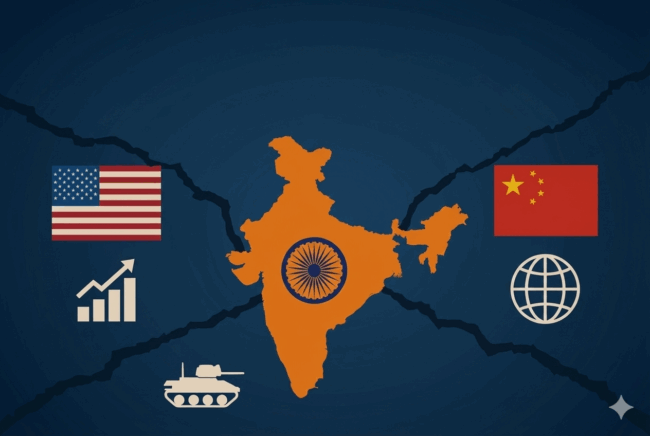
Abstract India’s contemporary foreign policy reflects a distinctive strategy of strategic diversification in an increasingly fragmented and multi-aligned world order. Moving beyond the binaries of Cold War non-alignment and post-Cold War strategic autonomy, India has adopted a pragmatic approach that combines issue-based partnerships, flexible alignments, and calibrated hedging across competing power centres. This article conceptualizes…

India’s deep-science ecosystem is undergoing structural transformation, driven by rising domestic patents, returning diaspora founders, and evolving Global Capability Centres. Ankur Capital’s report highlights faster validation cycles, lower capital intensity, and growing Series A/B funding across synthetic biology, semiconductors, and advanced materials. With government R&D support and corporate partnerships, India is building globally ambitious science-led…

The Indo-Russian agreement for 100% Transfer of Technology (ToT) of the RD‑191M semi‑cryogenic engine represents a decisive propulsion upgrade that can shorten India’s path to true heavy‑lift, reusable launchers and human‑rated systems by several years, if not a full decade. It combines diplomatic risk‑taking, industrial up‑skilling, and technological leapfrogging in a way that reshapes ISRO’s…