
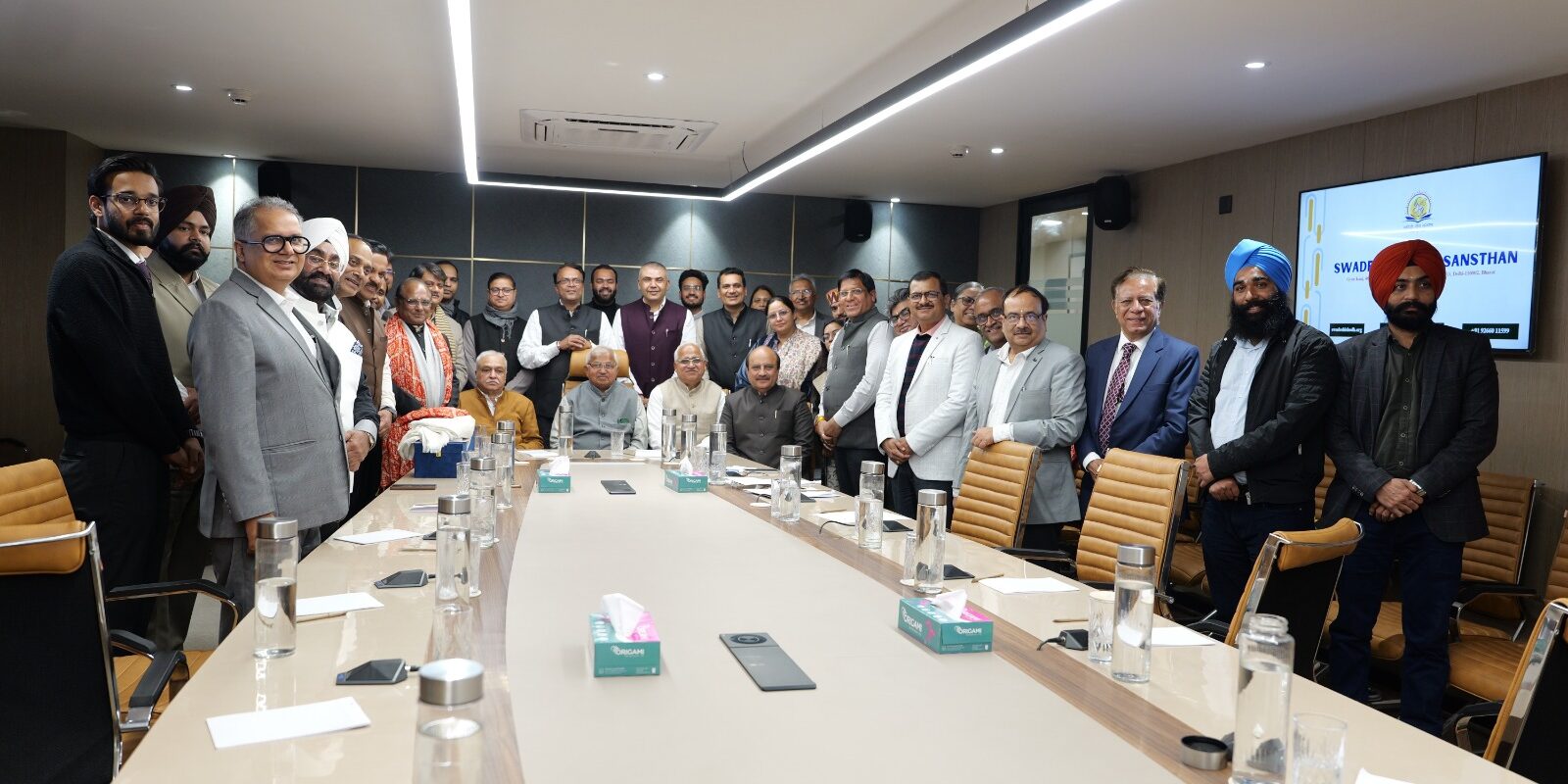
Organized by: Bharat Global Industries Forum (BGIF) & Swadeshi Shodh Sansthan
Date: 10 February 2026 | Time: 6:00 PM – 8:00 PM | Venue: Gyan Kunj, Deen Dayal Upadhyay Marg, New Delhi,110002
Special Dignitaries: Shri Kashmiri Lal Ji, Shri R Sundaram Ji, Shri Satish Kumar Ji, Prof. Somnath Sachdeva, Prof. Ashwini Mahajan, Prof. Pradeep Singh Chauhan, Dr. Sarabjeet Kaur, Shri Pritam Banerjee, Retd. IAS Rajesh Meena, Shri Yogesh Mehta, Shri Nitin Ji , Shri Vijay Setia, Shri Deepak Singhla, Shri Adit Gupta, CA Vijay Goel, Shri Kuldeep Ji, Dr. Sudhakar Sharma, CA Mohit Chaudhary , Prof. Nandini Sinha Kapoor, Adv. Iqbal Singh
Anchor: Mr. Yogesh Mehta, National General Secretary, BGIF
- Introduction
The Bharat Global Industries Forum, in collaboration with Swadeshi Shodh Sansthan, organized a high-level seminar focusing on India’s evolving position in global trade, particularly in the context of the India–EU trade framework and broader economic integration. The event brought together policymakers, economists, industry leaders, academicians, and researchers to deliberate on trade architecture, quality competitiveness, innovation, governance reforms, and strategic self-reliance. Dr Sarabjeet Kaur gave a headstart to the session with a presentation about Swadeshi Shodh Sansthan, reminding us all the vision we are all after, Viksit Bharat @2047.
Inaugural Address
- Pradeep Singh Chauhan (Economist & General Secretary of Swadeshi Shodh Sansthan)
Prof. Pradeep Chauhan inaugurated the seminar by emphasizing the strategic importance of India’s integration into global economic systems. He highlighted that modern trade agreements must be viewed not merely as tariff instruments but as frameworks for long-term institutional collaboration, technological upgrading, and sustainable development.
He stressed the need for synergy between academia, industry, and governance to ensure that India leverages global opportunities while strengthening domestic capabilities. His address set the intellectual tone of the seminar by framing the India–EU engagement as a catalyst for structural transformation.
- Pritam Banerjee (Head, Centre for WTO Studies, Centre for Research in International Trade (CRIT))
Mr. Banerjee opened the proceedings with a retrospective analysis of the India-EU trade negotiations, observing that the agreement had remained within grasp for nearly two decades before its finalization on 27 January 2024. He underscored the demographic and economic heft of the proposed trade zone—encompassing approximately two billion people and targeting twenty-five percent of global trade.
Key Observations:
- The agreement represents the world’s largest trade area by population coverage
- Trade reduction mechanisms have been strategically calibrated rather than merely concessional
- Visa liberalization has transitioned from country-specific arrangements to a unified EU-wide framework
- The Carbon Border Adjustment Mechanism (CBAM) now finds complementarity with India’s climate alignment objectives
- Recognition of Chartered Accountancy firms and establishment of a Carbon Trading System (CCTS) form critical components of the supporting architecture
On US-India Services Negotiations:
Mr. Banerjee noted the reciprocal tariff adjustments—fifty percent reduced to eighteen percent—characterizing this as the terminal stage for services negotiations, wherein both economies have substantially exhausted the concessional frontier.
- Ashwini Mahajan(Economist and National co-convenor swadeshi jagran manch)
Professor Mahajan offered a scholarly exegesis on the semantic and substantive shifts in global trade discourse. He rendered Bhoomandali karan (globalization) as a concept whose celebratory phase—epitomized by WEF’s agenda of prosperity through open markets—has yielded to protectionist sentiment, paradoxically championed by former advocates of global integration.
Key points:
- Globalization’s benefits have accrued unevenly, a reality acknowledged even by its principal architects
- The current epoch is appropriately termed the ‘Year of FTA’
- India’s historical opposition to EU and RCEP agreements was predicated on legitimate concerns regarding dairy and agricultural market access
- The concluded FTAs with Peru, the EU, and the United Kingdom conspicuously exclude dairy and agriculture
- This represents not concession but calibration—India negotiating on its own terms, protecting sensitive sectors while pursuing liberalization where industrially advantageous
Suggested Fiscal Policy Extension:
Professor Mahajan further directed the seminar’s attention to the structural realignment evident in India’s recent budgetary strategy. Unlike several European economies that sustain fiscal deficits primarily for consumption smoothing, India’s fiscal consolidation now accompanies elevated capital expenditure. He characterized this as the fiscal foundation upon which a ‘developed India’ must be constructed.
- Vijay Setia (Industrialist)
Mr. Vijay Sr. contextualized China’s technological ascendancy within its early and sustained investment in capital infrastructure. He, however, offered a contrarian assessment that China’s lead is not insurmountable—being merely a decade’s advantage—and that Indian enterprise has demonstrated capacity to compete effectively.
Recommendation:
Strategic investment in artificial intelligence and digital health education, with concomitant attention to service sector SOPs and functional standardization.
- Nitin Ji
Mr. Nitin Ji delivered a forceful intervention on the centrality of quality assurance in realizing the benefits of the EU agreement. His exposition drew upon the Ayurveda sector as an illustrative case study.
Key Points:
- Quality as Non-Negotiable: Indian goods cannot achieve global market penetration without uncompromising adherence to international quality benchmarks. The Ayurveda pharmaceutical sector exemplifies both the potential and the current deficit in standardization. He also mentioned that if we are not maintaining the Global Quality Standard then the ayurveda product will get banned in foreign market , and that will directly affect the market of other exported goods.
- Capacity Building: India presently provides Panchamrut Ayurveda training to allopathic medical practitioners—an initiative that bridges therapeutic traditions but requires rigorous quality frameworks to achieve credibility.
- Services Standardization: Service products must be governed by Standard Operating Procedures with mandatory quality checks. The absence of such protocols invites backlash against Indian service exports.
- Deepak Singhla (CA)
Mr. Deepak Raja intervened on textile sector constraints, noting that Western capital equipment remains prohibitively expensive while Chinese machinery, though economical, raises questions of technological sovereignty. The sector requires concerted policy intervention to address this infrastructural dichotomy.
- Kuldeep ji
Mr. Khaleel presented comparative data on innovation investment, revealing that China’s expenditure on research and development exceeds India’s by a factor of ten. He observed that while Indian R&D remains predominantly publicly funded, Chinese investment derives substantially from private enterprise.
Key points:
- Even when Chinese products encounter technical deficiencies, their cost advantage enables market capture
- India must intensify R&D expenditure not merely for innovation but for parity in quality competition
- The quality gap, if unaddressed, will vitiate the advantages conferred by tariff preferences
- Adit Gupta ji (Plastic Industry Representative)
The plastic sector representative articulated both aspiration and impediment. Export to EU markets, once a distant dream, is now achievable through joint ventures and technology transfer arrangements. However, the industry confronts structural limitations:
- Small enterprises lack access to intellectual capital pools
- R&D remains insufficiently intensive
- India possesses the demographic and institutional resources to conduct global-calibre research targeting multiple industrial sectors
- The imperative is to transition from technology management to indigenous innovation
- Rajesh Kumar Meena (retied IAS and Former Maharashtra Chief Secretary)
A significant portion of the proceedings was devoted to the disjuncture between policy formulation and practical implementation. A speaker observed that of forty-one policy ideas generated over thirty-eight years, only a fraction—estimated at five percent—have been operationalized with certainty.
Key points:
- Abundant opportunities but unavailable guidance mechanisms
- Preferential bureaucratic attention directed toward large-scale industries
- Status completion imperative supersedes nuanced sectoral engagement
- Small and medium enterprises remain peripheral to policy consciousness despite their employment footprint
- Regional industrial aspirations receive concessions but lack integrated support architecture
Proposed Solution:
A common platform to connect bureaucratic expertise with entrepreneurial execution, enabling the translation of policy ideas into ground-level outcomes.
- Professor Somnath Sachdeva (VC Kurukshetra University)
Professor Somnath Sir, made us realise the whole picture by contextualizing all the deals in a historical framework. The world which used to bi-polar till 90s, is multipolar in contemporary world. He emphasized how India has adapted itself to the changing times, from being dependent for basic necessities to becoming self-reliant during pandemic, proving to be a beacon of Self-Reliance. He invoked the idea, Dattopant Thengadi’s self- sufficiency. Further he advocated for investment in R&D.
- Shri Kashmiri Lal Ji (National Org. secretary (SJM))
Shri Kashmiri Lal Ji offered a metaphorical reflection on India’s treaty experience, invoking the historical memory of trade union’s victory over Chinese Mink Blanket in Panipat. Symbolizing how Panipat lost three historical wars but won the trade one. His submission suggested that India has historically underrated its negotiating position, yielding to more aggressive counterparts.
Optimistic Prognosis:
The institutional mechanisms established through this agreement will bridge the enduring gap between business education and civil administration. India has articulated its intentions; the architecture for realization is now being constructed.
Swadeshi Research Framework:
Kashmiri Lal Ji advanced the concept of Swadeshi Shodh (indigenous research) not as ideological assertion but as pragmatic necessity. He proposed a framework wherein joint ventures and licensing agreements function as technology acquisition mechanisms, with explicit provisions for capability absorption and domestic innovation spin-offs. The aspiration to match US and EU export competitiveness is not utopian but requires sequenced, disciplined execution.
- Sundaram (Akhila Bharatiya (AB) Convenor, SJM)
Mr. Sundaram offered the following formulation:
- Globalization, in its idealized form, promises non-discrimination without qualification
- Contemporary geopolitical formations evidence a transition from multilateral liberalization to bilateral arrangements
- This transition need not signify retreat but rather recalibration toward more enforceable commitments
Mr. Sundaram noted that the Antyodaya philosophy animated the government’s decision to resist pressure from those advocating SSI concessions as the price for RCEP accession. The decision not to sign, he argued, has been vindicated by subsequent developments.
- Conclusion
The seminar concluded with a consensus that India’s global trade success depends on a triad of quality, innovation, and governance. Trade agreements serve as enabling frameworks, but domestic capability-building remains the decisive factor.
Participants agreed that India stands at a pivotal moment where disciplined execution, institutional reform, and strategic investment can transform it into a globally competitive industrial economy aligned with the vision of a prosperous and developed Bharat by 2047