Report on the Lecture on India’s Strategic and Military Dimensions
Organised by: Swadeshi Shodh Sansthan
Date: 20 January 2026
Venue: Swadeshi Shodh Sansthan, ITO
Introduction
Swadeshi Shodh Sansthan organised a thought-provoking lecture on India’s Strategic and Military Dimensions on 20 January 2026, aimed at fostering strategic awareness and national consciousness among students and academicians. The session addressed India’s evolving geopolitical environment, military preparedness, and the importance of safeguarding national sovereignty.
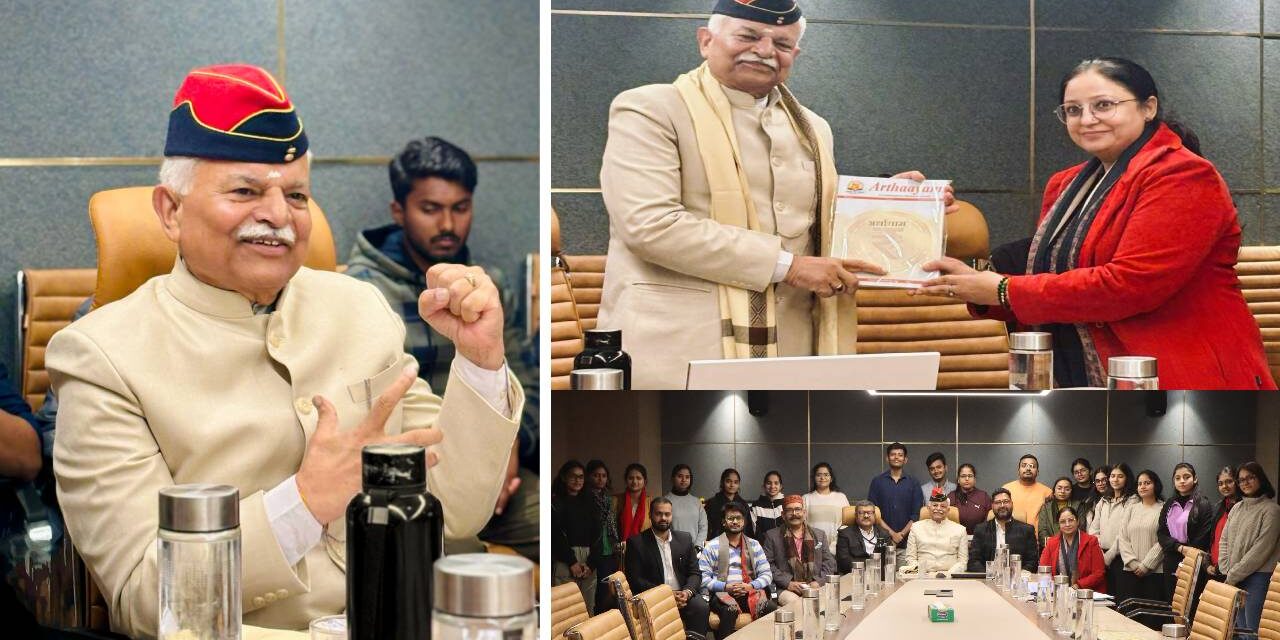
The event was honoured by the presence of Lt. Gen. V.K. Chaturvedi as the Chief Guest. Other distinguished guests included Kashmiri Lal ji (Pracharak), Prof. Suresh Kumar from the Department of African Studies (Academician and Author), Dr. Sarabjeet Kaur, Professor at Zakir Husain College, University of Delhi and Secretary of Swadeshi Shodh Sansthan, Advocate Satyendra Tripathi, Shri Bhogendea Pathak, Shri Ankit Sharma, and Advocate Anuj.
Inaugural Session
The programme began with the lamp lighting ceremony, symbolising enlightenment and the pursuit of knowledge. This was followed by the felicitation of the dignitaries, during which Lt. Gen. V.K. Chaturvedi was presented with Arthaayam, the official research journal of Swadeshi Shodh Sansthan, as a token of respect and appreciation.
A formal welcome address given by Prof. Suresh Kumar introduced the Chief Guest and highlighted his distinguished career. Lt. Gen. Chaturvedi is an alumnus of the Indian Military College (IMC), Dehradun, a veteran of the 1971 Indo-Pak War, and a recipient of several prestigious honours, including the Sena Medal for Gallantry, Ati Vishisht Seva Medal, and Param Vishisht Seva Medal, reflecting his exemplary service to the nation.
Key Address by Lt Gen V.K. Chaturvedi
Lt. Gen. Chaturvedi structured his address around seven major thematic areas, offering both strategic depth and practical insight.
Historical Perspective
He underlined India’s unique geographical location, surrounded by unstable and often hostile neighbours. He highlighted the limitations of international institutions and noted the prevailing display of power in global geopolitics. According to him, India’s tradition, culture, and civilisational identity form the foundation of its security.
Geopolitical Turmoil
Addressing current global instability, he advocated for a multipolar world order. He stressed on the need to revive India’s historical strategic wisdom to navigate challenges such as grey-zone conflicts and the weakening of multilateral institutions.
India’s Strategic Environment
He described the contemporary strategic environment as complex and fast-evolving, where sovereignty is constantly tested and requires continuous vigilance.
Military Dimensions
Lt. Gen. Chaturvedi highlighted the relevance of land power, stressing on the importance of capability building. He advocated for centralised operational command with decentralised control and highlighted cyber warfare as a key dimension of future conflicts.
Strategic Drivers
He outlined key drivers of India’s security framework, including strategic autonomy, defence indigenisation, perception management through continuous dialogue (manthan and chintan), jointness amongst forces, technological advancement across the Indian Military, and maintaining a well-trained and well-equipped military even in peacetime.
Challenges
He acknowledged political stability under strong leadership while cautioning that national existence itself can be threatened if complacency sets in. He stressed on the need for technology development, multi front contingencies, and logistics resilience.
Way Forward
He discussed issues such as the National Register of Citizens (NRC) from a national security perspective and reiterated the importance of Atmanirbharta (self-reliance). He urged citizens to actively exercise and strengthen national capabilities.
He concluded his address with the patriotic poem:
“Utho dhara ke veer sapooton,
Punah naya nirman karo.”
Other Addresses and Conclusion
Kashmiri Lal ji addressed the youth, particularly encouraging young women to shed the perception of weakness. He compared life to a hurdle race and by invoking figures like Rani Lakshmibai as a symbol of courage, he highlighted resilience and determination.
Dr. Sarabjeet Kaur concluded by acknowledging the interactive nature of the lecture. She shared her personal experiences of growing up in Amritsar surrounded by army personnel and underlined that peace is achieved through strength (“Shaanti shakti se aati hai”).