
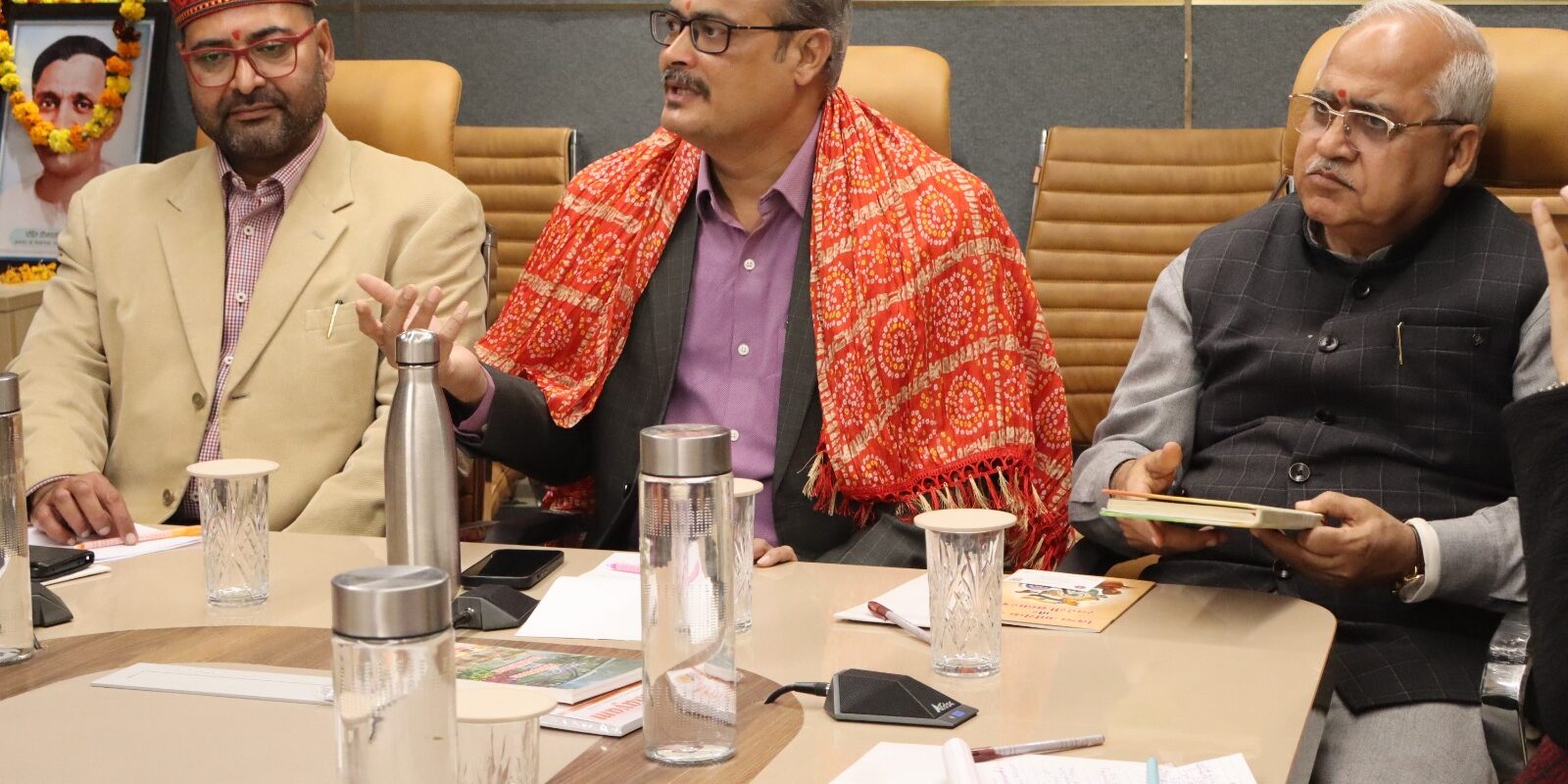
Ātmanirbhartā and Strategic Autonomy: Philosophical Roots of Self-Reliance
Organized by: Swadeshi Shodh Sansthan (Rich Bharatiya Value System)
Speaker: Prof. Balaganapathi Devarakonda
Date: December 03, 2025
Supervised by: Prof. Nandini Sinha Kapoor
Mentor: Dr. Chetna Gupta
Researcher: Anushka Verma
Swadeshi Shodh Sansthan, an institution devoted to preserving and promoting India’s indigenous knowledge systems and civilizational values, organized a profound lecture on the theme “Ātmanirbhartā and Strategic Autonomy: Philosophical Roots of Self-Reliance”. The talk was delivered by Prof. Balaganapathi Devarakonda, a distinguished scholar and Professor of Philosophy at the University of Delhi, known for his extensive work in Indian philosophy, social and political thought, philosophical practice, and counseling. The event served as an intellectual exploration of how self-reliance, when understood through the lens of Indian philosophy, becomes not merely an economic ideal but a deeply moral and spiritual pursuit.
The session began with a warm welcome address by Prof. Sarabjeet Kaur, who underlined the vision of India@2047 and highlighted the Sansthan’s commitment to nurturing Bharat’s civilizational ethos. She emphasized that progress must be grounded in cultural self-awareness and authentic moral foundations, cautioning that mere modernization without value orientation could lead to cultural dislocation. Following this, Prof. Suresh formally introduced the eminent speaker, acknowledging Prof. Devarakonda’s academic contributions and his instrumental role in representing Indian philosophical perspectives on global platforms.
At the core of Prof. Devarakonda’s talk was a call to rediscover selfhood beyond external validation. He observed that in modern societies, individuals often understand themselves through the gaze of others, through social approval, comparison, and performance. This constant dependence on external benchmarks, he argued, weakens genuine self-awareness and makes individuals psychologically vulnerable. He emphasized that no person is entirely perfect or completely aware, and thus, allowing others’ opinions to define one’s worth is inherently flawed. True Ātmanirbhartā (self-reliance), therefore, begins with an inward journey of reflection and self-realization, understanding “who I truly am” rather than being consumed by “how others see me.”
Moving deeper into the philosophical terrain, Prof. Devarakonda contrasted Western dichotomous thinking with Bharatiya holistic thought. He noted that Western intellectual traditions often cultivate dualisms such as earth vs. sky, land vs. water, or male vs. female, frameworks that divide existence into opposing categories. In contrast, Indian philosophy recognizes Pancha Mahābhūtas, the five great elements: earth, water, fire, air, and space, as complementary realities that together sustain cosmic harmony. Rather than opposites, these elements signify balance and unity, reflecting an ontological wholeness. This worldview encourages integration and synthesis over separation, reinforcing the vision of life as a coordinated totality rather than a fragmented system of contradictions.
Prof. Devarakonda then turned to a critical reflection on how modern social and educational systems treat human beings as objects rather than subjects. In the race for material advancement, creativity and moral independence often stand compromised. He proposed that authentic education must reorient itself toward nurturing the ability to think independently, decide wisely, express freely, and live meaningfully. Philosophy, he emphasized, is not a theoretical luxury but a necessity, because it teaches individuals to reflect upon the meaning of life, responsibility, and conduct. Every human action, whether at home, in professional life, or in governance, carries a philosophical dimension, as it reflects one’s underlying worldview and moral understanding.
Expanding upon the notion of Ātmanirbhartā, the speaker offered a deeply reflective insight: self-reliance is not the mere capacity to produce goods or achieve economic sufficiency; it is a transformation of consciousness. Real independence begins within the mind. Only when a person realizes their innate potential, awareness, and strength do they become capable of leading themselves authentically. Indian philosophy, he noted, teaches that every individual is inherently complete and divine, endowed with an inner light that guides action. When a person attains inner clarity and self-confidence, this clarity extends to society, culminating in collective strength and national integrity. Thus, Ātmanirbhartā is first and foremost a spiritual and psychological awakening before it becomes a political or economic goal. A community of awakened individuals naturally builds a self-reliant and strategically autonomous nation.
To ground this philosophical argument, Prof. Devarakonda articulated a twofold foundation for true self-reliance: Metaphysics and Ethics. Through Metaphysics, one understands existence, purpose, and the underlying nature of reality; through Ethics, one learns how to act responsibly in alignment with values. Together, they form the philosophical architecture of Ātmanirbhartā. He argued that without a metaphysical comprehension of self and an ethical commitment to righteousness, the idea of self-reliance remains superficial. Returning to our cultural roots, internalizing moral values, and living with philosophical awareness are, therefore, necessary steps toward genuine self-reliance.
Drawing from the wisdom of the Bhagavad Gītā, particularly Chapter 6, Verse 5, he reiterated a timeless truth: “Raise yourself by yourself.” This verse, he explained, captures the essence of inner autonomy. We are our own best friend and also our worst enemy; our liberation or bondage lies in how we discipline and direct our own mind. Such spiritual responsibility is fundamental to both personal freedom and national development.
Addressing the concept of equality, Prof. Devarakonda clarified that treating everyone as identical is neither possible nor desirable. Individuals differ in their capacities and purposes, but all possess intrinsic dignity. Real equality lies in recognizing and respecting these unique strengths rather than imposing uniform sameness. Through the symbolic story of the rich brother and sister, he illustrated how society too often values wealth over humanity. A self-reliant society, in contrast, honors moral worth and spiritual depth above material possessions.
Further enriching his argument, he presented Kabir’s metaphor of the needle and the sword: “If a needle can do the job, the sword must stay aside.” This poetic imagery encapsulates the Indian philosophical respect for contextual appropriateness (maryādā) and unity in diversity. Every being, like every tool, has a rightful role and inherent value. Harmony in society emerges when each entity fulfills its purpose in coordination, not in competition.
In another striking observation, Prof. Devarakonda elaborated on the Indian idea of totality, explaining that while Western thought often perceives relationships as part-to-whole or incomplete halves, Indian philosophy regards every relation as a meeting of wholes. The example of mother and child expresses this perfectly: each is a complete being, and yet their union represents continuity, affection, and shared being. Such understanding reinforces the rootedness of Indian thought in wholeness, continuity, and complementarity.
Citing inspirations from thinkers and texts, the professor acknowledged the philosophical legacy of K.C. Bhattacharya, who explored the roots of Indian autonomy through his reflections on svarāj in thought. Mahatma Gandhi too was mentioned for his transformative conception of self-reliance, “Self-reliance is not having more; it is being more.” This Gandhian insight resonates with the Upanishadic inquiry “Koham?”, Who am I?, which directs the seeker inward toward self-knowledge. The spirit of Ātmanirbhartā thus emerges as an ongoing reflection on being, action, and responsibility, connecting metaphysical insight with practical living.
In his concluding remarks, Prof. Devarakonda delineated two forms of dependence: essential and non-essential. Essential dependence refers to interdependence where cooperation is necessary for survival, such as ecological balance or social support structures. Non-essential dependence, however, arises from habit, convenience, or lack of inner discipline. He urged that while essential forms of dependence may be accepted, non-essential ones must be minimized by promoting self-production, creativity, and skill development. A truly self-reliant nation, he emphasized, is one that produces what it can within its borders, drawing strength from its own knowledge, talent, and resources.
The event concluded with a session of questions and reflections, followed by Maargdarshan by Mn. Satish Ji, whose guidance further deepened the philosophical resonance of the discussion. Prof. Nandini Sinha Kapoor proposed the vote of thanks, expressing gratitude to the distinguished speaker and participants. The program left the audience with a renewed conviction that Ātmanirbhartā is not merely an economic slogan but a civilizational principle, an inner journey that begins with self-awareness, matures into social responsibility, and culminates in national strength. It reaffirms that the path to true strategic autonomy lies in drawing from India’s philosophical heritage, where self-knowledge and value-based action form the foundation of a resilient, self-reliant Bharat.