
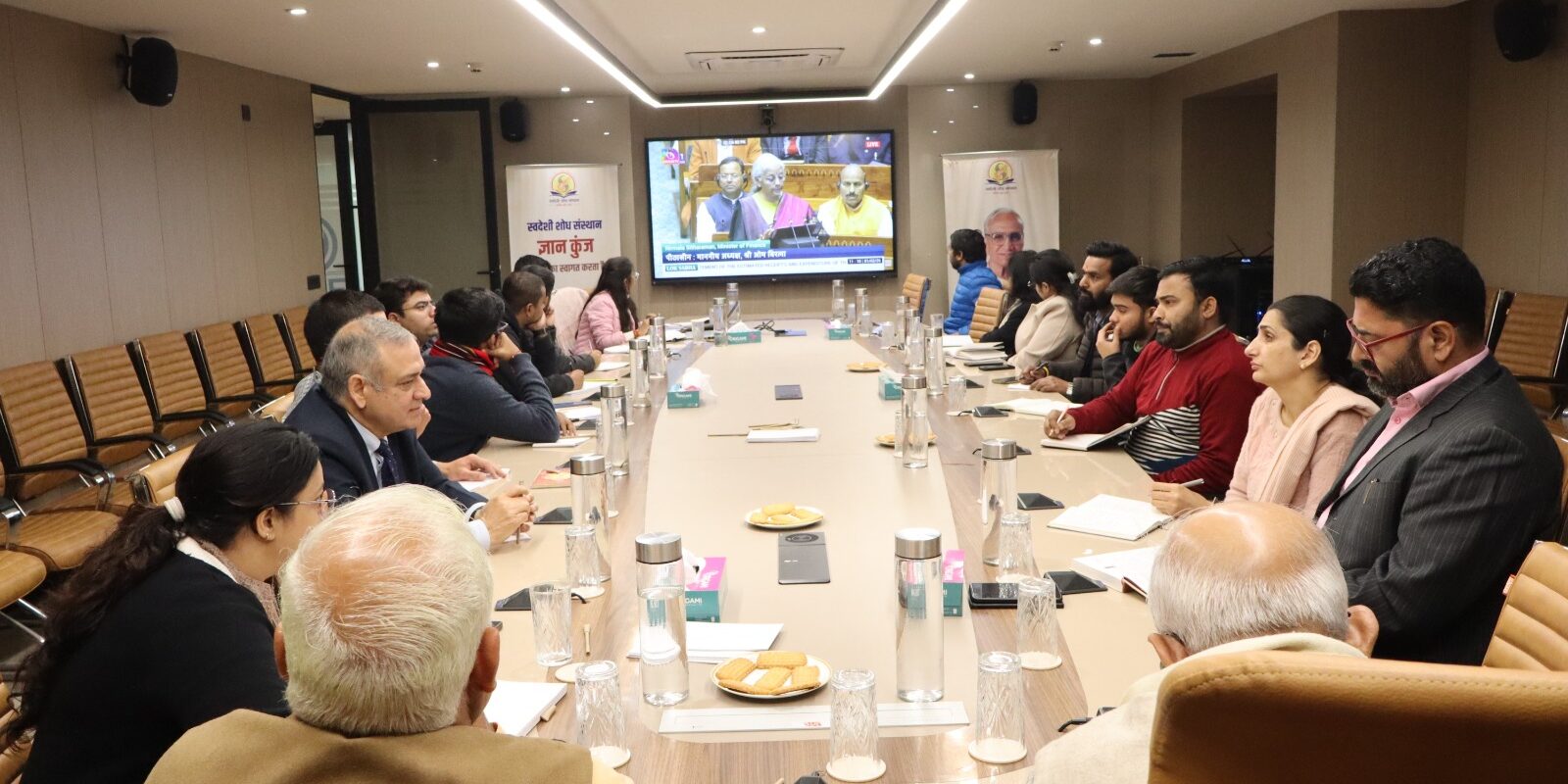
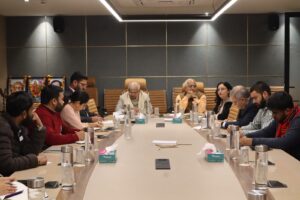
Swadeshi Shodh Sansthan organised a focused discussion on the Union Budget 2026–27 under the theme “From Potential to Performance” at Gyan Kunj, New Delhi, on 1st February 2026. The session was graced by the distinguished presence of Shri Kashmiri Lal Ji Bhaisahab, Shri Satish Kumar Ji Bhaisahab, Dr. Sarbjeet Kaur, Prof. Suresh Kumar, Dr. Compesh Pannu and Dr. Himani Sharma. Their guidance gave the discussion both intellectual depth and practical direction, linking the Budget’s provisions to national priorities and on-ground realities.
Speakers opened by highlighting the core message of the Budget: “Action over Ambivalence, Reform over Rhetoric, People over Populism.” The Union Budget aims to reduce critical import dependencies, expand domestic manufacturing capacity, ensure energy security, and maintain a strong emphasis on public investment so that national aspirations translate into tangible outcomes.
The discussion covered the six broad pillars outlined in the Budget: sustaining economic growth, strengthening the foundations of growth, people-centric development, trust-based governance, ease of doing business, ease of living, and fiscal matters. Speakers underlined that the Budget builds on India’s “Reform Express,” with over 350 reforms already in motion to boost employment, productivity, and competitiveness. The gathering also emphasised the youth-driven nature of the Budget and its commitment to the poor, underprivileged, and disadvantaged, consistent with the vision of “Sabka Saath, Sabka Vikas.”
A key theme was India’s push to become a manufacturing powerhouse. The launch of India Semiconductor Mission (ISM) 2.0 and the Biopharma SHAKTI scheme was seen as a major step towards leading in frontier technologies. Everyone discussed related initiatives in electronics components, textiles, container manufacturing, rare earth magnets, and hi-tech tool rooms, as well as the plan to revive 200 legacy industrial clusters, viewing them as critical to deepening domestic industrial capabilities.
MSMEs featured prominently in the deliberations. The transformative ₹10,000 crore SME Growth Fund, together with additional support to the Self-Reliant India Fund, was welcomed as a strong commitment to small and medium enterprises. The three-pronged approach of equity support, liquidity through trade receivables platforms, and professional assistance via “Corporate Mitras” was recognised as essential for helping MSMEs grow into genuine champions, especially in Tier-II and Tier-III cities.
The services sector was seen as a central driver of future growth. The High-Powered “Education to Employment and Enterprise” Standing Committee was identified as a key instrument to bridge skill gaps and align education with emerging opportunities.
The discussion also touched on tax and regulatory provisions that aim to create a future-ready, stable environment. Tax holidays until 2047 for foreign companies providing cloud services via India-based data centres, a 15 per cent safe-harbour on cost for related entities offering data centre services, and a 15.5 per cent common safe-harbour margin for IT services were recognised as measures that can attract investment and provide greater certainty to the digital and IT sectors.
In closing, attendees reflected on targeted non-resident incentives, including a five-year income tax exemption for non-residents providing capital goods, equipment, or tooling to toll manufacturers operating in bonded zones, and viewed this as a strategic move to bring advanced technology and capital into India while supporting domestic production.
The event concluded with a shared understanding that Budget 2026–27 is a strategic roadmap for national transformation. Swadeshi Shodh Sansthan resolved to align its future initiatives with the Budget’s priorities, so that the journey from potential to performance is inclusive and impactful.